Rare Small Scale 13 Star Antique American Flag | Hopkinson Pattern | Circa 1895-1926
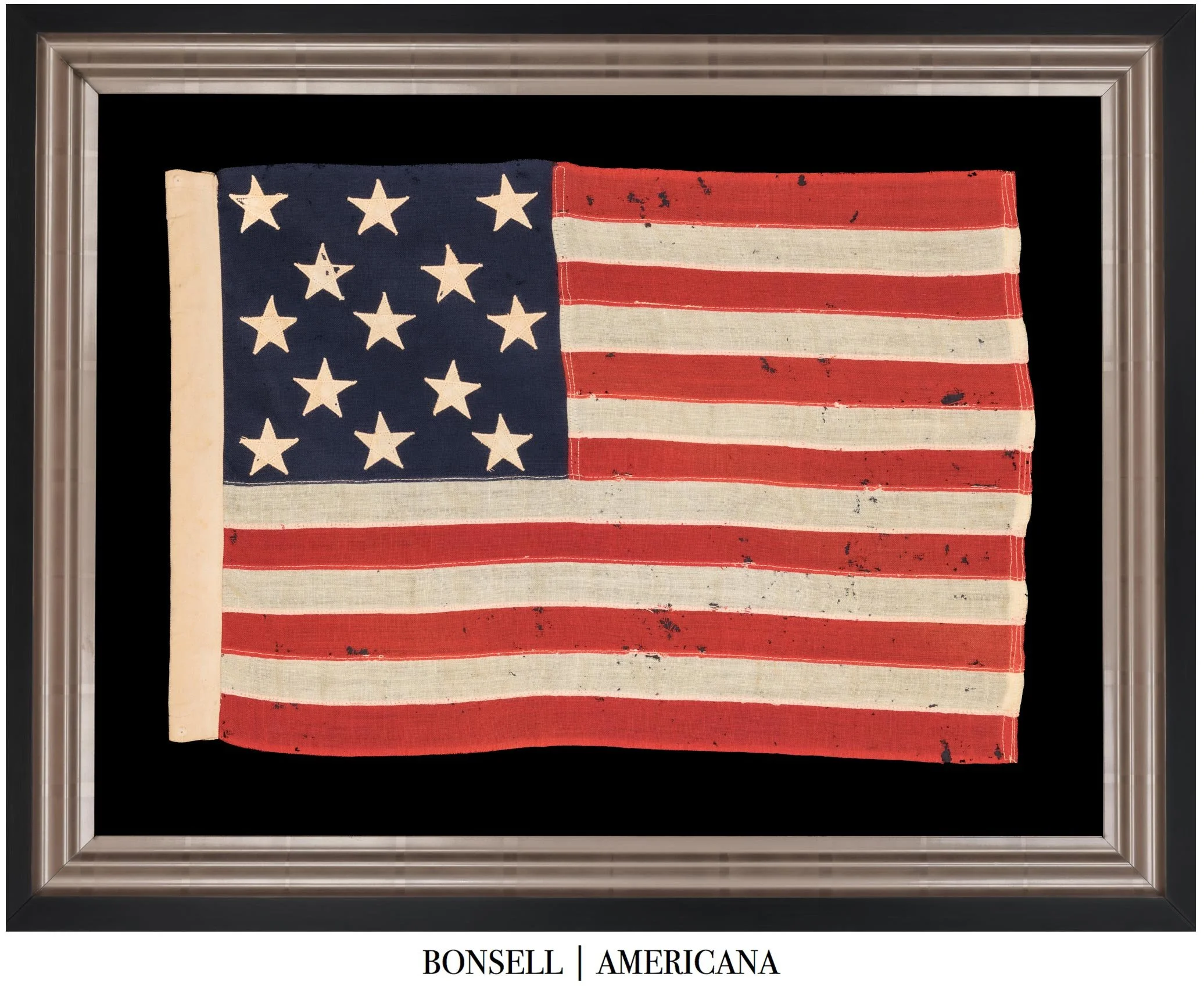
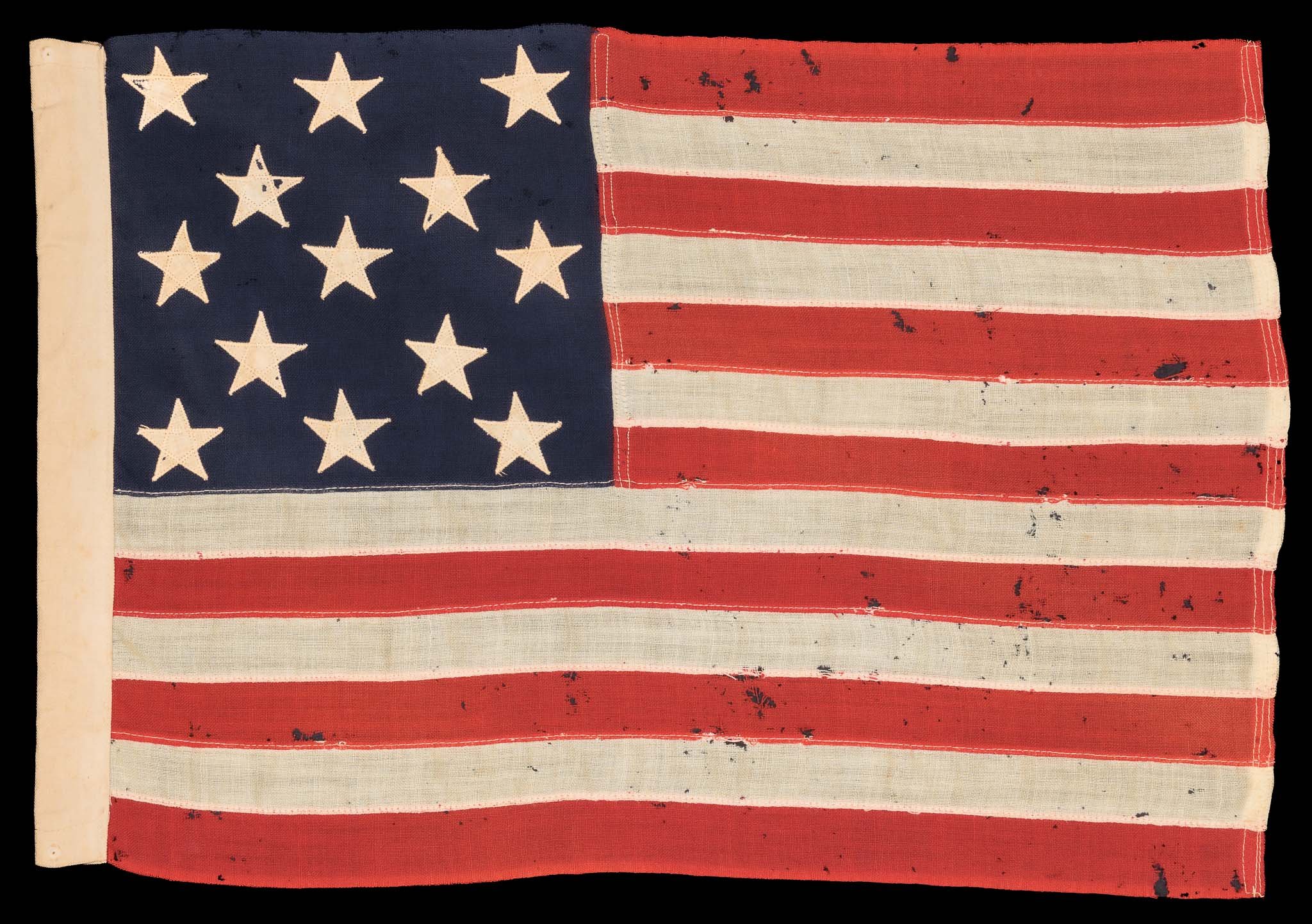
Rare Small Scale 13 Star Antique American Flag | Hopkinson Pattern | Circa 1895-1926
Frame Size (H x L): 26” x 33”
Flag Size (H x L): 17” x 24”
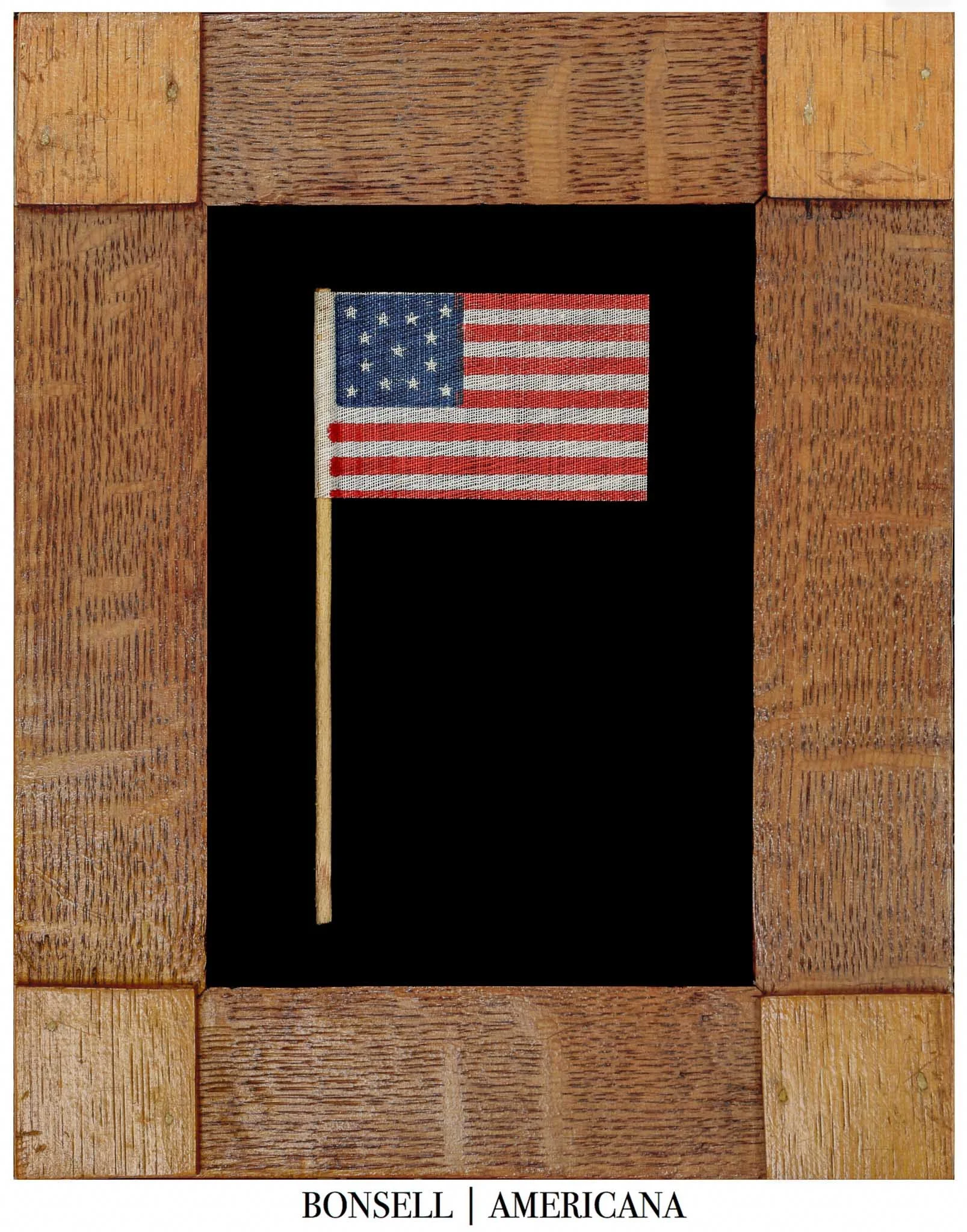
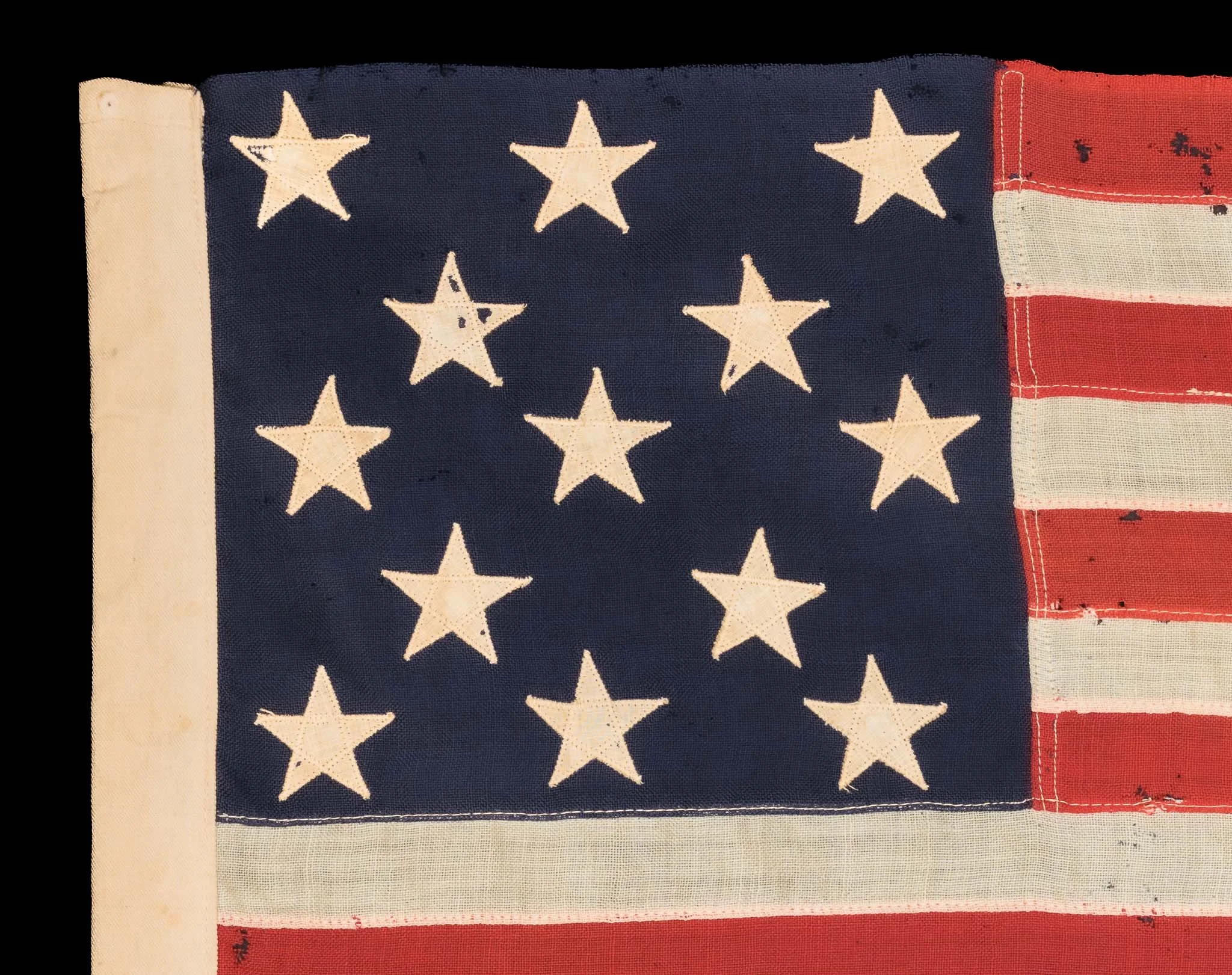
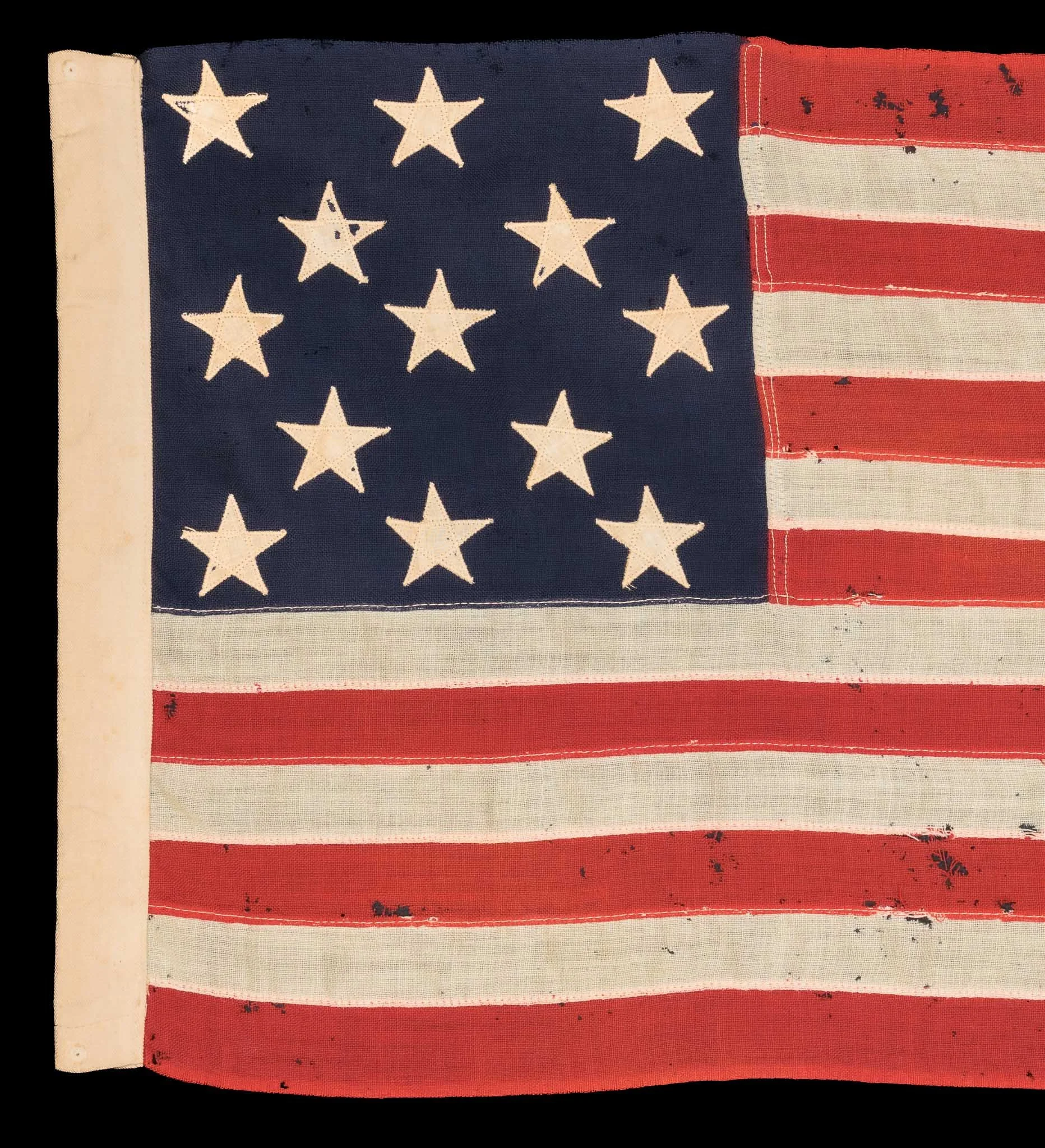
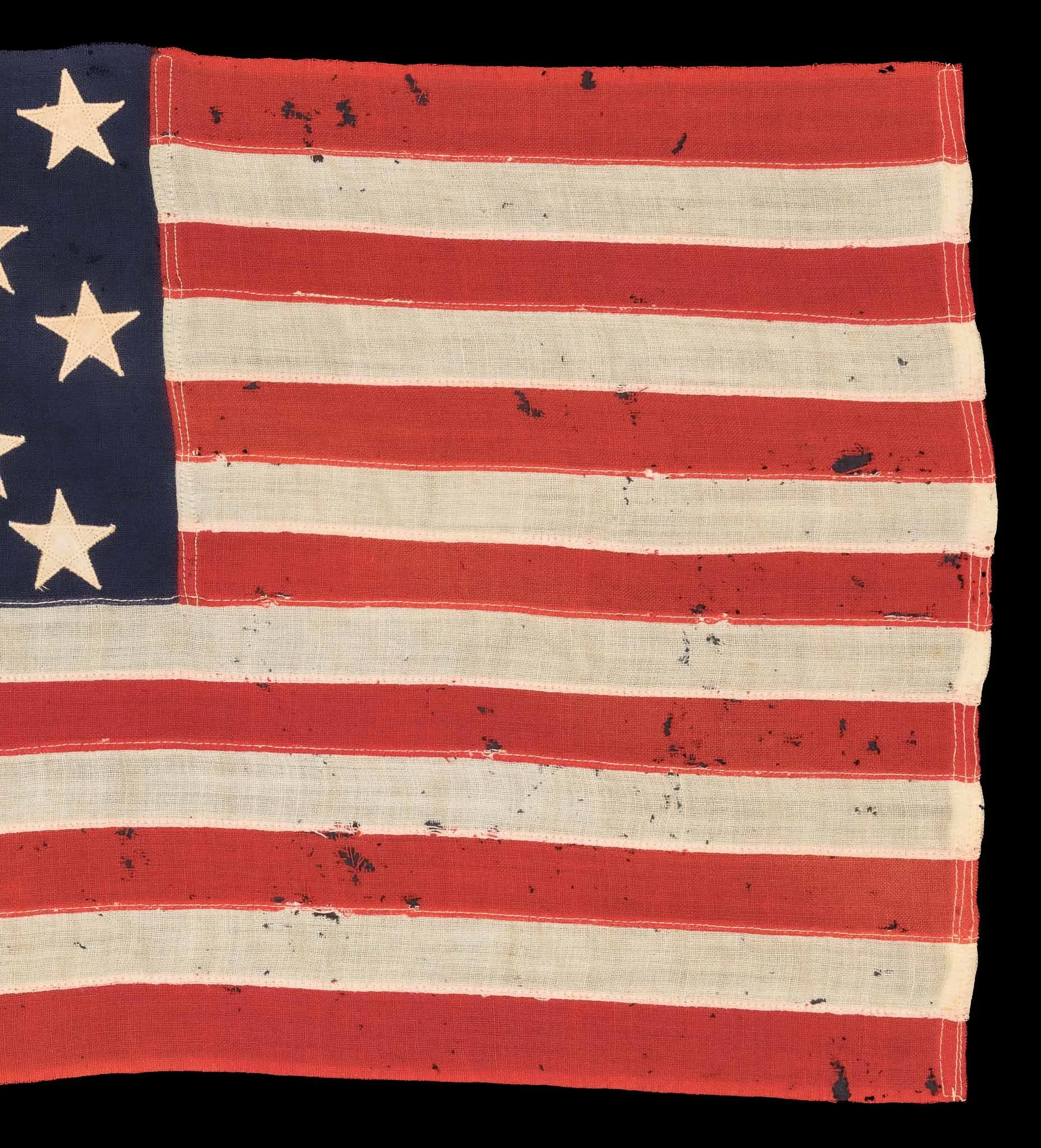
Offered is a 13-star antique American flag, featuring a 3-2-3-2-3 arrangement of stars. Constructed of wool bunting with double-appliquéd cotton stars, it is an unusually small example of a fully pieced-and-sewn commercial flag. While diminutive flags of this general period are encountered, examples of traditional sewn construction at this scale are considerably less common than their larger counterparts.
Viewed as a whole, the star configuration produces a diamond-shaped arrangement at the center, surrounded by a star at each corner of the canton. This design is commonly referred to as the Hopkinson pattern, after Francis Hopkinson, the New Jersey delegate to the Continental Congress and signer of the Declaration of Independence who is generally credited with playing the principal role in designing the first American national flag.
The Flag Resolution adopted by the Continental Congress on June 14, 1777 specified only that the new national flag contain 13 alternating red and white stripes and a union of 13 white stars on a blue field, representing “a new constellation.” Congress provided no instructions regarding the arrangement, number of points, or orientation of the stars. Consequently, a number of different 13-star configurations appeared during the nation’s earliest years, and the precise appearance of the first official American flag remains unknown.
Francis Hopkinson nevertheless has the strongest surviving documentary claim to its design. In 1780, he submitted a request for compensation for various designs he had furnished to the government, specifically including the “flag of the United States of America.” His proposed compensation famously included a “Quarter Cask of the public wine.” When that request was not honored, he later submitted a monetary claim. Congress did not dispute that Hopkinson had participated in the design work, but declined to compensate him on the basis that he was not the only individual who had been consulted. The surviving documentation has led most historians to credit Hopkinson with the design of the American flag, although no surviving drawing conclusively establishes the precise arrangement of stars that he employed.
The familiar association between Hopkinson and the 3-2-3-2-3 configuration is therefore best understood as a historical attribution rather than a certainty. The pattern appears on later representations associated with the early flag and became particularly common on 13-star flags manufactured during the late 19th and early 20th centuries. Its strong geometry and relatively large stars also made it particularly well suited to small flags such as the present example, where attempting to accommodate the full complement of stars then in the Union would have required stars of considerably smaller size.
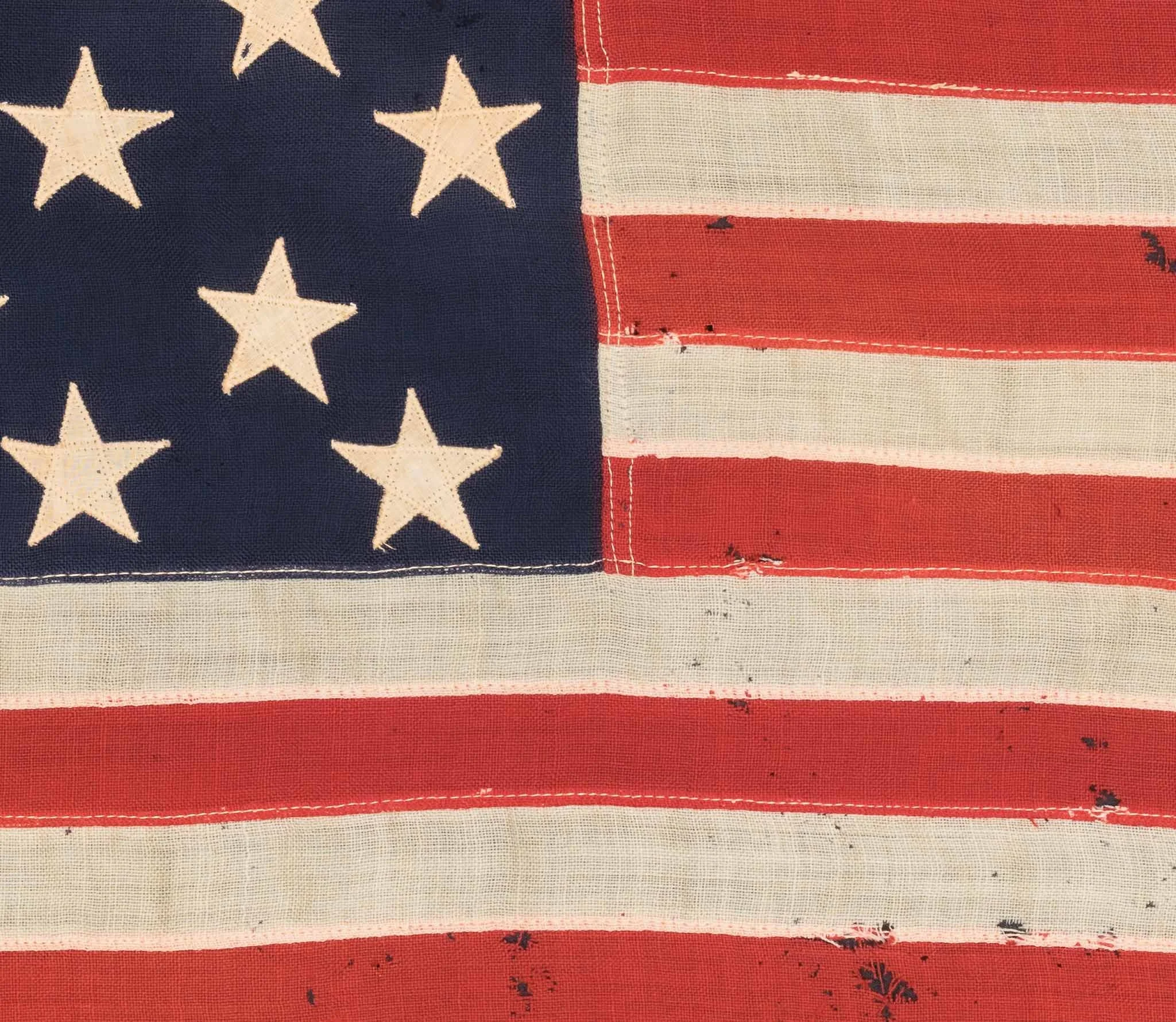
The stripes and canton of this flag are made of wool bunting and joined by machine stitching. Its hoist is made of cotton twill, while its cotton stars are sewn to both sides of the canton, a construction method commonly referred to as double appliqué, and are secured with zig-zag stitching. The latter is particularly useful for binding the unfinished edges of appliquéd stars and became widespread among commercial flag manufacturers during the late 19th century. Henry Bowman sought patent protection for a method of flag construction employing this technique in 1889, receiving U.S. Patent No. 469,395 in February 1892. Similar construction is regularly encountered on commercially produced American flags beginning in the 1890s.
As mentioned, the present flag is noteworthy for its compact scale. Most sewn wool flags were intended to function as actual outdoor flags, where greater dimensions improved visibility. Small sewn examples required essentially the same basic manufacturing operations—piecing 13 individual stripes, constructing the canton, cutting and applying stars, and finishing the hoist—while producing an object with considerably less surface area. Their small size made them practical for boats, architectural display, ceremonial use, and other applications where a conventional large flag was unnecessary or impractical.
Although the United States had long since expanded beyond 13 states when this flag was made, the 13-star flag never disappeared from American use. Rather, 13 stars became a historical and patriotic device representing the original states and the founding generation. Such flags appeared throughout the 19th century in commemorative, military, maritime, and celebratory contexts and experienced renewed popularity during events that encouraged Americans to look back to the Revolutionary period.
This was especially true during the nation’s Centennial in 1876 and again during the decades surrounding the turn of the century, when Colonial Revival interest in the country’s founding history became widespread. Thirteen-star flags were also well suited to yachts and small boats, where reducing the number of stars allowed them to remain individually legible on comparatively small ensigns. Commercial flag makers continued to produce 13-star examples well into the 20th century for precisely these historical, decorative, and maritime purposes.
Based upon its wool-bunting construction, machine stitching, double-appliquéd cotton stars, zig-zag stitching, and overall form, we date the flag to approximately 1895-1926. The upper end of this range encompasses the Sesquicentennial of American independence in 1926, another period of intense interest in Revolutionary imagery and 13-star flags.
The combination of the classic 3-2-3-2-3 star configuration and exceptionally small 17” x 24” size makes this an especially appealing example of the commercially produced 13-star flags of the late 19th and early 20th centuries.
Conservation Process: This flag was hand sewn to silk organza, and both were hand sewn to cotton fabric. The silk organza provides a strong layer of protection and a professional appearance. The flag, the silk organza, and the cotton fabric were then hand sewn to a mounting board. To prevent the black dye in the cotton fabric from seeping into the flag, it was first washed in a standard wash and then in a dye setting wash. The flag is positioned behind Optium Museum Acrylic.
Frame: The frame features a wide black outer profile with a stepped, silver-toned inner detail, all incorporated into a single molding. The layered profile gives the frame depth and definition.
Condition Report: The flag exhibits scattered small holes, surface wear, and areas of staining and discoloration throughout, with somewhat heavier wear along portions of the stripes and fly end. There are also a couple of small pin holes in the hoist. Overall, the fabric remains intact and the colors retain good visual presence.
Collectability Level: The Great – Perfect for Rising Collectors
Date of Origin: 1895-1926
Number of Stars: 13
Associated War: Spanish-American War (1898) and World War I (1914-1918)
Associated State: Original 13 Colonies