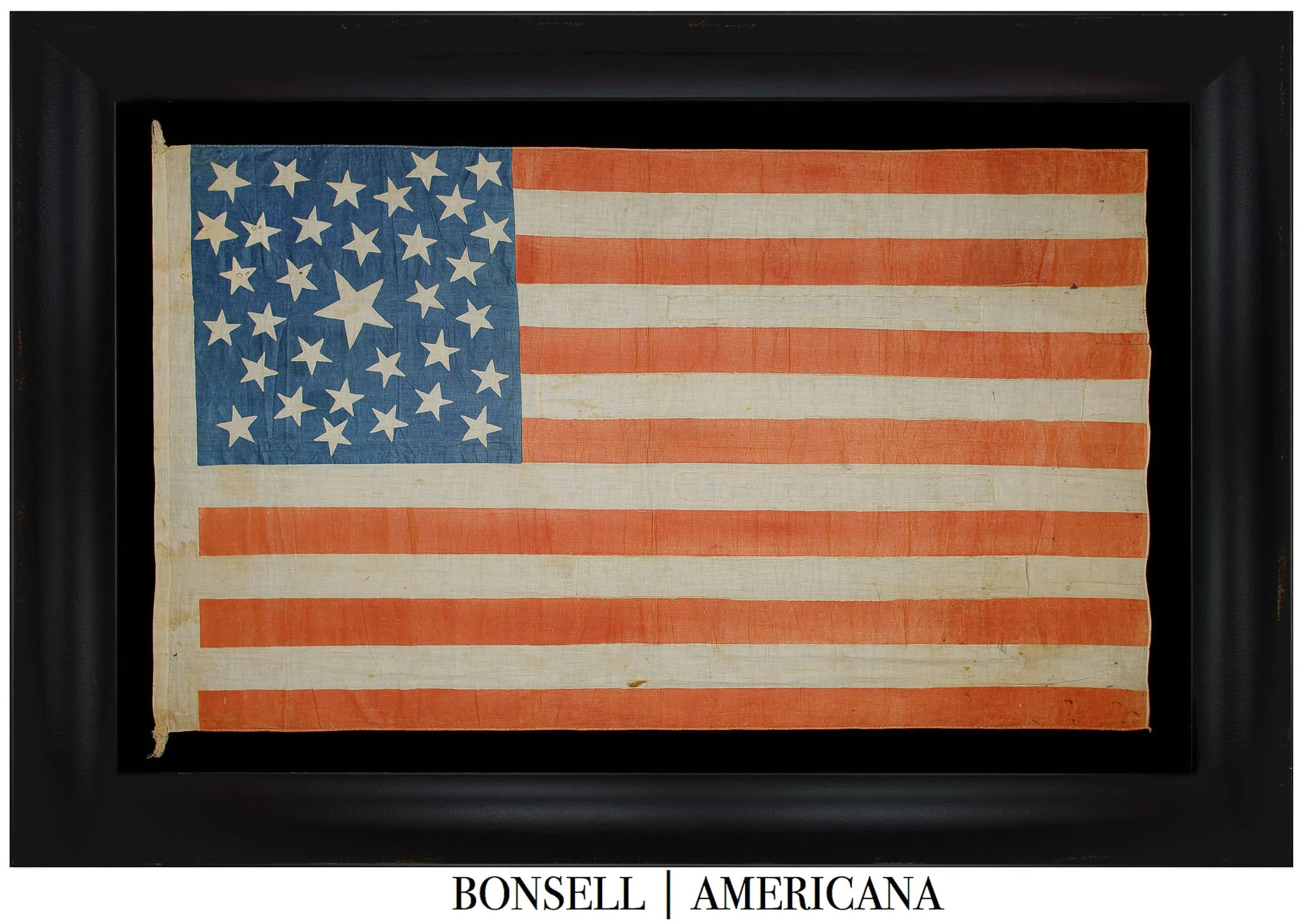
34 Star Miniature American Flag | Hand-Sewn Grand Luminary and 32 Star Reverse | Civil War Period | Circa 1861–1863
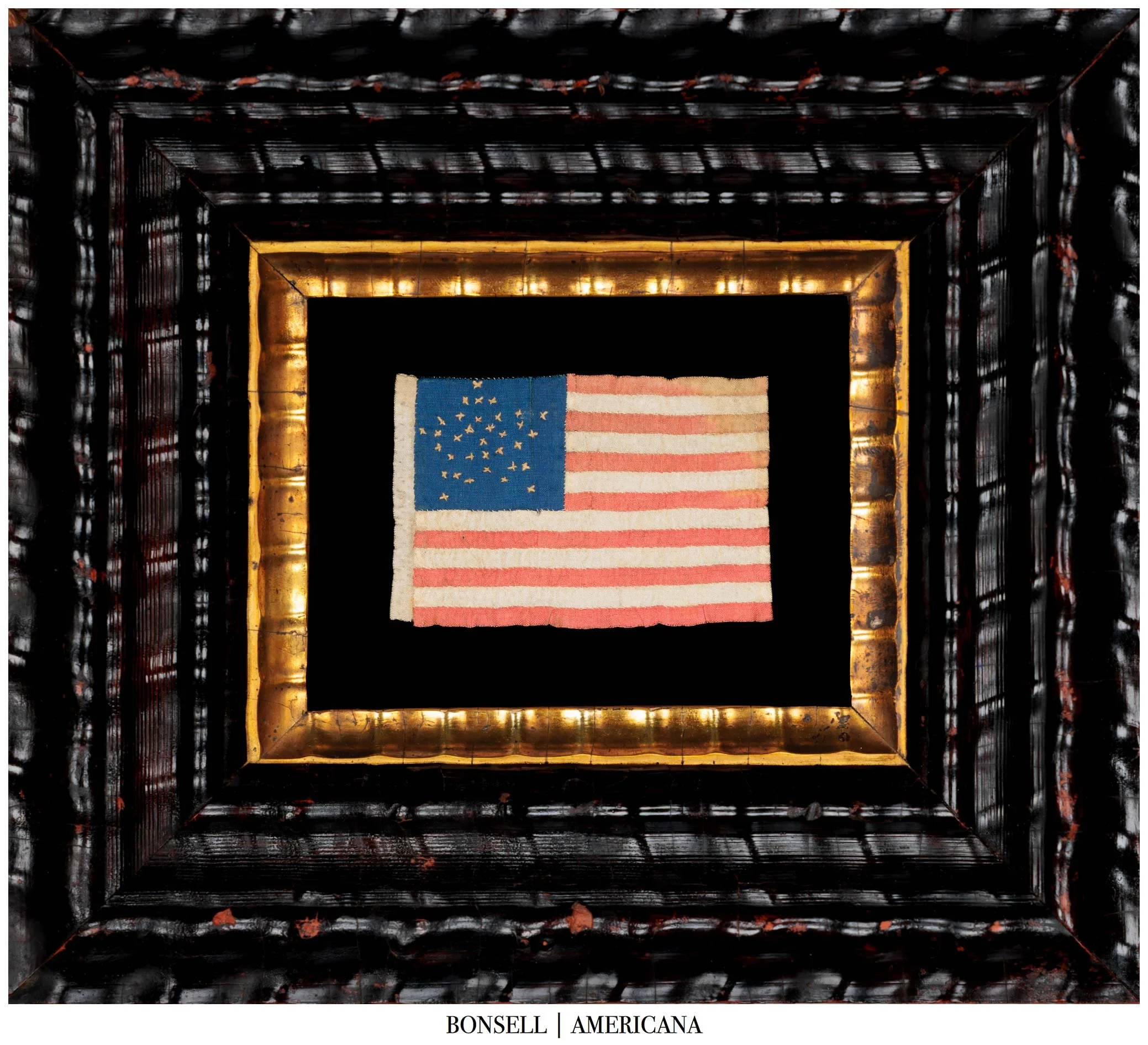
34 Star Miniature American Flag | Hand-Sewn Grand Luminary and 32 Star Reverse | Civil War Period | Circa 1861–1863
Frame Size (H x L): 6 ½” x 7 ½”
Flag Size (H x L): 1 ¾” x 2 ¾”
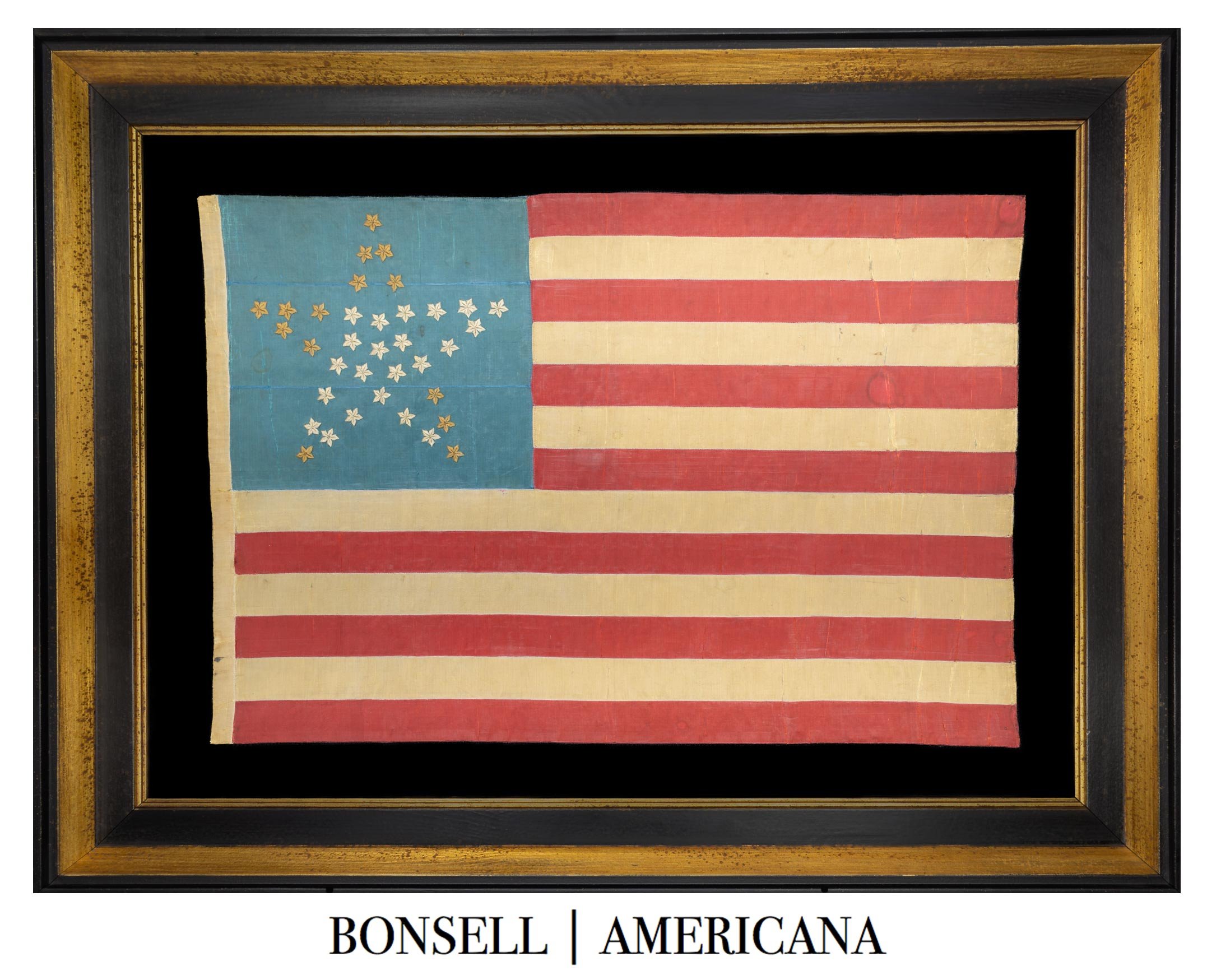
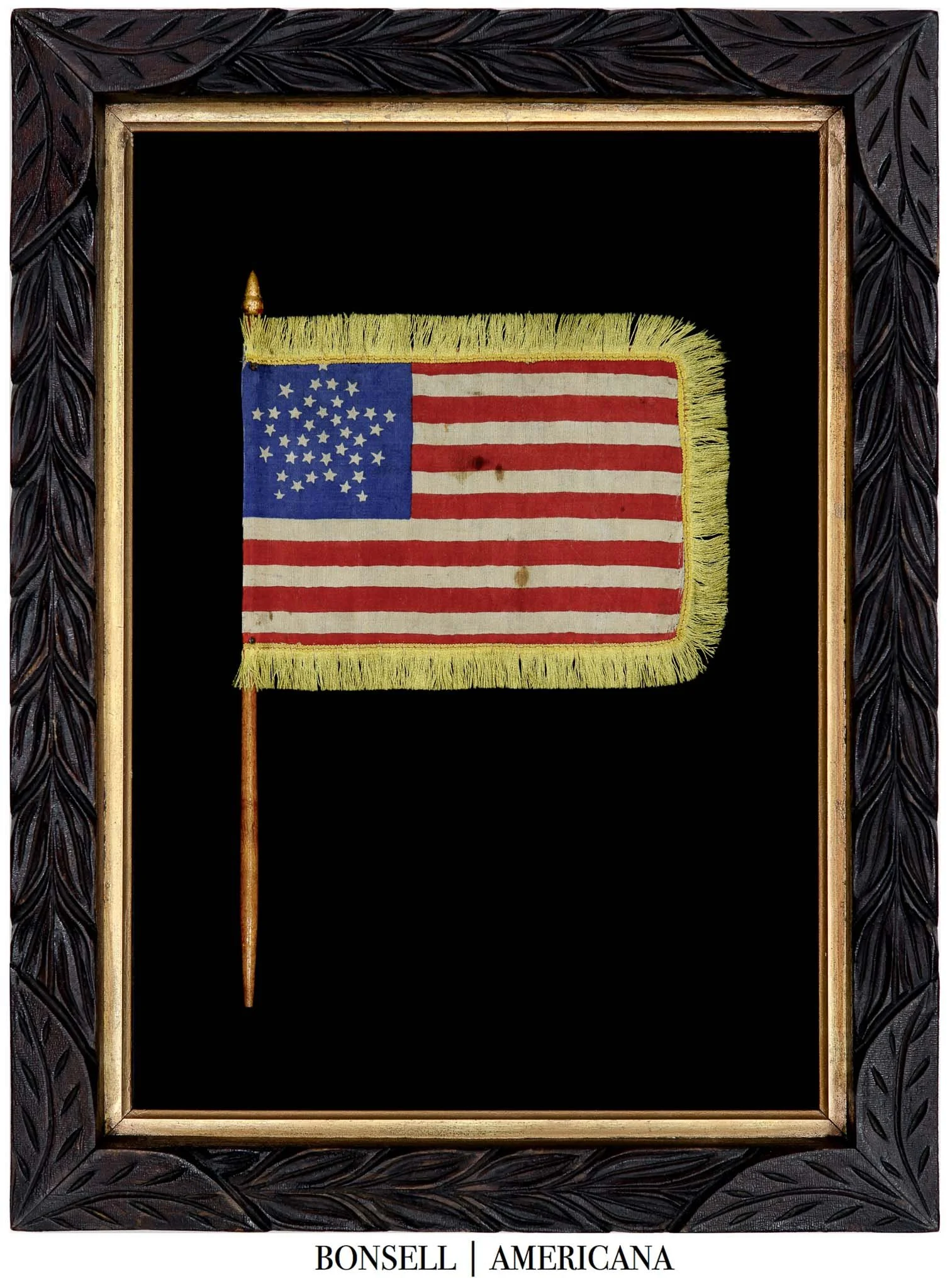
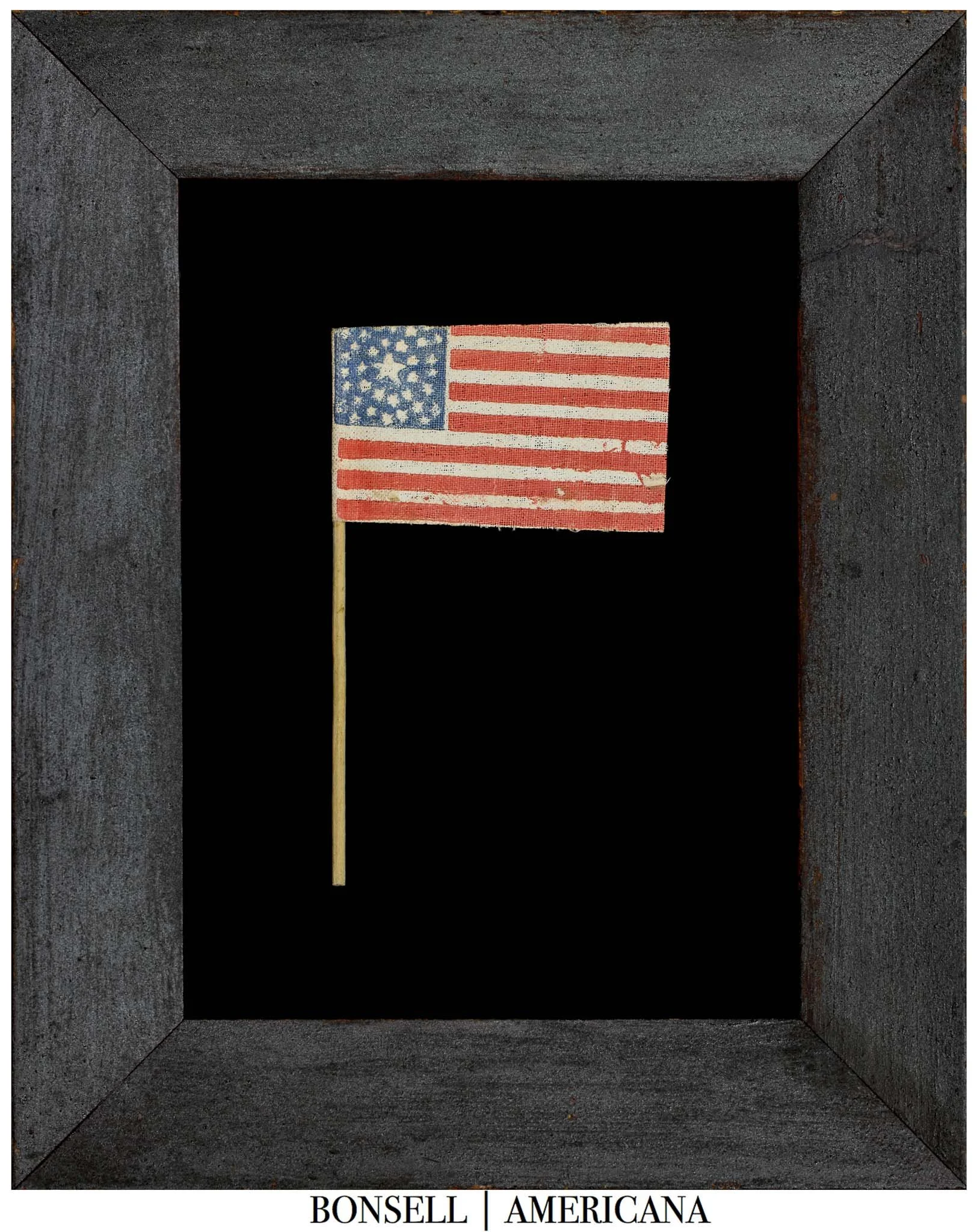
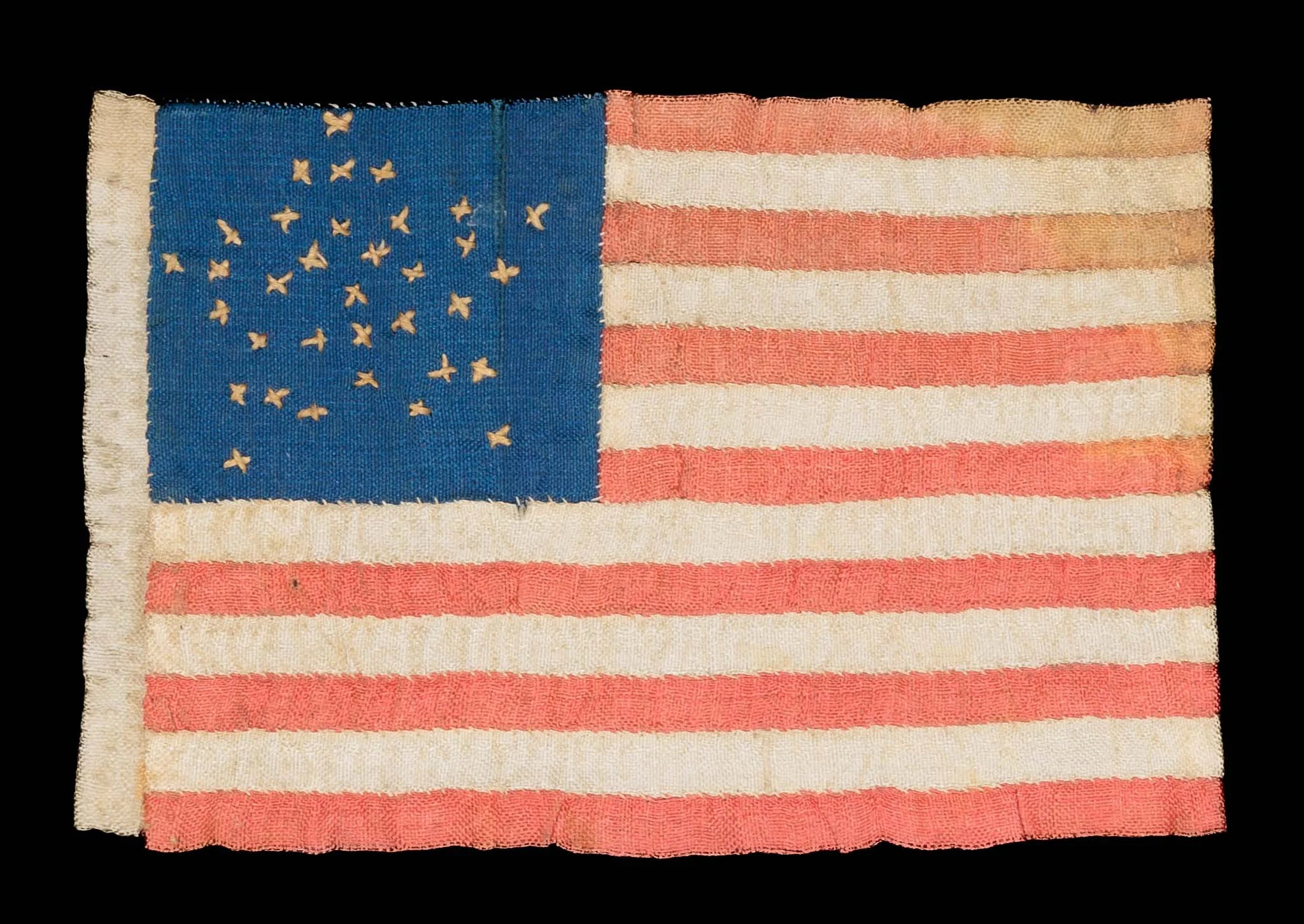
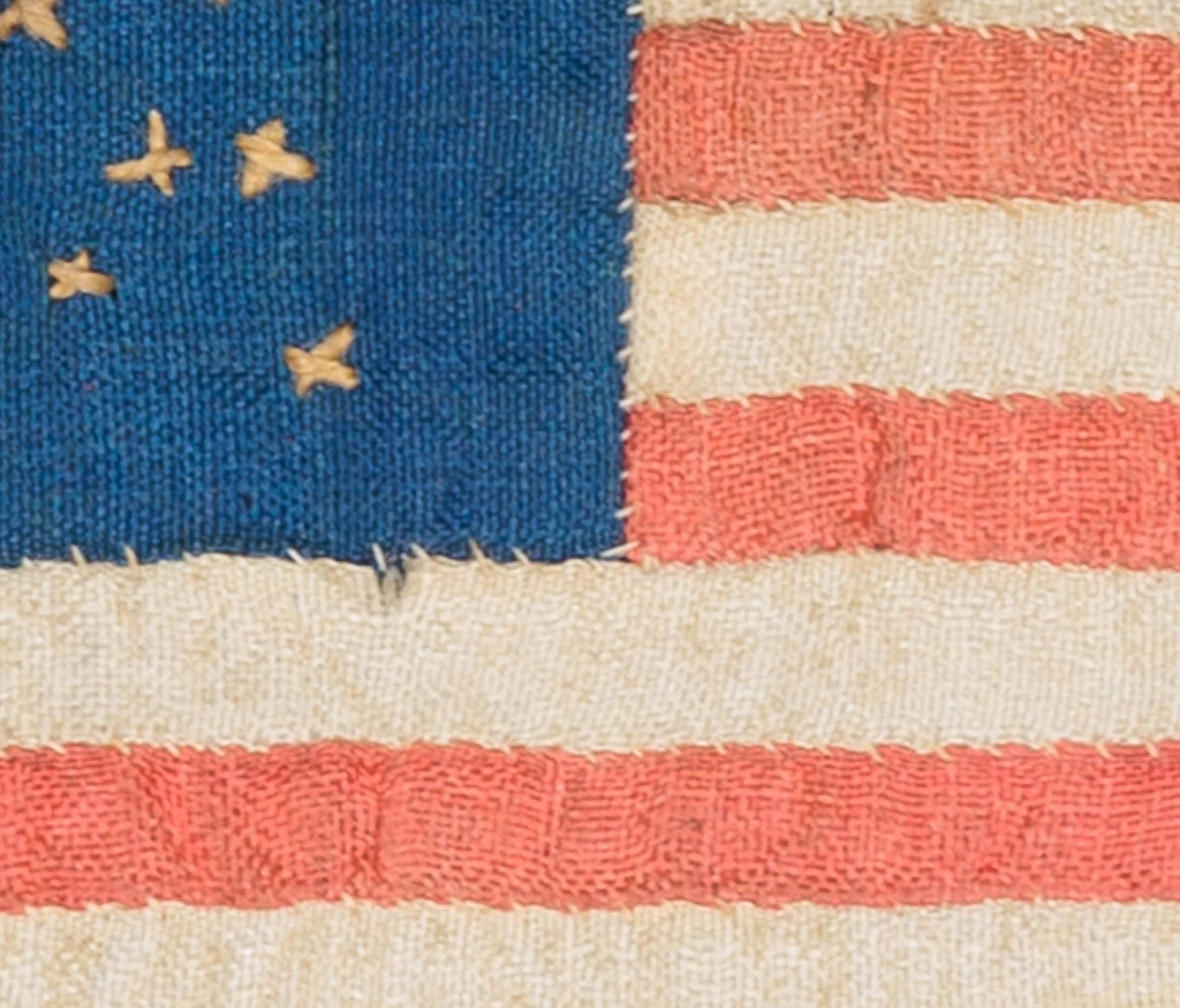
Offered is an exceptionally small, entirely hand-sewn American flag dating to the Civil War period, measuring just 1.75" x 2.75". Constructed of plain-weave cotton, the flag features 13 individually pieced and hand-sewn stripes, with a blue canton displaying 34 embroidered stars arranged in a grand luminary configuration. The reverse is equally unusual, displaying a different arrangement of 32 embroidered stars. Every component was fashioned on an extraordinarily small scale, making this one of the smallest and most intricately constructed hand-sewn American flags we have encountered.
The flag dates to the 34-star period, corresponding to the admission of Kansas as the 34th state on January 29, 1861. The 34-star flag became official on July 4, 1861, and remained so until July 4, 1863, when a 35th star was added following the admission of West Virginia. This period coincided with the opening years of the American Civil War, including the secession crisis, the outbreak of hostilities at Fort Sumter, and the early campaigns of the Union and Confederate armies.
The Civil War brought about a significant transformation in the public's relationship with the American flag. Although the Stars and Stripes had long served as the national emblem, privately owned and displayed flags were considerably less prevalent before the conflict than they would become during and after it. The outbreak of war in April 1861 generated an extraordinary wave of patriotic expression throughout the Northern states. American flags appeared on homes, businesses, public buildings, and in countless patriotic gatherings. The flag became a visible declaration of loyalty to the Union and an increasingly important symbol of national identity.
This atmosphere of heightened patriotism provides important context for understanding the present example. Its exceptionally small size, delicate construction, and elaborate handwork suggest that it was created as a personal patriotic object rather than for conventional display. While its original purpose cannot be established with certainty, its construction is consistent with the broader tradition of homemade patriotic articles produced during the Civil War. Such objects represented individual expressions of national allegiance and often required considerable personal effort to create.
The 34-star configuration carried particular significance during the conflict. Although eleven Southern states declared their secession from the United States, the federal government continued to recognize them as members of the Union. Their stars were consequently retained on the national flag. The 34-star flag thus represented the entire nation, including the states then in rebellion, and became a powerful symbol of the Union's preservation.
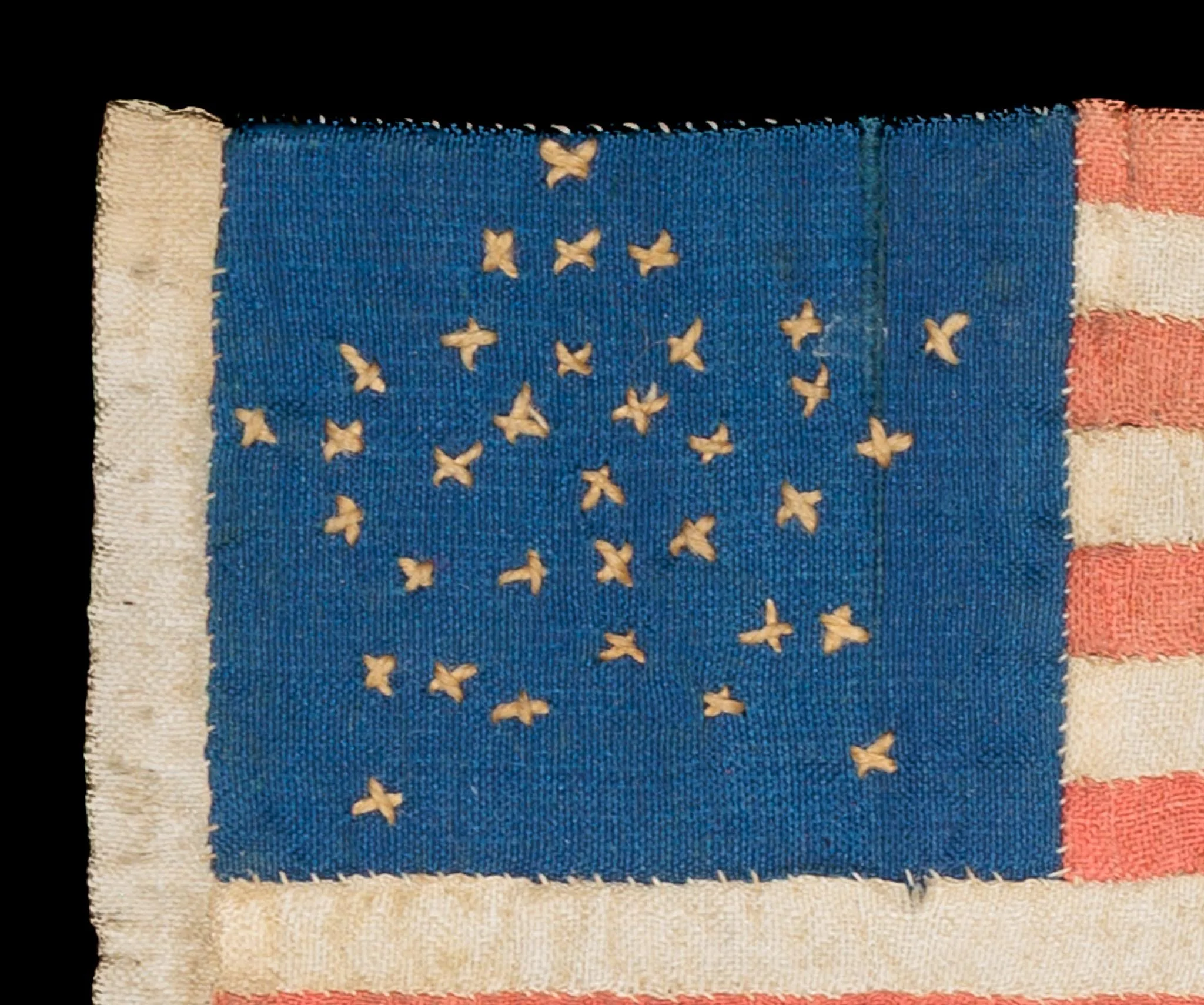
The arrangement of the stars on the obverse is particularly noteworthy. Rather than placing the stars in conventional rows and columns, the maker employed a grand luminary, or great-star, configuration, in which the individual stars collectively form a single larger star. This arrangement was popularized during the early nineteenth century, particularly through the efforts of naval officer Samuel Chester Reid, who advocated its adoption as a national standard. Although never formally prescribed, grand luminary arrangements appeared on numerous American flags throughout the nineteenth century.
The symbolism of the grand luminary was especially appropriate during the Civil War. Its configuration visually expressed the principle of E Pluribus Unum, or "Out of Many, One," with the individual stars representing the states and their collective arrangement representing the nation. In the context of the Civil War, this expression of unity carried considerable significance.
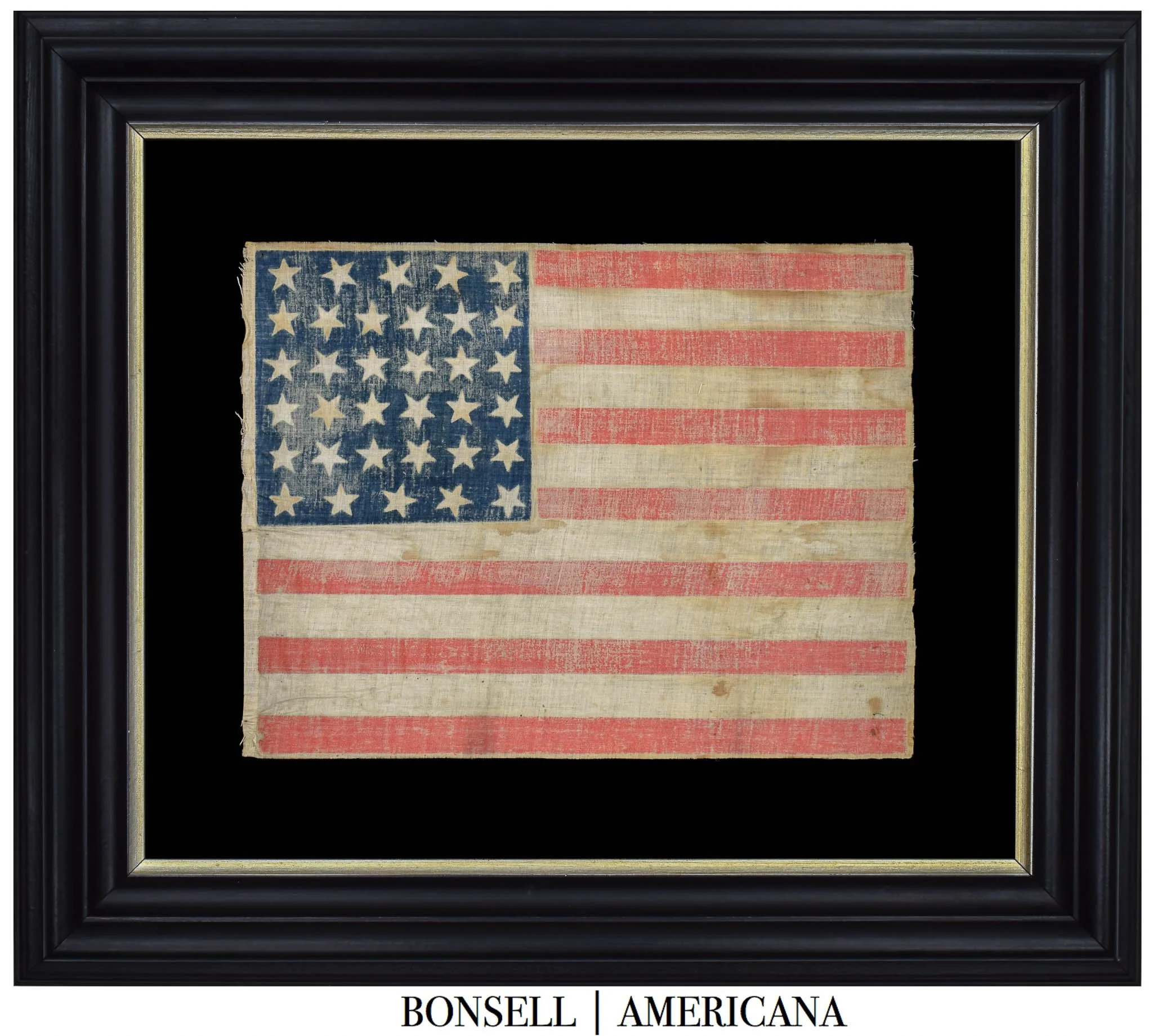
Perhaps the most unusual characteristic of the flag is found on its reverse, which features 32 embroidered stars rather than the 34 displayed on the obverse. Thirty of these stars are arranged in relatively regular, aligned rows and columns, while two additional stars extend beyond the principal arrangement. The resulting configuration has a somewhat beehive-like appearance, contrasting with the more elaborate grand luminary on the opposing face.
The 32-star count is historically associated with the admission of Minnesota to the Union in 1858, and the official 32-star flag period of July 4, 1858, through July 3, 1859. However, the presence of 34 stars on the obverse supports dating the present flag to the subsequent 34-star period of 1861–1863. The difference between the two faces is more reasonably understood as an unusual characteristic of the flag's individual construction than as evidence that the entire object predates the Civil War.
The reason for the discrepancy remains unknown. It may reflect the maker's personal interpretation of the design, the considerable challenges associated with embroidering individual stars at this scale, or another circumstance that cannot now be determined. The two arrangements nevertheless distinguish the flag from more conventional examples and provide an interesting record of the maker's individual approach to its construction.
The workmanship is extraordinary. Despite measuring less than three inches across, the flag was not printed or fashioned from a single piece of striped material. Each of the thirteen stripes consists of a separate piece of plain-weave cotton, individually cut and joined to the adjoining stripes entirely by hand. The blue canton was similarly fashioned and attached, while a narrow white cotton heading completes the hoist.
The stars were individually created using embroidery thread, rather than appliquéd, printed, or painted onto the fabric. Each required a series of small, carefully placed stitches to suggest the form of a star. At this scale, the stars measure only a tiny, tiny fraction of an inch, making the precision required to create the two configurations especially remarkable. The slight irregularities in their shape, placement, and orientation are consistent with their handmade character.
The use of lightweight cotton is consistent with the flag's probable personal or decorative purpose. While larger military and institutional flags were often constructed from wool bunting, cotton was widely employed in smaller patriotic textiles. Its relatively fine weave and pliable character permitted the delicate needlework necessary to produce an object of this size.
The flag's intended use is unknown. It may have been worn as a patriotic accessory, displayed as a miniature decoration, or retained as a personal keepsake. Its dimensions would have permitted it to be attached to clothing or worn on a lapel. Another possibility is that it was preserved within a Bible or other personal volume, although many surviving examples associated with that practice are somewhat larger. In the absence of specific provenance, these possibilities remain interpretations rather than established facts.
What is clear is that the object was made with considerable care. Its construction required the maker to assemble thirteen separate stripes, secure the canton and heading, and execute two differing embroidered star arrangements within an exceptionally confined space. Such detailed workmanship would have required patience, dexterity, and a substantial investment of time relative to the finished flag's size.
An exceptional survivor of Civil War-era patriotic material culture, this flag combines a historically significant 34-star grand luminary, an unusual 32-star reverse, and an extraordinary degree of hand craftsmanship. Its miniature proportions are remarkable in their own right, but its individually sewn stripes and embroidered stars distinguish it further. As a personally constructed patriotic textile dating to the opening years of the Civil War, it offers a particularly compelling example of the ways Americans expressed national identity and allegiance during one of the most consequential periods in the nation's history.
Conservation Process: This flag was hand sewn to cotton fabric, and both were hand sewn to a mounting board. To prevent the black dye in the cotton fabric from seeping into the flag, it was first washed in a standard wash and then in a dye setting wash. The flag is positioned behind Optium Museum Acrylic.
Frame: The flag is presented in a substantial, two-piece antique frame, dating to approximately the mid-nineteenth century, circa 1850–1870. The ebonized outer frame features deeply carved ripple molding, complemented by a broad, gilded inner liner. Both elements exhibit age-related wear and patina consistent with their period of manufacture.
Condition Report: The flag remains in excellent condition, particularly considering its age and delicate construction. The cotton exhibits minor age-related toning and fading, with slight irregularities and fraying along the edges. The hand-sewn construction and embroidered stars remain well preserved.
Collectability Level: The Best – Perfect for Advanced Collectors
Date of Origin: 1861-1863
Number of Stars: 34
Associated War: The Civil War (1861-1865)
Associated State: Kansas