38 Star American Parade Flag | “CENTENNIAL 1876” Commemorative Overprint | Colorado Statehood | Circa 1876
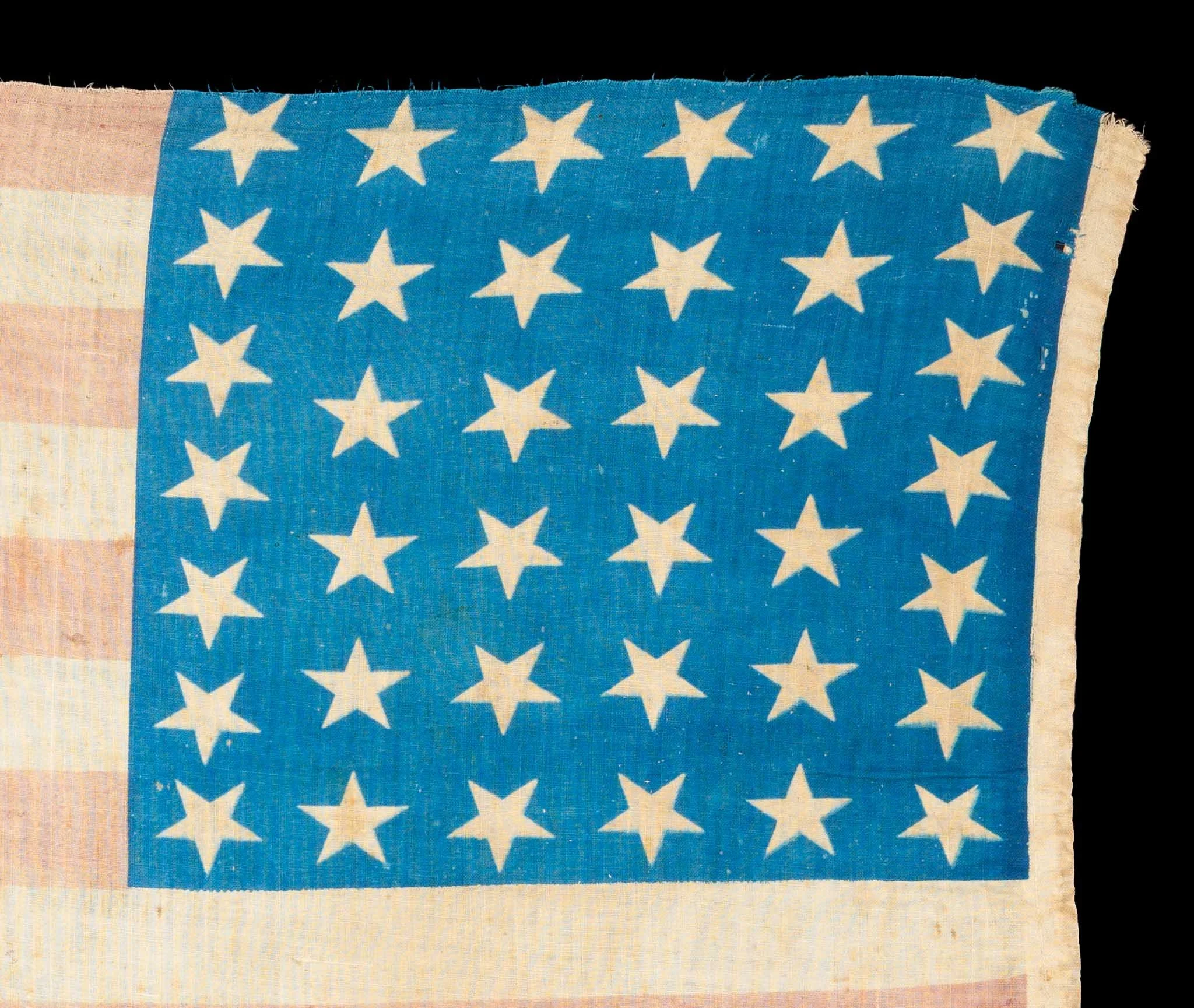
38 Star American Parade Flag | “CENTENNIAL 1876” Commemorative Overprint | Colorado Statehood | Circa 1876
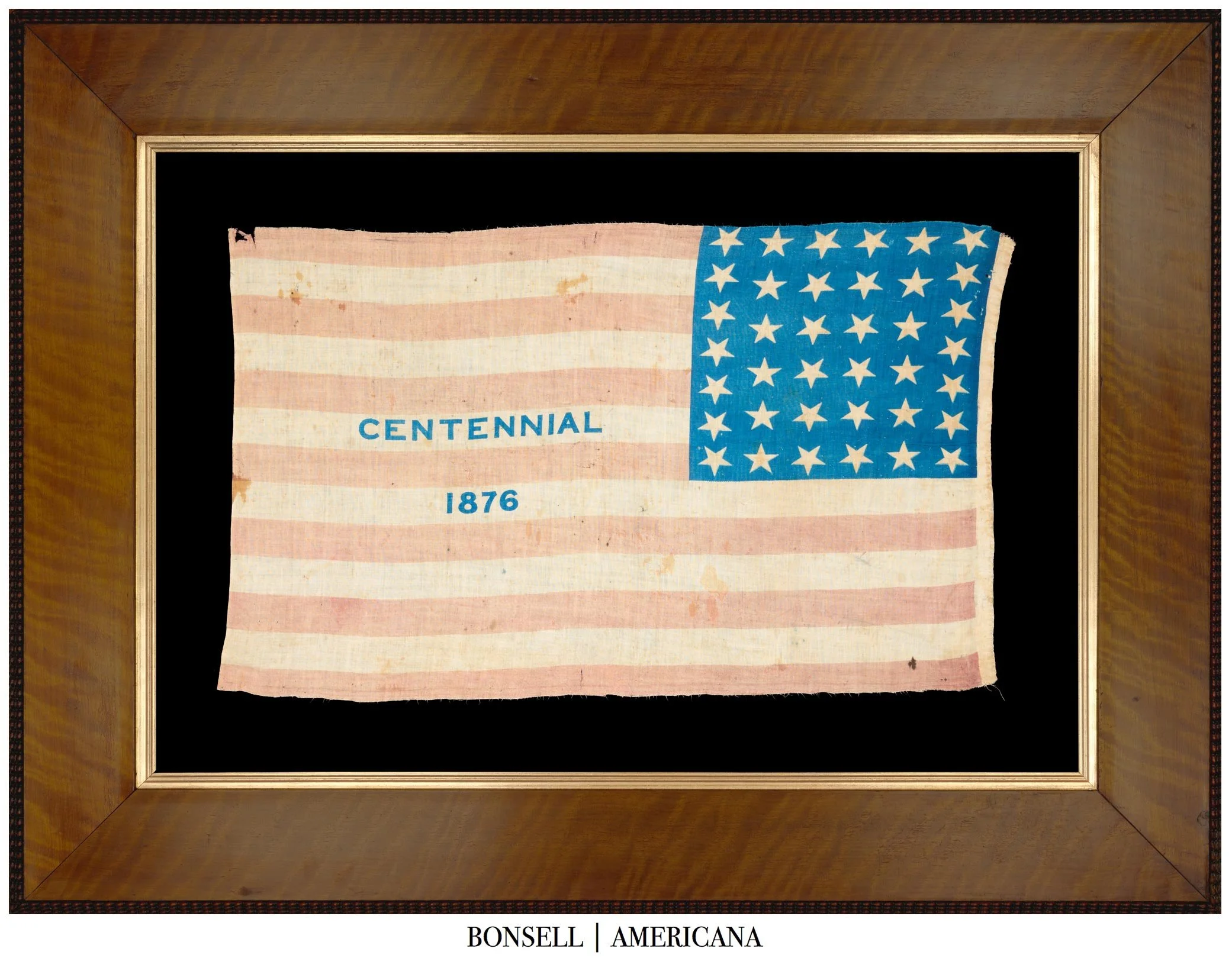
Frame Size (H x L): 29” x 38.75”
Flag Size (H x L): 16” x 22.5”
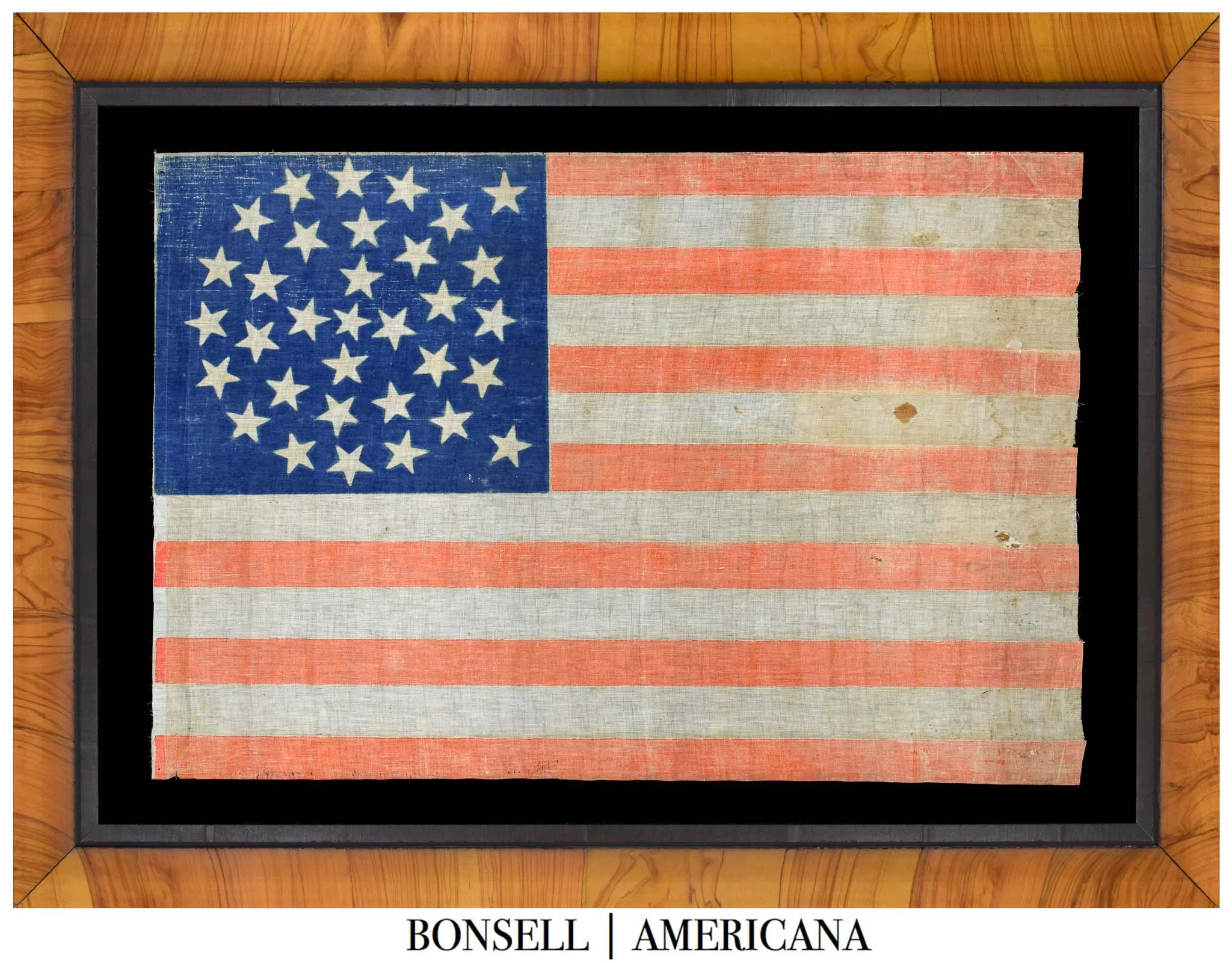
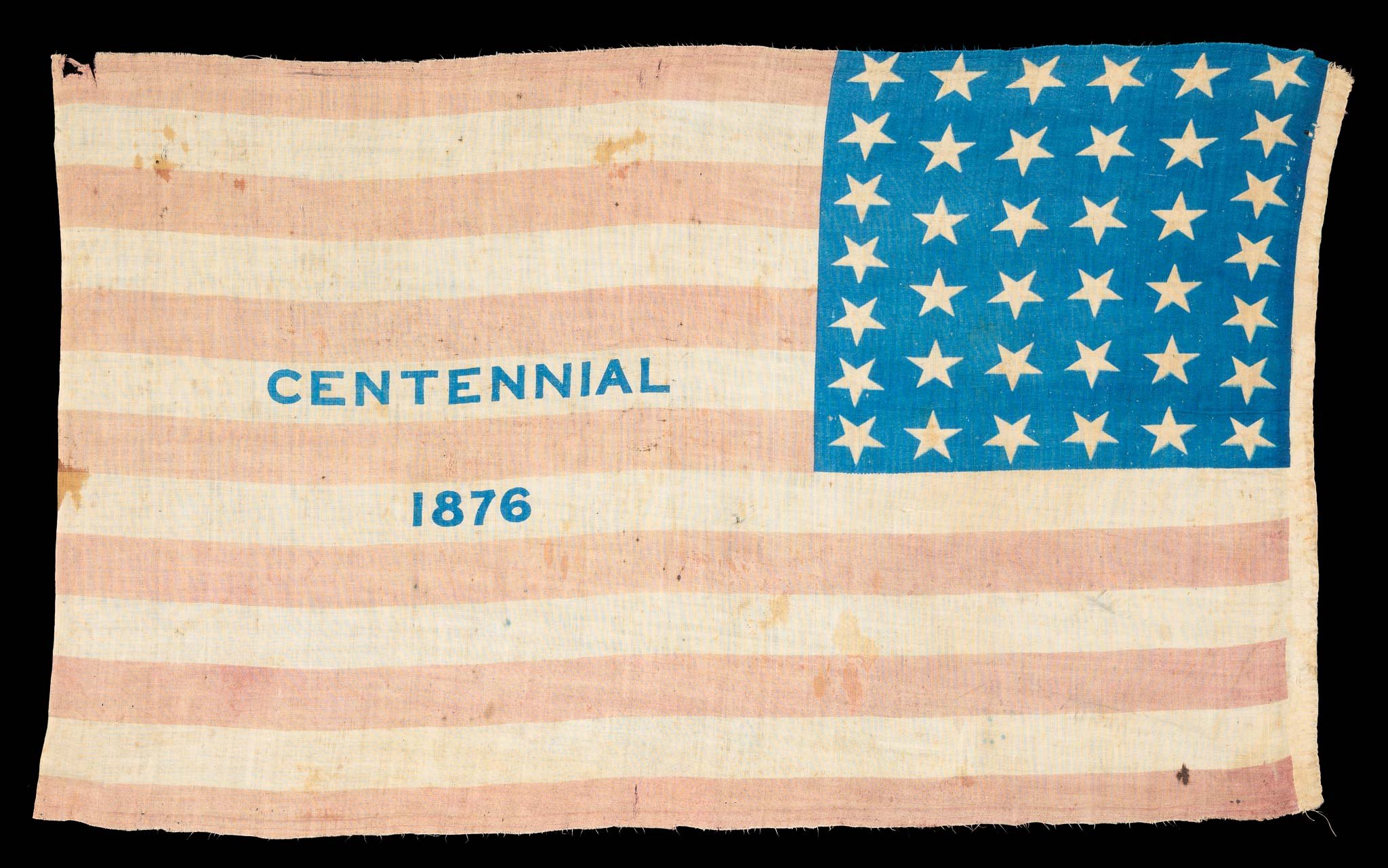
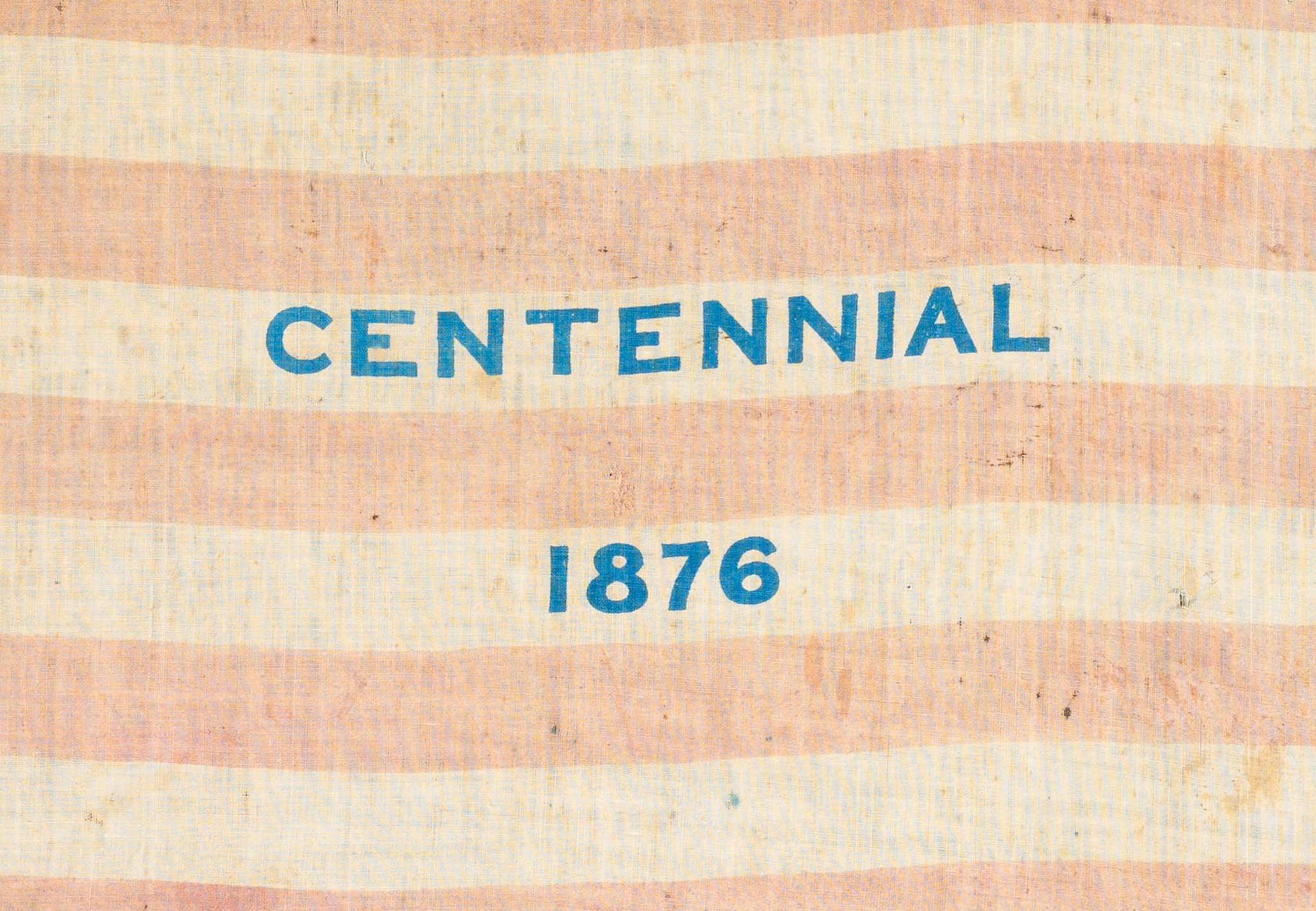
Offered is a 38-star antique American parade flag, printed on cotton and bearing the patriotic overprint CENTENNIAL | 1876. Made during the nation’s centennial year, the flag combines two important events of 1876: the celebration of the 100th anniversary of American independence and the admission of Colorado as the 38th state.
The centennial prompted an extraordinary display of patriotic material culture throughout the United States. Cities and towns hosted parades, ceremonies, exhibitions, and public gatherings, while homes, businesses, and civic buildings were decorated with flags and other red, white, and blue textiles. At the center of these celebrations was the Centennial International Exhibition in Philadelphia, held from May through November 1876 and recognized as the first official world’s fair in the United States. The exposition attracted millions of visitors and provided a national stage for American industry, technology, art, and culture.
This particular pattern appears to have a strong association with Philadelphia and the Centennial Exhibition. Surviving examples are scarce, with approximately twenty presently known in collections and the marketplace, and examples have frequently surfaced in Philadelphia and the surrounding region. More compellingly, a documented example bears the period inscription “Philadelphia, Sept 1876, G.N.M.”, providing direct evidence that flags of this pattern were present in the city during the exposition.
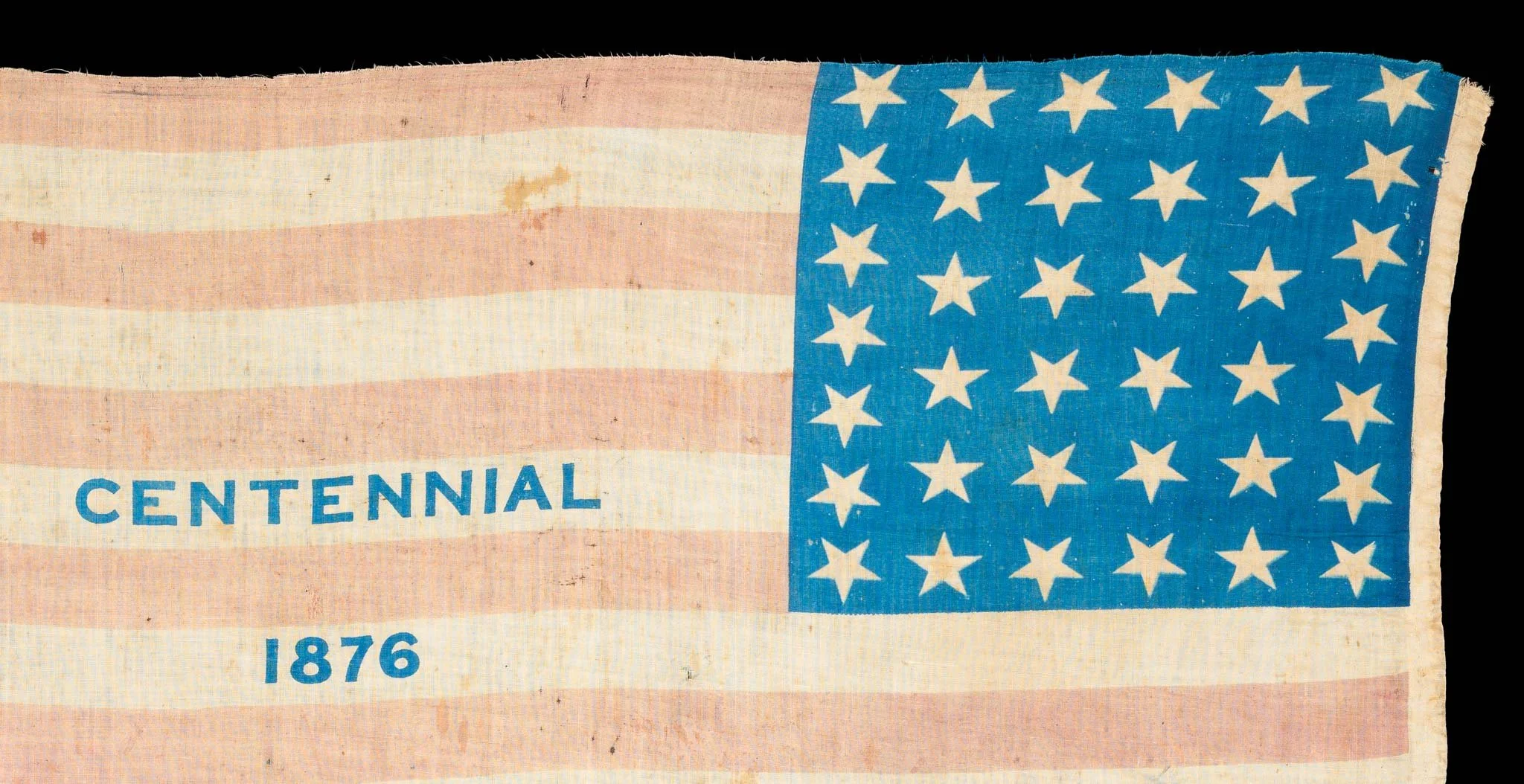
The canton contains 38 stars arranged in six vertical columns. The first and last columns contain seven stars each, while the four interior columns contain six. Their orientation alternates in an unusual fashion: the stars in the first, third, fourth, and sixth columns point downward, while those in the second and fifth columns point upward. The resulting arrangement is distinctive and readily identifiable among surviving Centennial-era parade flags.
Of particular interest, the blue used for the canton closely corresponds to that of the CENTENNIAL | 1876 inscription. This suggests that the inscription was incorporated into the original printing process rather than applied as a later secondary overprint. Many 19th-century parade flags were produced as standard patriotic flags and subsequently customized with campaign slogans, commercial advertising, commemorative text, or organizational information, often in black or another contrasting ink. Here, the coordinated printing strongly indicates that the flag was conceived specifically as a Centennial commemorative textile.
The flag was also printed in what collectors commonly describe as a reverse-mount orientation, with the canton positioned at upper right when the flag is viewed as shown. Although modern display convention calls for the canton to appear at upper left when a flag is presented horizontally, 19th-century manufacturers were considerably less standardized in this respect. Reverse-oriented parade flags are encountered with some regularity among early printed examples and reflect the broad variety of formats produced for decorative and commemorative use.
An example of this same flag is documented as item 437 in Threads of History: Americana Recorded on Cloth, 1775 to the Present, by Herbert Ridgeway Collins, then curator of political history at the Smithsonian Institution. The landmark reference illustrates more than 1,500 examples of American political and patriotic textiles, many drawn from the collection of Boleslaw and Marie-Louise Mastai. Another example appears in J. Richard Pierce’s The Stars and Stripes: Fabric of the American Spirit. The Pierce example carries the aforementioned inscription “Philadelphia, Sept 1876, G.N.M.”, providing important period documentation for the pattern and supporting its association with Philadelphia’s Centennial celebrations.
The presence of 38 stars is especially appropriate to the year. Colorado was admitted to the Union on August 1, 1876, earning its enduring nickname, the “Centennial State.” Under federal convention, the additional star formally became part of the national flag on July 4, 1877. Consequently, the official American flag throughout the Centennial Exhibition still contained 37 stars. Flag makers, however, routinely anticipated the admission of new states, and 38-star flags were produced and displayed well before their official date. Alongside 13-star flags recalling the original colonies, 38-star examples became particularly fitting symbols of the Centennial year: one looking back to the nation’s founding and the other acknowledging its newest state.
The 38-star flag remained the official national flag from July 4, 1877 until July 3, 1890. It served during the administrations of Rutherford B. Hayes, James A. Garfield, Chester A. Arthur, Grover Cleveland, and Benjamin Harrison. On July 4, 1890, it was succeeded by the 43-star flag following the admission of North Dakota, South Dakota, Montana, Washington, and Idaho.
This example is notable for its CENTENNIAL | 1876 inscription, unusual star arrangement, and documented connection to other known examples associated with Philadelphia. These features place it among a small group of identifiable parade flags produced in direct response to the nation’s 1876 centennial celebrations.
Conservation Process: This flag was hand sewn to cotton fabric, and both were hand sewn to a mounting board. To prevent the black dye in the cotton fabric from seeping into the flag, it was first washed in a standard wash and then in a dye setting wash. The flag is positioned behind Optium Museum Acrylic.
Frame: The flag is housed in a substantial circa-1830s figured birch frame, with pronounced flaming grain and a warm period finish. The frame incorporates a narrow ripple-molded outer edge and a modern inner gilt fillet, creating a restrained but elegant presentation. It retains an exceptional degree of original character and surface.
Condition Report: Overall good condition for its age, with moderate fading to the red stripes, scattered staining and light soiling, and minor areas of discoloration throughout. There is some fraying and small losses along the edges, including a more noticeable loss at the upper-left corner, along with minor wear near the fly end. The blue canton and CENTENNIAL | 1876 overprint remain strong and clearly legible.
Collectability Level: The Best – Perfect for Advanced Collectors
Date of Origin: 1876
Number of Stars: 38
Associated War: The Indian Wars (1860-1890)
Associated State: Colorado