Unusual and Attractive 13 Star Betsy Ross Pattern Flag | Paper Stars & Glazed Cotton | Circa 1910–1940
Unusual and Attractive 13 Star Betsy Ross Pattern Flag | Paper Stars & Glazed Cotton | Circa 1910–1940
Price: Call 618-553-2291, or email info@bonsellamericana.com
Frame Size (H x L): 28” x 38”
Flag Size (H x L): 17” x 27”
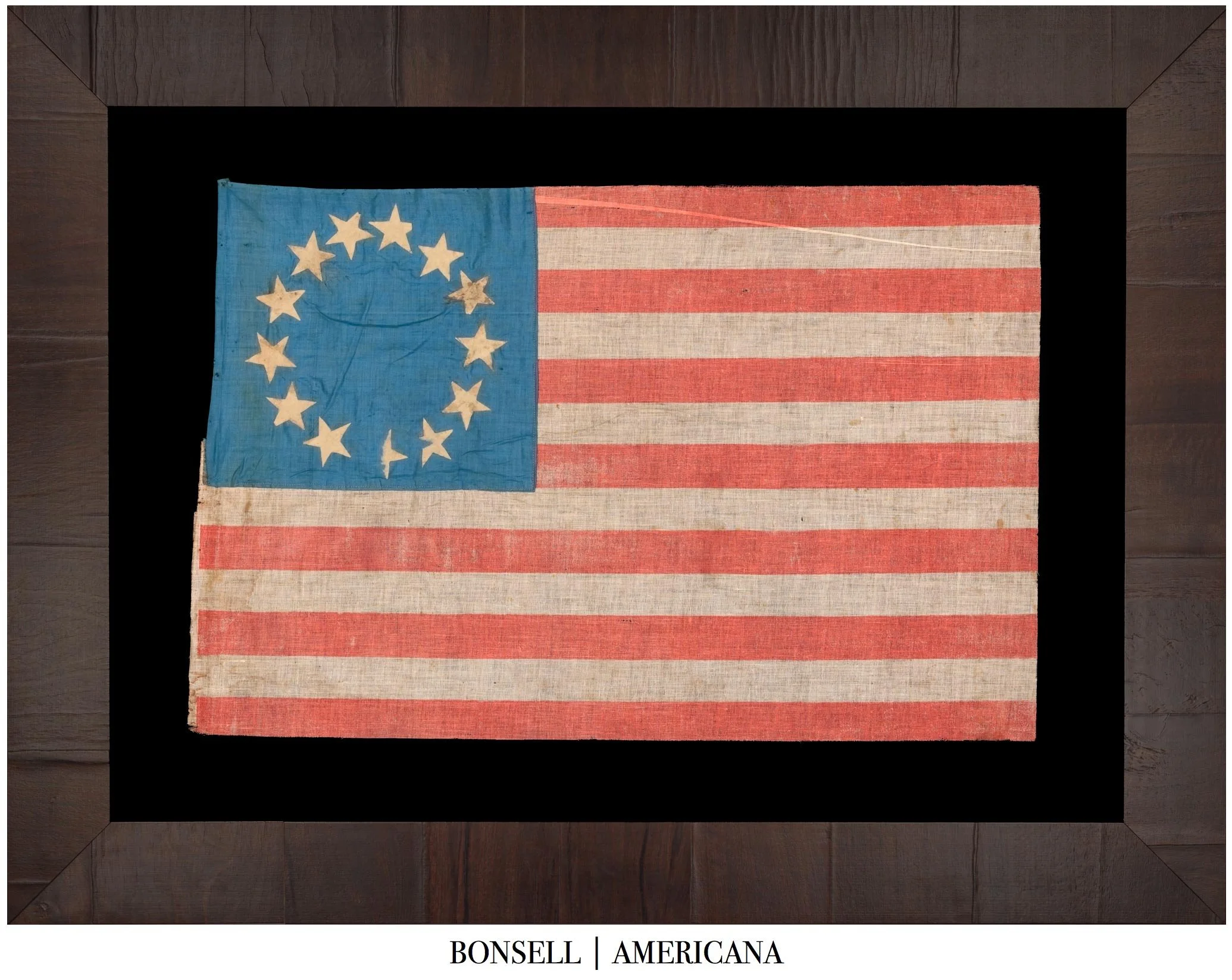
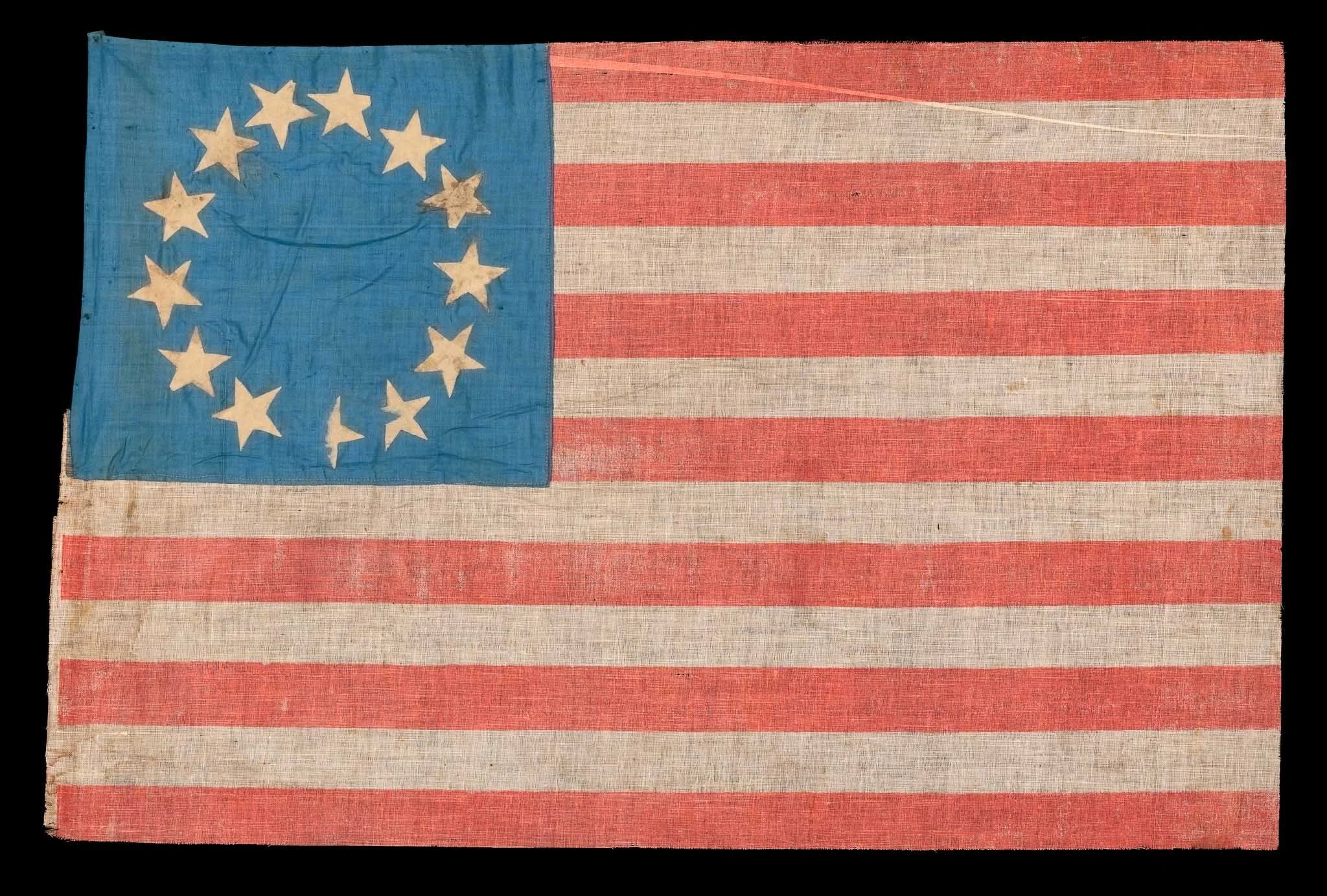
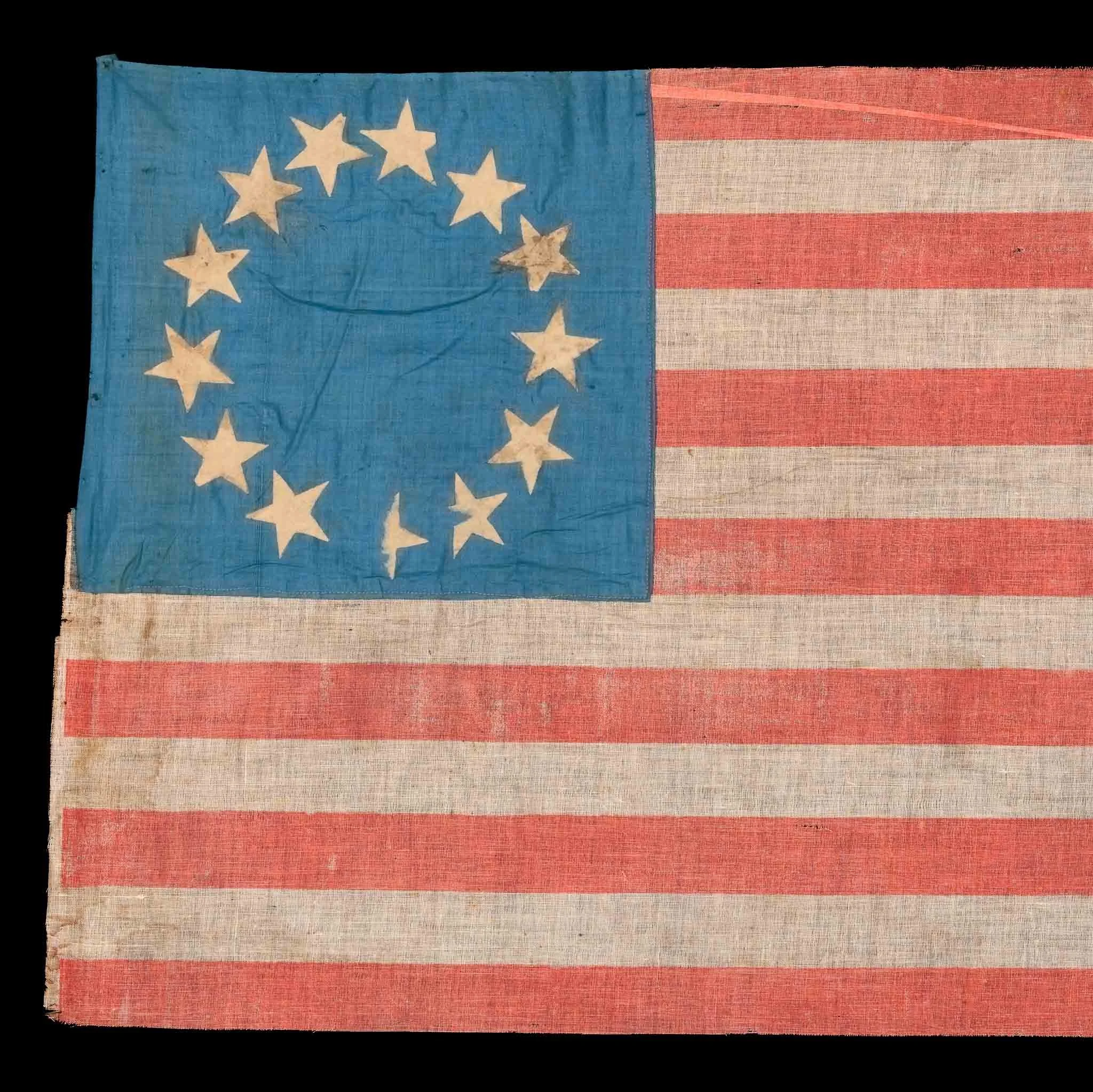
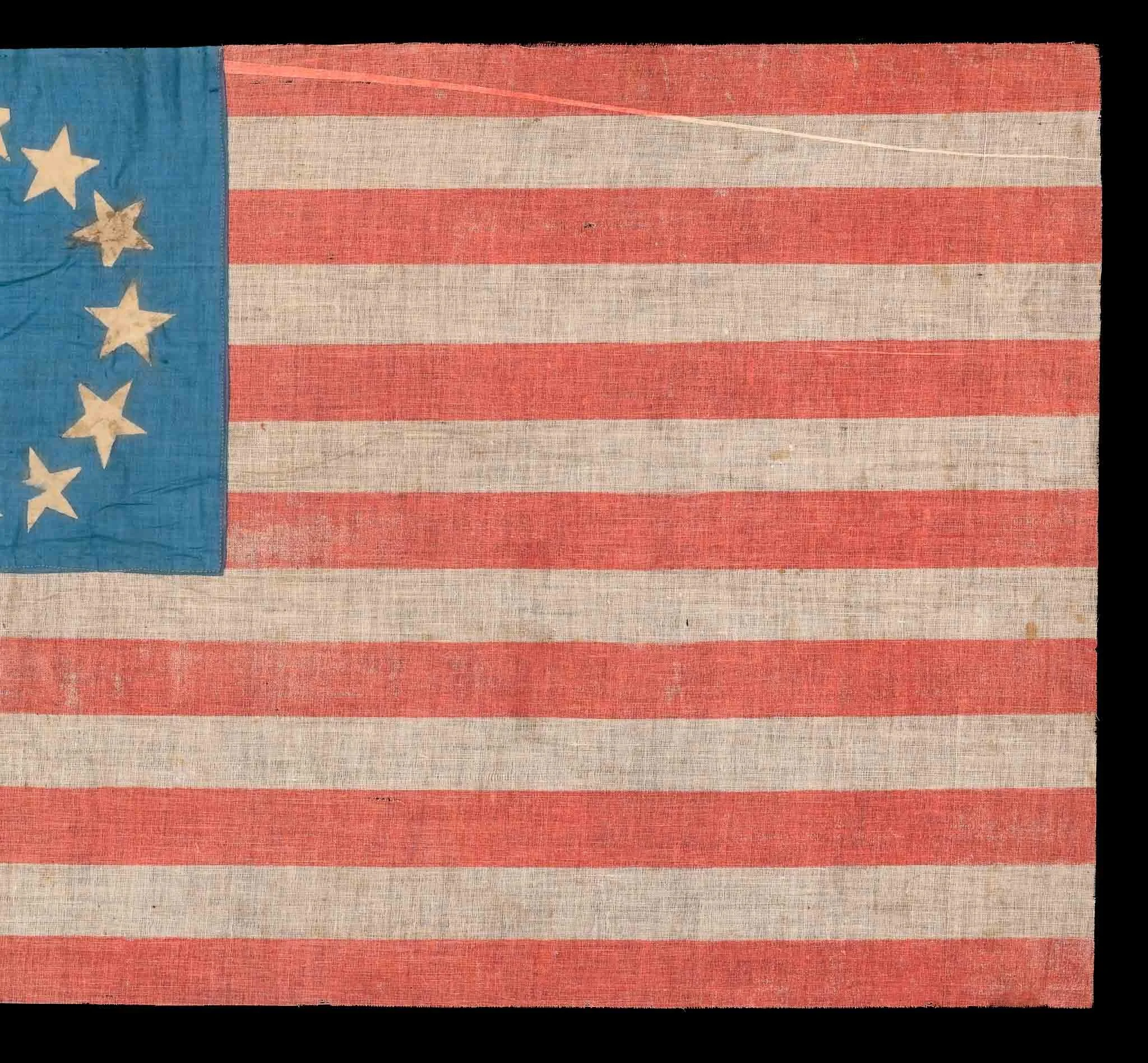
Offered is an unusual 13-star American flag, dating to approximately 1910–1940, with its stars arranged in the widely recognized “Betsy Ross” pattern. The flag is particularly interesting for its unconventional construction, incorporating what appear to be materials repurposed from an earlier American flag, a separately attached blue canton, and 13 paper stars glued directly to the fabric. As homemade example, it may have originated as a school project, classroom display, or other patriotic exercise intended to commemorate the nation's founding.
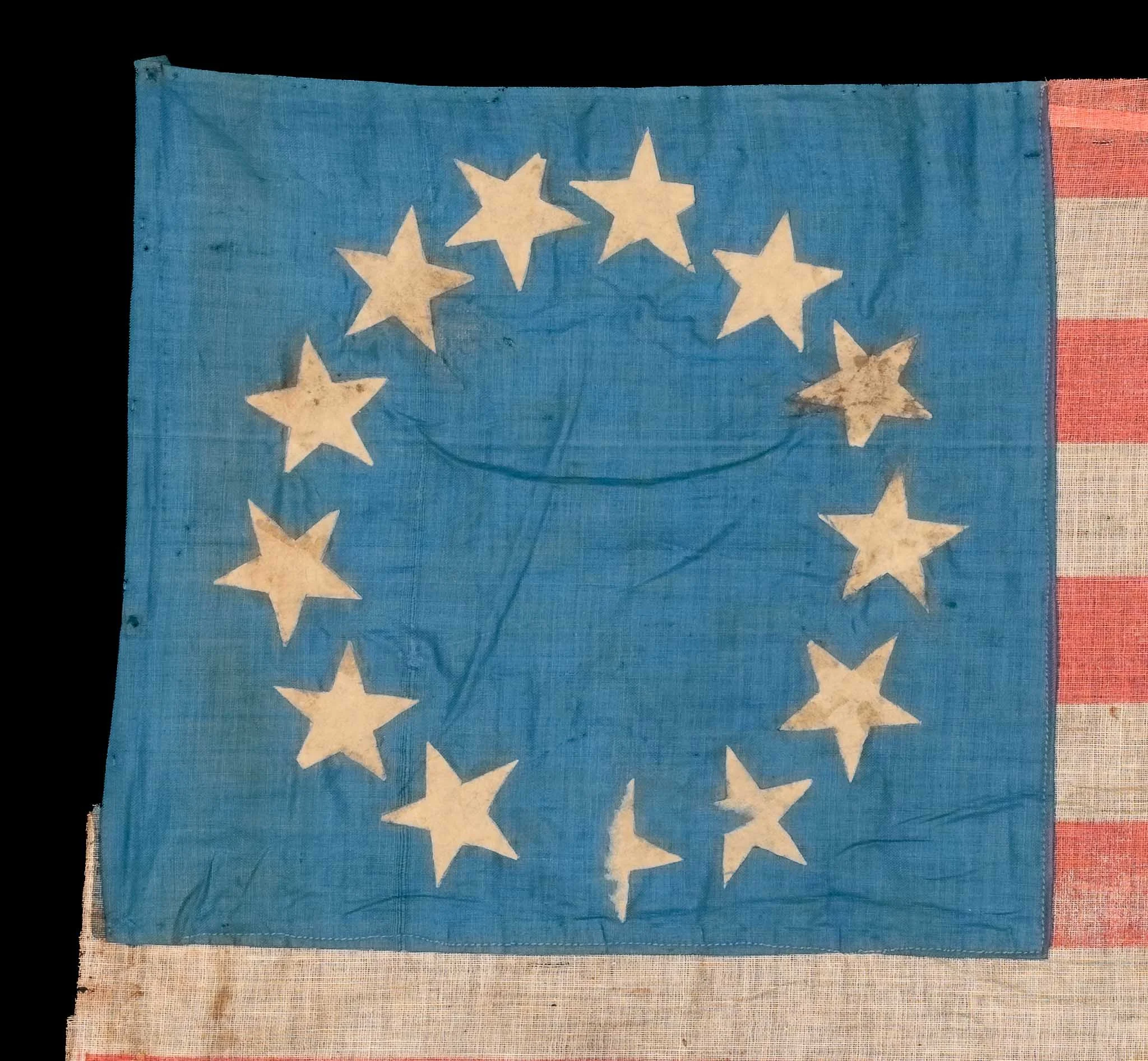
The flag's 13 stars are arranged in a circular formation, representing the original 13 colonies. While this configuration is among the most recognizable in American flag history, antique examples are surprisingly uncommon. Most surviving 13-star flags feature either the traditional 3-2-3-2-3 arrangement or some variation of the medallion pattern. Flags displaying a simple circle of 13 stars constitute a much smaller portion of the surviving population.
The arrangement is closely associated with Betsy Ross, the Philadelphia upholsterer traditionally credited with making the first American flag. Although the historical foundation of that story is questionable, its influence on American patriotic imagery has been substantial. The circular pattern has become so closely associated with the nation's founding that it is frequently assumed to have been the original arrangement adopted in 1777, despite the absence of contemporary documentation establishing that fact.
CONSTRUCTION AND DATING
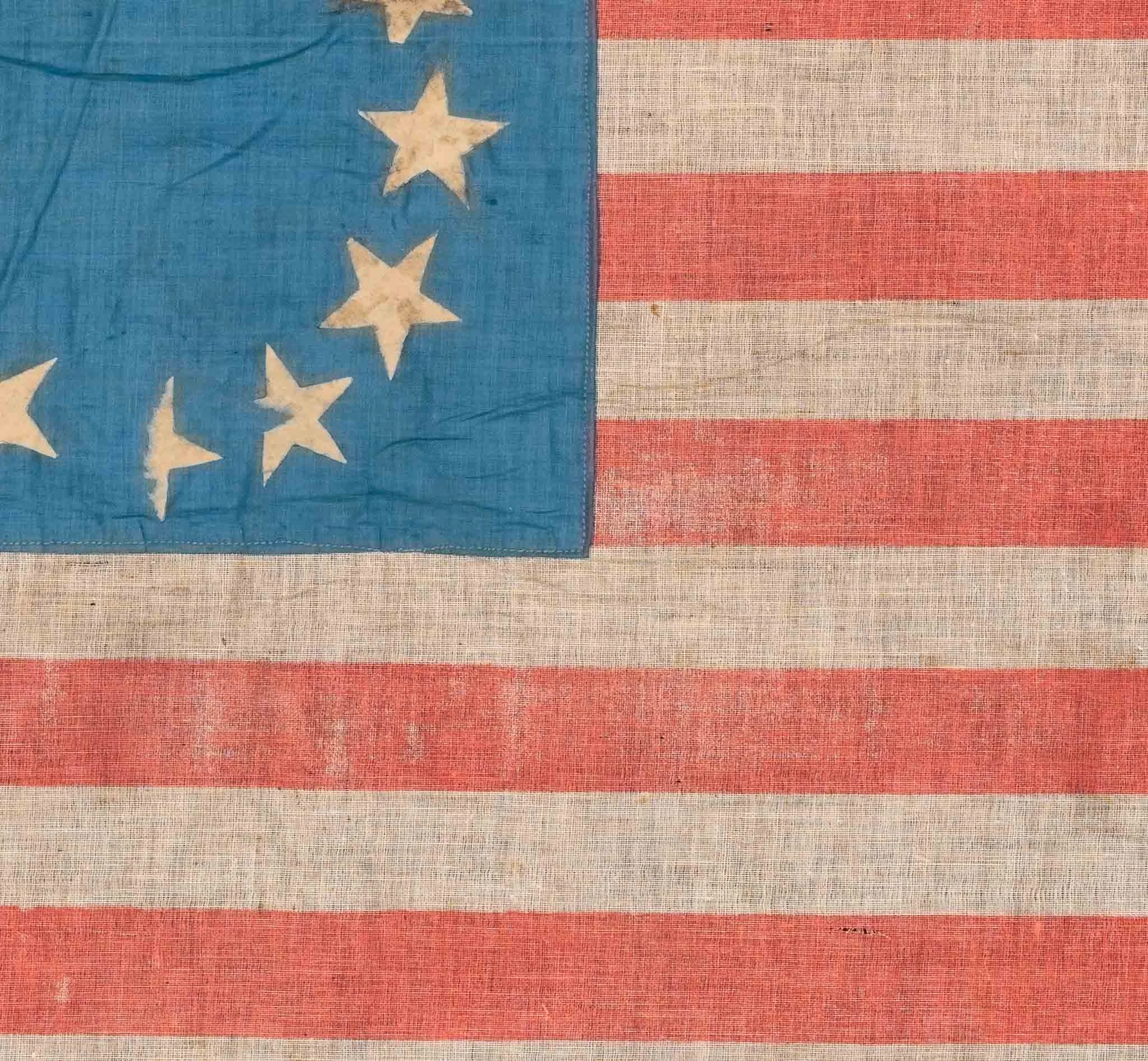
One of the most compelling aspects of this flag is the manner in which it was assembled. The red and white stripes appear to have been cut from an earlier American flag, rather than manufactured specifically for this example. The fabric is glazed cotton, with a relatively open weave and a red coloration consistent with many commercially produced flags of the early twentieth century. The red is notably a true red, rather than the orange-red frequently encountered on printed flags of the late nineteenth century, particularly those dating to the 38-star period.
Based on these characteristics, we believe the striped fabric likely originated from a flag manufactured sometime between approximately 1910 and 1940. A 48-star American flag, representing the period following Arizona's admission to the Union in 1912, is perhaps the most plausible source, although earlier 42-star to 46-star flags cannot be ruled out. Without the original canton, the precise star count of the source flag cannot be established.
The blue canton appears to be glazed cotton as well, although its surface is somewhat shinier and its weave noticeably tighter than that of the striped field. The canton was machine-sewn to the striped field, further supporting the conclusion that the flag was assembled from individual components.
Most unusual are the 13 stars, which are made of paper and adhered directly to the blue canton. Their individual shapes and placement have a distinctly handmade character. This method of construction would have been impractical for a flag intended to fly outdoors, where exposure to wind and moisture would quickly compromise the paper elements. It is instead consistent with an object intended for interior display, educational use, or some other commemorative purpose.
Taken together, these characteristics suggest a homemade flag, perhaps assembled by a student or teacher as part of a classroom lesson on American history. The use of an existing flag would have provided readily available red and white stripes, while the separately attached canton and paper stars allowed the maker to recreate the familiar Betsy Ross design. Although its original purpose is unknown, a schoolroom origin seems plausible given the prominence of the Betsy Ross story in American education during the early twentieth century.
We favor a date of approximately 1910–1940 for the completed flag, although the materials could have been reused some years after their original manufacture.
THE BETSY ROSS LEGEND
Betsy Ross is perhaps the most recognizable figure associated with the creation of the American flag. According to popular tradition, she was visited in Philadelphia in 1776 or 1777 by George Washington and a small committee seeking a flag for the newly independent nation. Ross purportedly agreed to manufacture the flag but suggested replacing the six-pointed stars in the proposed design with five-pointed stars, demonstrating how the latter could be produced with a single cut of folded paper.
Despite its enduring popularity, there is no surviving contemporary documentation establishing that Ross designed or made the first American flag. She was a working upholsterer and flagmaker during the Revolutionary era, but the specific claim that she created the first national flag rests on family testimony recorded many decades after the alleged event.
The story first gained significant public attention in 1870, when William Canby, Ross's grandson, presented an account of her involvement to the Historical Society of Pennsylvania. Canby relied on family recollections and affidavits rather than contemporary letters, contracts, or official records. His narrative was subsequently repeated in popular publications, including an 1873 account in Harper's New Monthly Magazine, helping establish the story in the American imagination.
By contrast, documentary evidence links Francis Hopkinson, a signer of the Declaration of Independence and member of the Continental Congress, to the design of the American flag. In 1780, Hopkinson sought compensation from Congress for designing what he described as the flag of the United States of America. Although his claim does not conclusively establish every detail of the earliest flag's appearance, it provides a contemporary documentary foundation lacking in the Betsy Ross account.
The historical uncertainty surrounding Ross did little to diminish the story's popularity. In the decades following the Civil War, Americans increasingly embraced patriotic narratives celebrating the Revolutionary generation. The Centennial of American independence in 1876 gave particular momentum to this movement, and the Ross story offered a memorable account connecting George Washington, the nation's first flag, and the contributions of an American woman.
By the late nineteenth and early twentieth centuries, the legend had become firmly established in classrooms, patriotic literature, and public commemorations. Ross's descendants Rachel Albright and Sarah Wilson contributed to its popularity by producing and selling handmade reproductions of the supposed original flag at Independence Hall in Philadelphia, principally during the period from approximately 1895 to 1913. Their examples were generally made of silk, with carefully embroidered stars, and are distinctly different from the flag offered here.
If made between 1910 and 1940, the present example would have originated during a period when the Betsy Ross narrative was deeply embedded in American popular culture. Its paper stars and repurposed fabric seem particularly appropriate for an educational or patriotic project, in which reproducing the familiar design may have mattered more than following conventional flagmaking practices.
13-STAR FLAGS GENERALLY
The first national flag was established by the Continental Congress on June 14, 1777. The resolution specified 13 alternating red and white stripes and 13 white stars on a blue field, representing a new constellation. Importantly, it did not prescribe a particular arrangement for the stars. Consequently, several configurations appeared on early American flags, and no surviving congressional directive establishes the familiar Betsy Ross circle as the original design.
Although the official number of stars increased as additional states entered the Union, 13-star flags continued to be manufactured and displayed for generations. They remained associated with the nation's founding and appeared in patriotic celebrations, military and maritime contexts, and commemorations of American independence. The 1876 Centennial was an especially important occasion for their revival, while later anniversary celebrations helped sustain their popularity well into the twentieth century.
Of the various 13-star arrangements, the Betsy Ross circle is among the most familiar to the public yet one of the less frequently encountered patterns on genuinely antique flags. Its prevalence in modern reproductions should not be confused with its relative scarcity among surviving historical examples.
The flag offered here is a particularly interesting survivor of that tradition. Its modest materials and unconventional construction distinguish it from professionally manufactured flags of the period, while its circular arrangement of paper stars speaks directly to the enduring influence of the Betsy Ross legend. Whether produced in a classroom, a private home, or for a patriotic celebration, it represents an early twentieth-century interpretation of one of America's best-known flag designs.
Conservation Process: The flag has been professionally conserved, mounted to silk, and is now protected behind Optium Museum Acrylic to ensure long-term preservation.
Frame: The frame is a dark-stained hardwood molding with a clean square profile and subtle variations in grain and tone that lend warmth and visual depth.
Condition Report: The flag is in good overall condition, with scattered discoloration and staining throughout, particularly along the hoist and portions of the white stripes. There is some fading and minor wear to the fabric, including small areas of fraying along the edges. Several of the paper stars exhibit staining, wear, and partial loss, most notably one near the bottom of the canton.
Collectability Level: The Best – Perfect for Advanced Collectors
Date of Origin: 1895-1913
Number of Stars: 13
Associated State: Original 13 Colonies