38 Star American Parade Flag | Handwritten “Emily Gates” Inscription | Colorado Statehood | Circa 1876-1890
38 Star American Parade Flag | Handwritten “Emily Gates” Inscription | Colorado Statehood | Circa 1876-1890
Frame Size (H x L): 13” x 17”
Flag Size (H x L): 6.75” x 10”
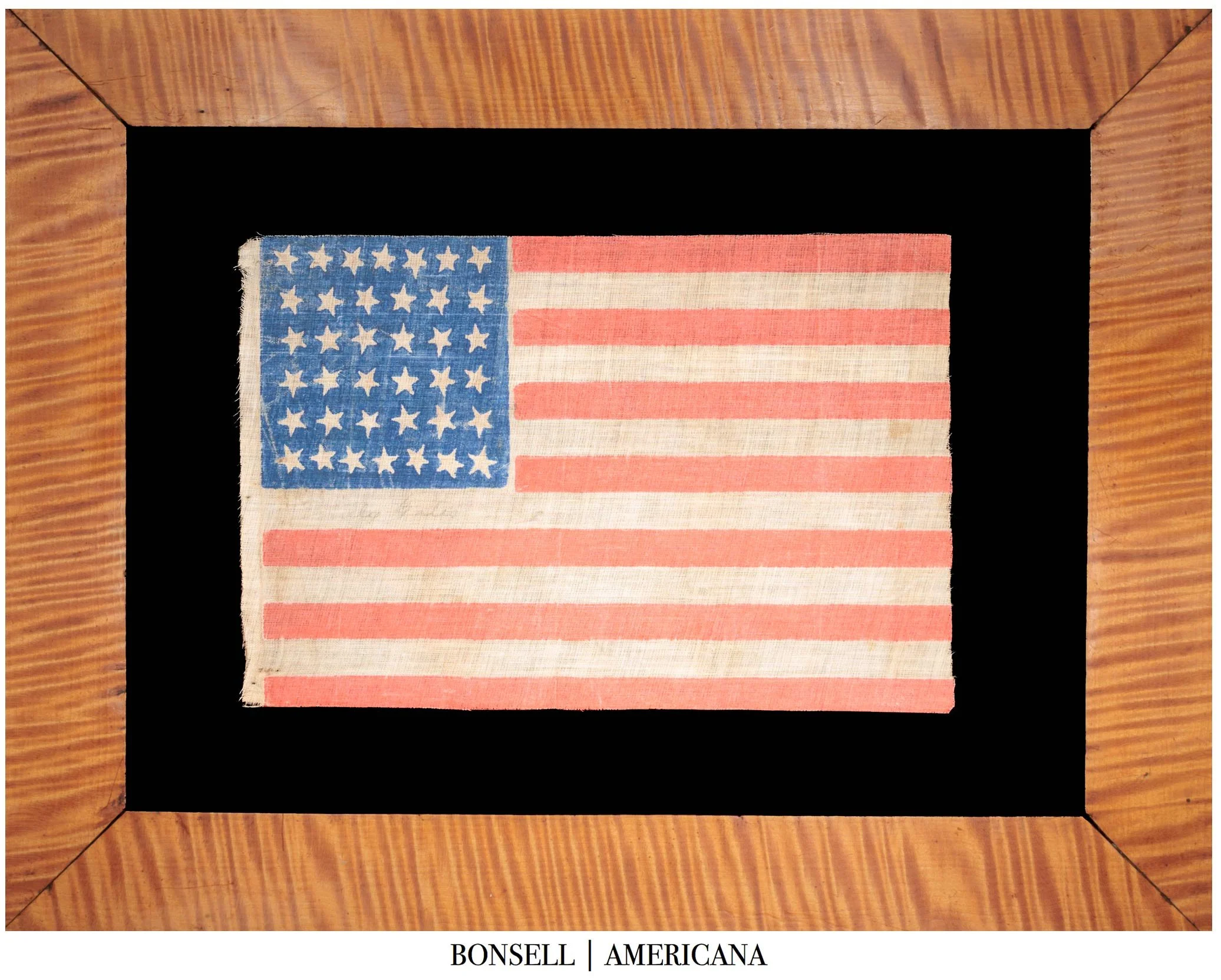
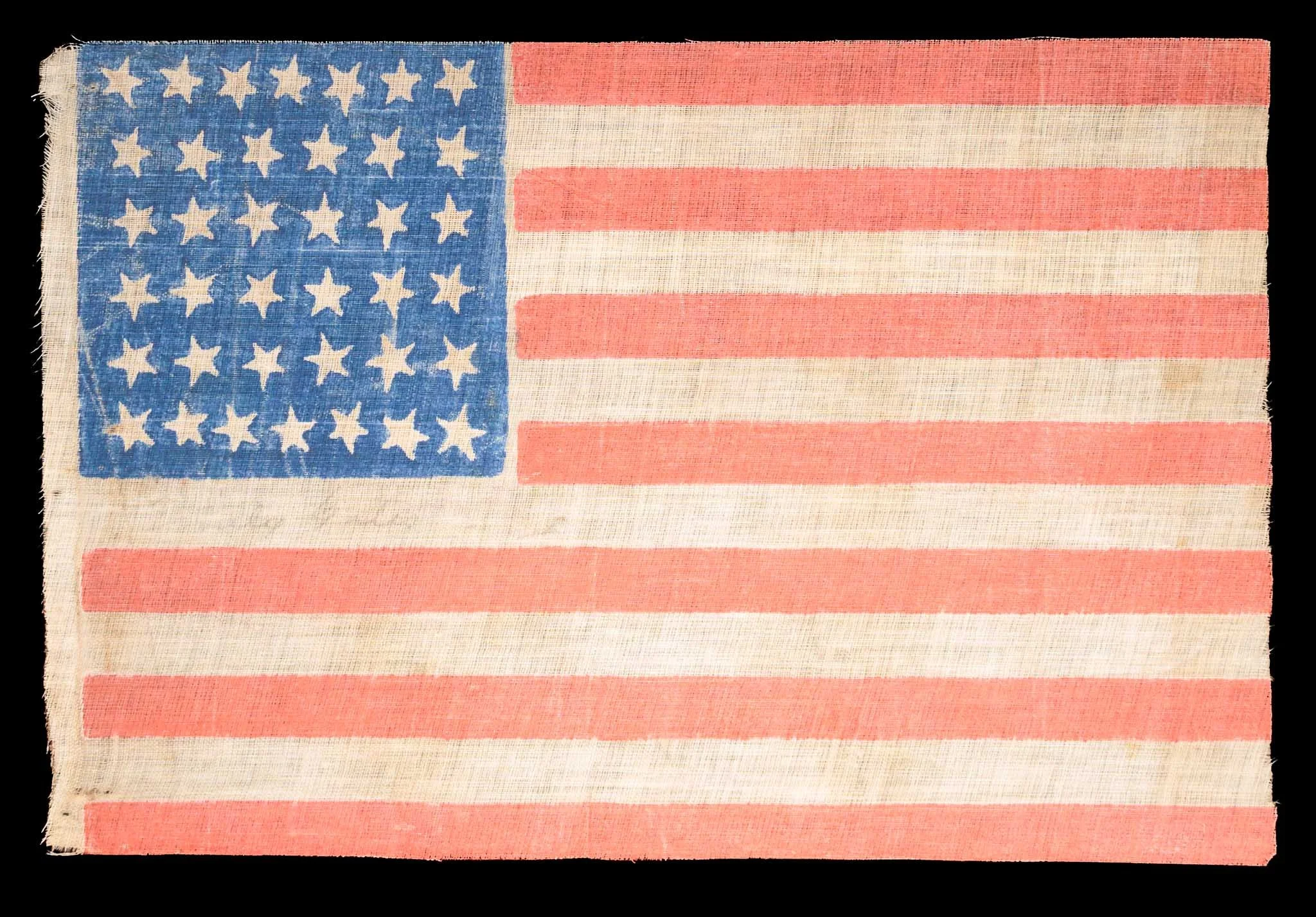
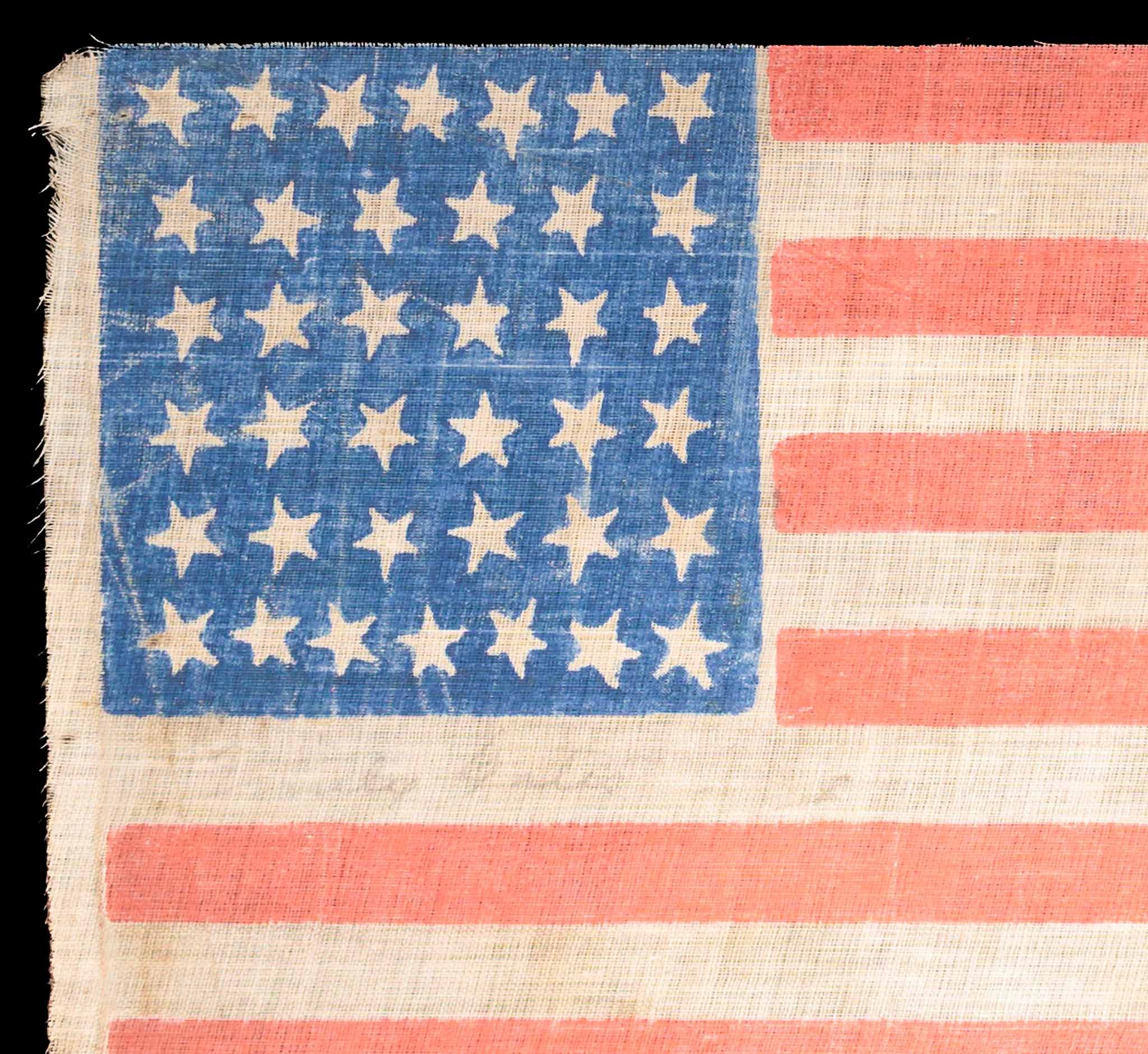
Offered is a 38-star American parade flag, printed on glazed cotton and dating to the period following Colorado’s admission to the Union. The canton displays a 7-6-6-6-6-7 star configuration, with the stars arranged in generally linear rows and oriented in slightly varying directions. The stripes retain a warm orange-red tone, contrasting with the blue canton and giving the flag the characteristic appearance of a 19th-century printed parade flag.
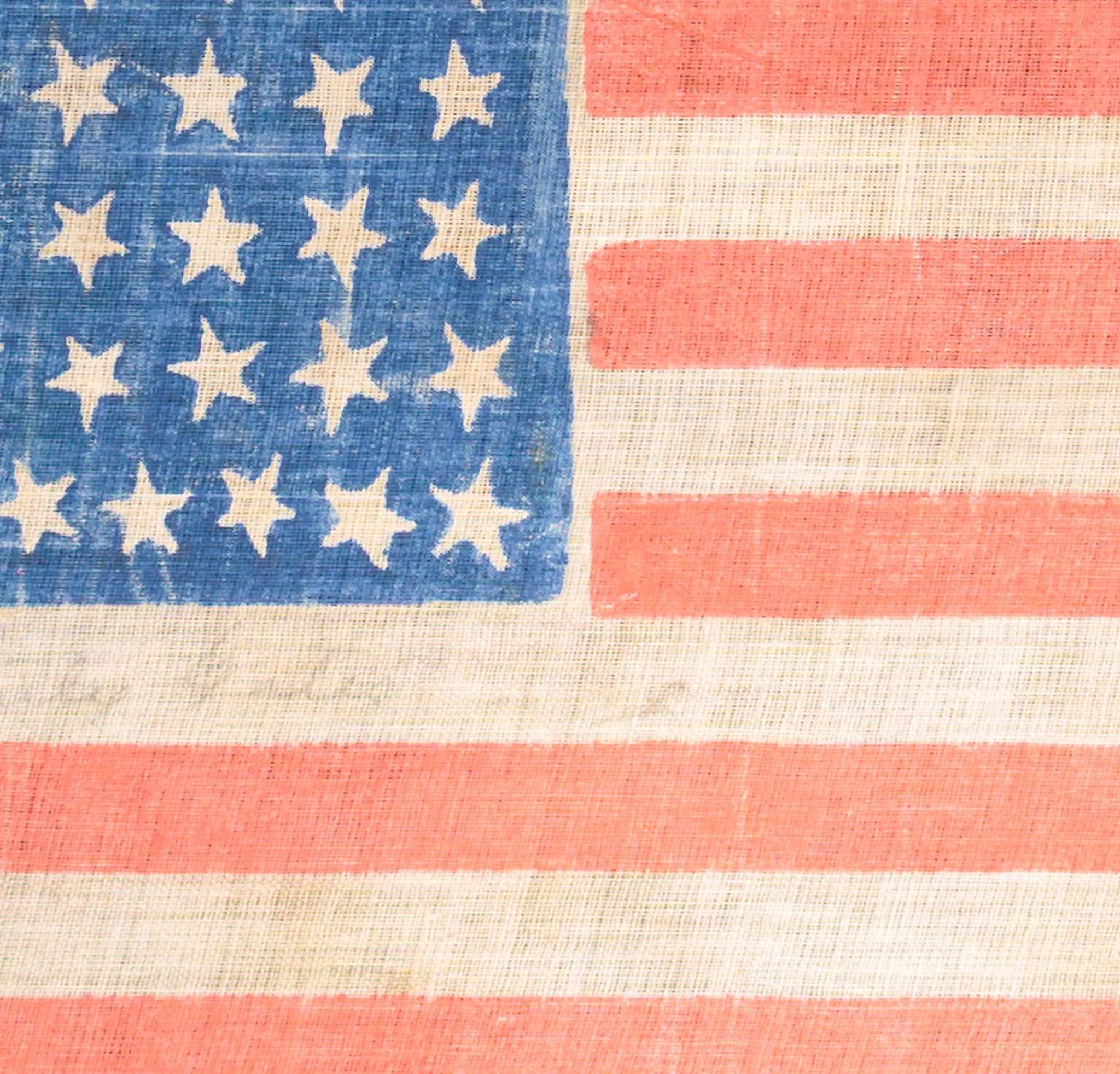
Of particular interest is a period pencil inscription that appears to read “Emily Gates,” written in cursive. Personal inscriptions are occasionally encountered on 19th-century flags and can take the form of names, dates, locations, messages, or other notations. Small parade flags were commonly carried at political rallies, civic parades, veterans’ gatherings, holiday celebrations, and similar events, and inscriptions sometimes served simply to identify the owner.
While the identity of Emily Gates has not been established, the inscription provides evidence of individual ownership or use. This is a meaningful distinction, as the majority of surviving parade flags remain anonymous. The inscription therefore adds a personal element to an otherwise commercially produced patriotic textile.
The 38 stars represent Colorado’s admission to the Union on August 1st, 1876. Colorado became the 38th state just 28 days after the nation’s centennial and consequently became known as the “Centennial State.” The 38-star flag officially became the national standard on July 4th, 1877, in accordance with the established practice of adding new stars on the Independence Day following a state’s admission.
The 38-star flag remained official until July 3rd, 1890. Its period of use coincided with significant national growth, including continued western expansion, railroad development, industrialization, and the post-Reconstruction period. Because Colorado entered the Union during the Centennial year, 38-star flags are also closely associated with the broad wave of patriotic material produced during and immediately after the celebrations of 1876.
The timing of Colorado statehood is important when considering surviving 38-star flags. Flag makers were already producing large quantities of patriotic textiles for the Centennial, and some manufacturers incorporated 38 stars in anticipation of Colorado’s admission or immediately afterward. Other examples were produced throughout the official 1877–1890 period. As a result, the star count can appear on flags made both for Centennial-related use and for later patriotic events.
This example is printed on glazed cotton, a material commonly used for parade flags during the period. Unlike large sewn flags intended for sustained outdoor use, printed parade flags were inexpensive, portable, and suitable for distribution in quantity. They were used at political events, military reunions, civic ceremonies, and public celebrations. Their relatively lightweight construction also meant that many were discarded or damaged, contributing to the scarcity of well-preserved examples today.
The printed surface exhibits the irregularities associated with period production, including slight variation in color saturation and star orientation. The red stripes have mellowed toward a warm orange-red, while the blue canton remains clearly defined. These characteristics are consistent with the pigments, printing methods, and materials used in late-19th-century parade flags.
The combination of a desirable 38-star count, glazed-cotton construction, attractive period coloration, and the handwritten “Emily Gates” inscription makes this a particularly strong example of a late-19th-century American parade flag. The inscription is especially noteworthy, providing a direct indication of personal ownership or use and adding a level of historical context not present on most comparable examples.
Conservation Process: This flag was hand sewn to cotton fabric, and both were hand sewn to a mounting board. To prevent the black dye in the cotton fabric from seeping into the flag, it was first washed in a standard wash and then in a dye setting wash. The flag is positioned behind Optium Museum Acrylic.
Frame: The flag is in an attractive tiger maple frame. Tiger maple frames are cherished for their striking, wavy grain patterns that shimmer with a unique iridescence, reminiscent of a tiger's coat.
Condition Report: The flag is in very good overall condition for its age, with strong, legible colors and no significant losses. There is minor fraying along the perimeter, particularly at the hoist, along with scattered light soiling, staining, and areas of wear consistent with age and use.
Collectability Level: The Great – Perfect for Rising Collectors
Date of Origin: 1876-1890
Number of Stars: 38
Associated War: The Indian Wars (1860-1890)
Associated State: Colorado