Unique Texas Flag with Hand-Drawn Bullseye and Centered Bullet Hole | Philmont Scout Ranch Black Powder Rifle Exercise | Circa 1986
Unique Texas Flag with Hand-Drawn Bullseye and Centered Bullet Hole | Philmont Scout Ranch Black Powder Rifle Exercise | Circa 1986
Price: Call 618-553-2291, or email info@bonsellamericana.com
Frame Size (H x L): 32” x 34”
Flag Size (H x L): 21” x 23”
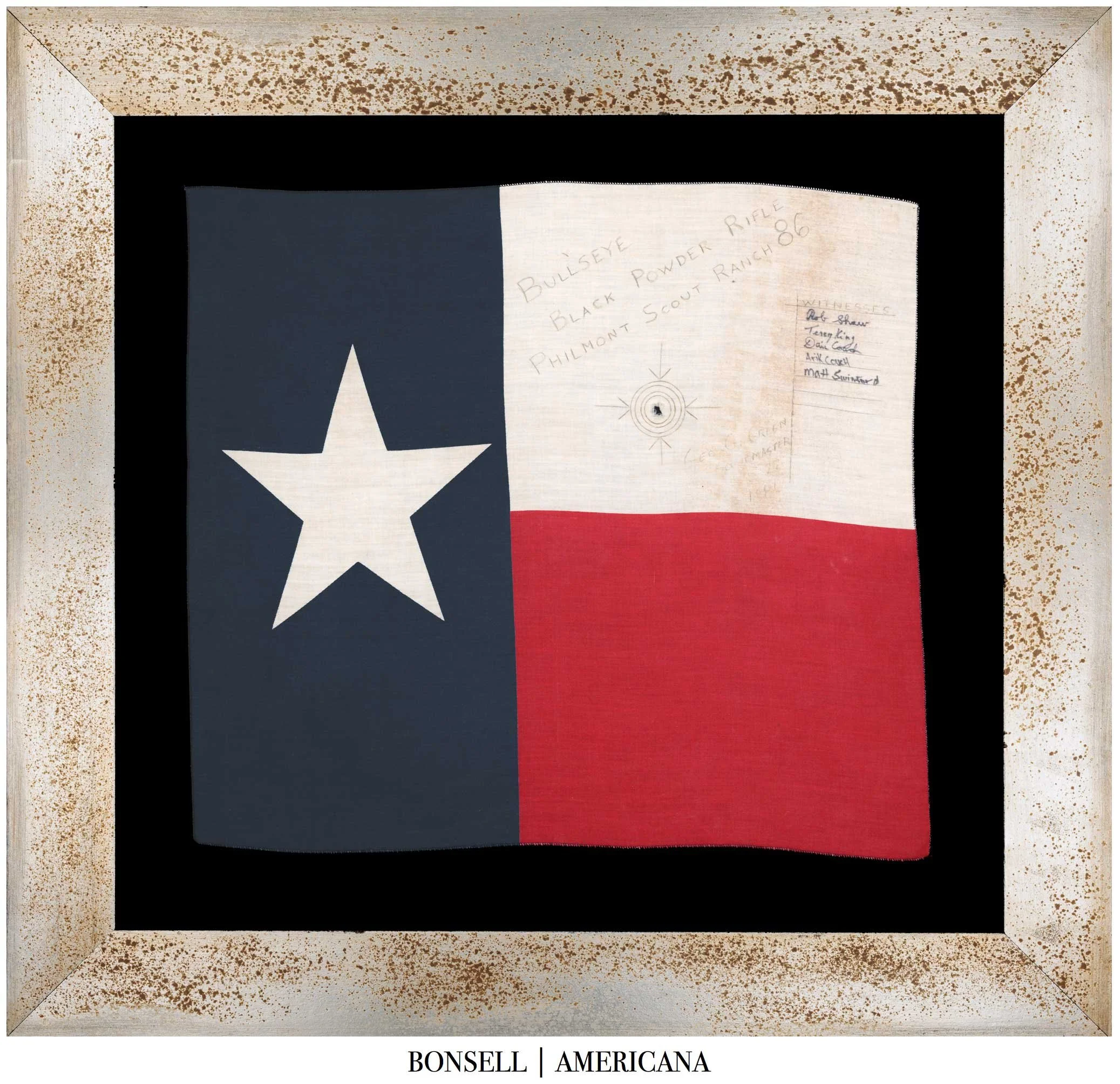
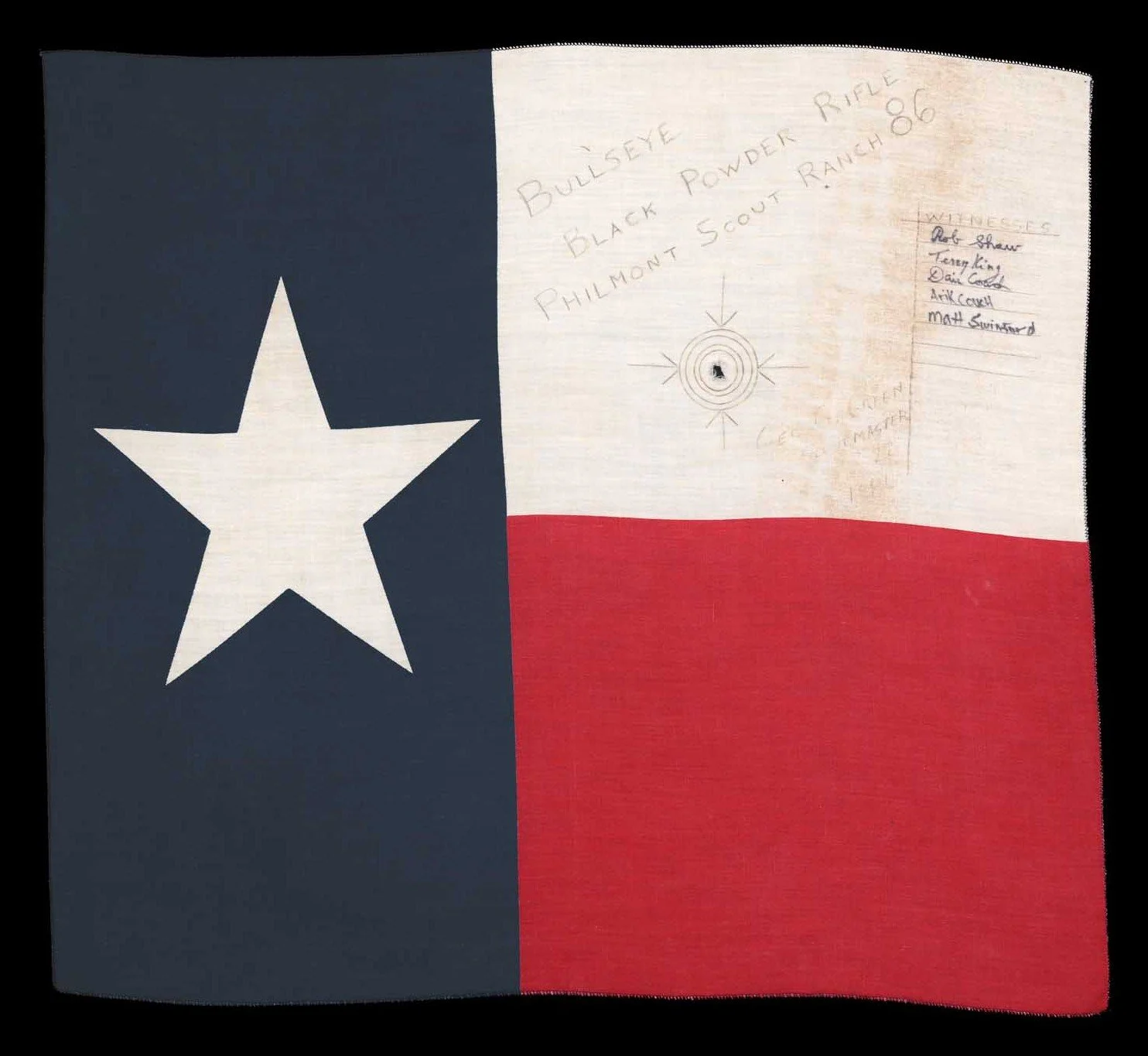
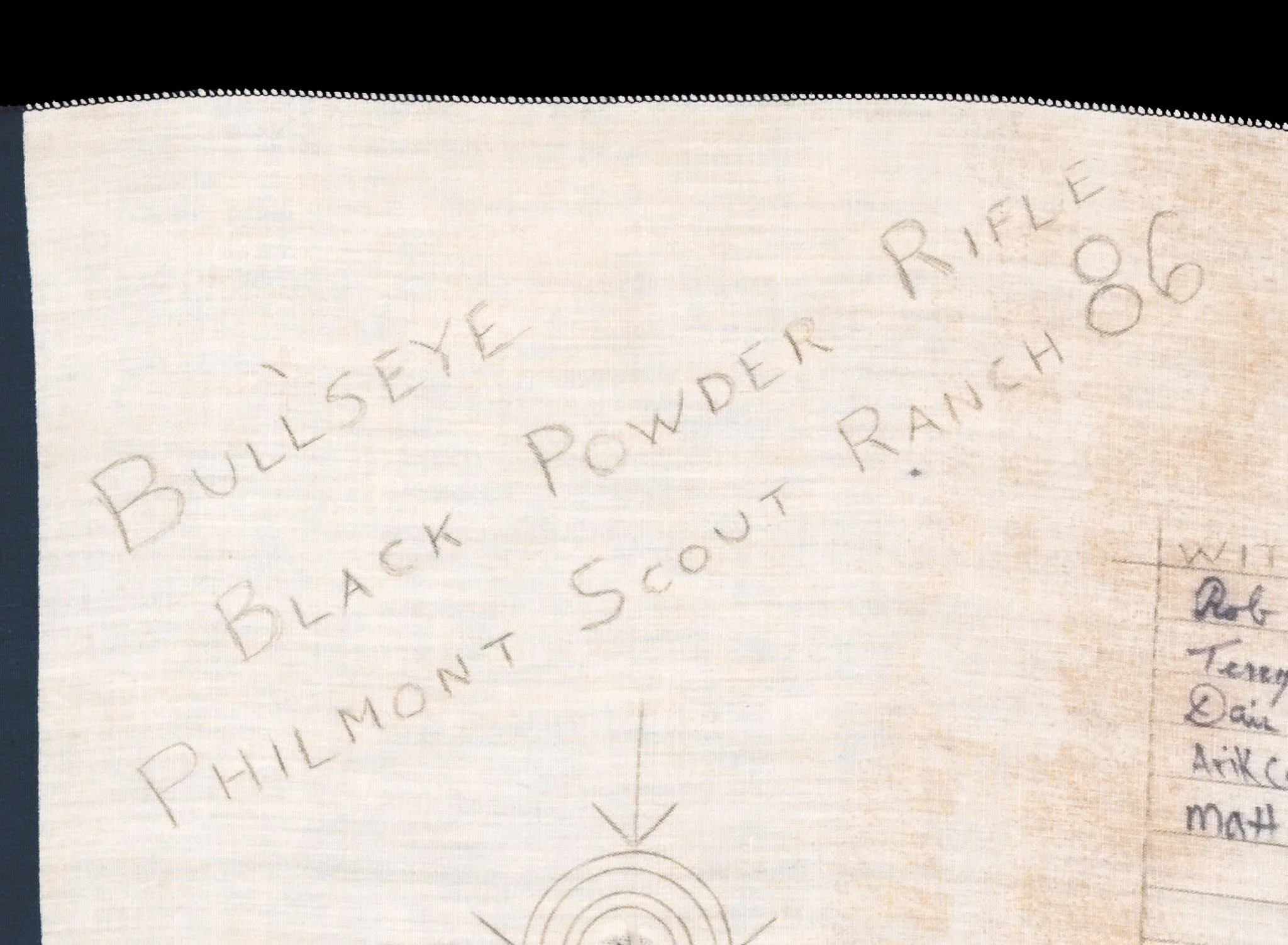
Offered is a particularly fun and highly personal Texas state flag, dating to 1986 and used during a black powder rifle exercise at Philmont Scout Ranch in northern New Mexico. Printed on a single piece of cotton, the flag was transformed from an otherwise straightforward Texas flag into a one-of-a-kind record of a Scout experience through a combination of handwritten inscriptions, a drawn bullseye, a remarkably centered bullet hole, and the names of those who witnessed the shot.
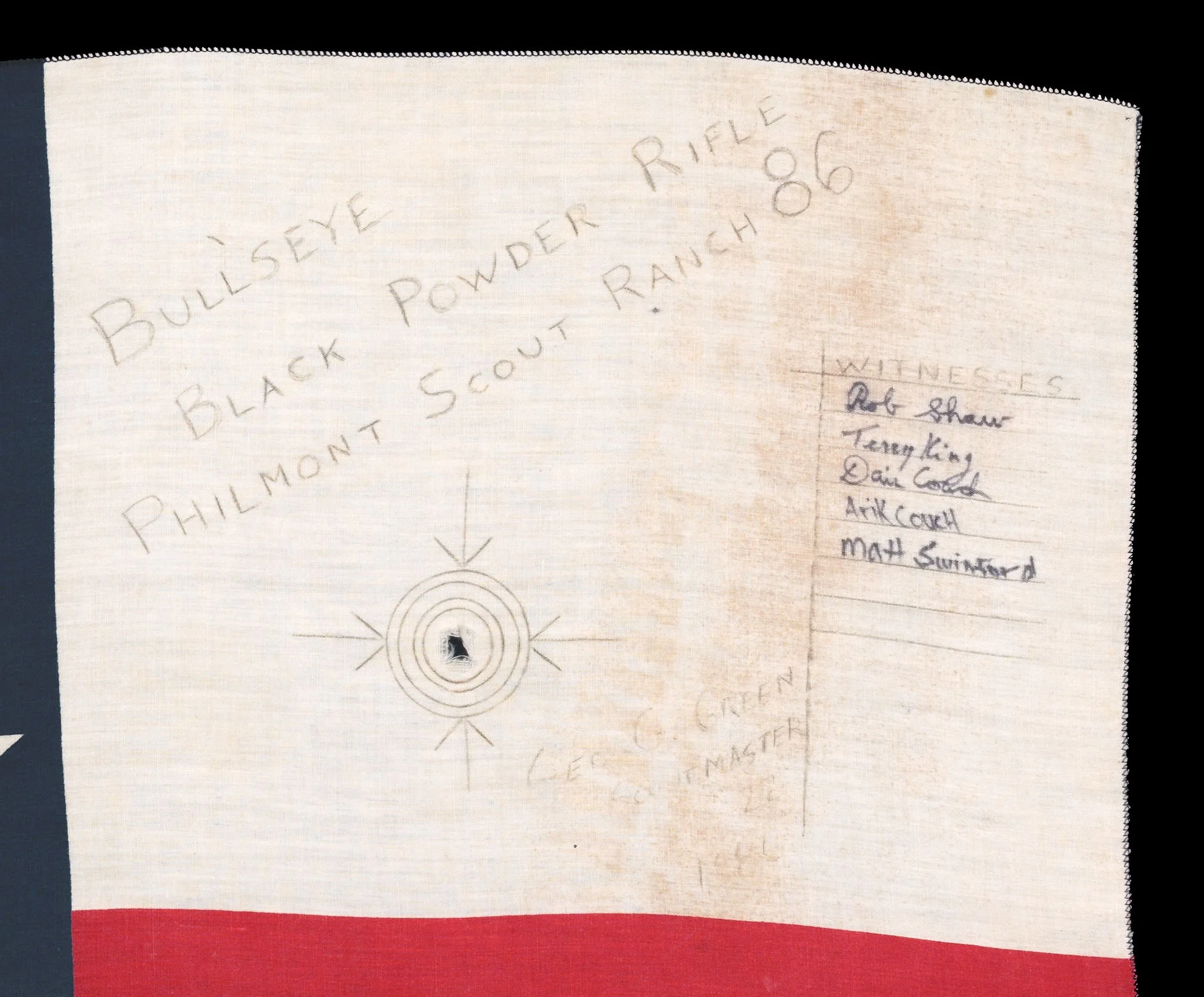
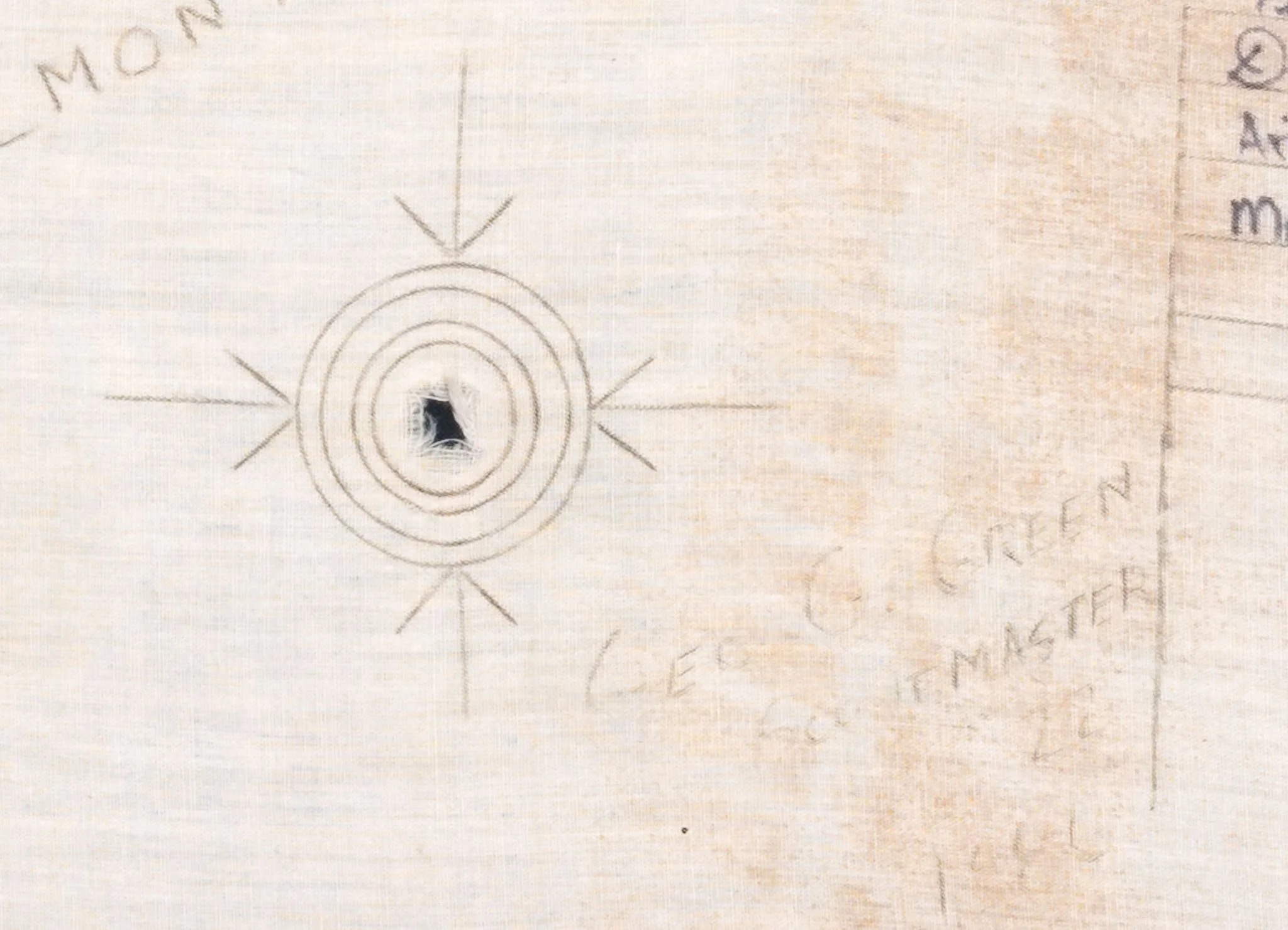
Across the white field, written in pencil, are the words “Bullseye,” “Black Powder Rifle,” “Philmont Scout Ranch,” and “86.” Below this inscription is a hand-drawn target composed of concentric circles and directional marks. At the very center is the actual bullet hole, placed almost perfectly within the bullseye. The relationship between the drawn target and the shot is what gives the flag much of its appeal. This was not simply a flag carried to camp or signed as a souvenir; it was deliberately preserved as evidence of a memorable shot.
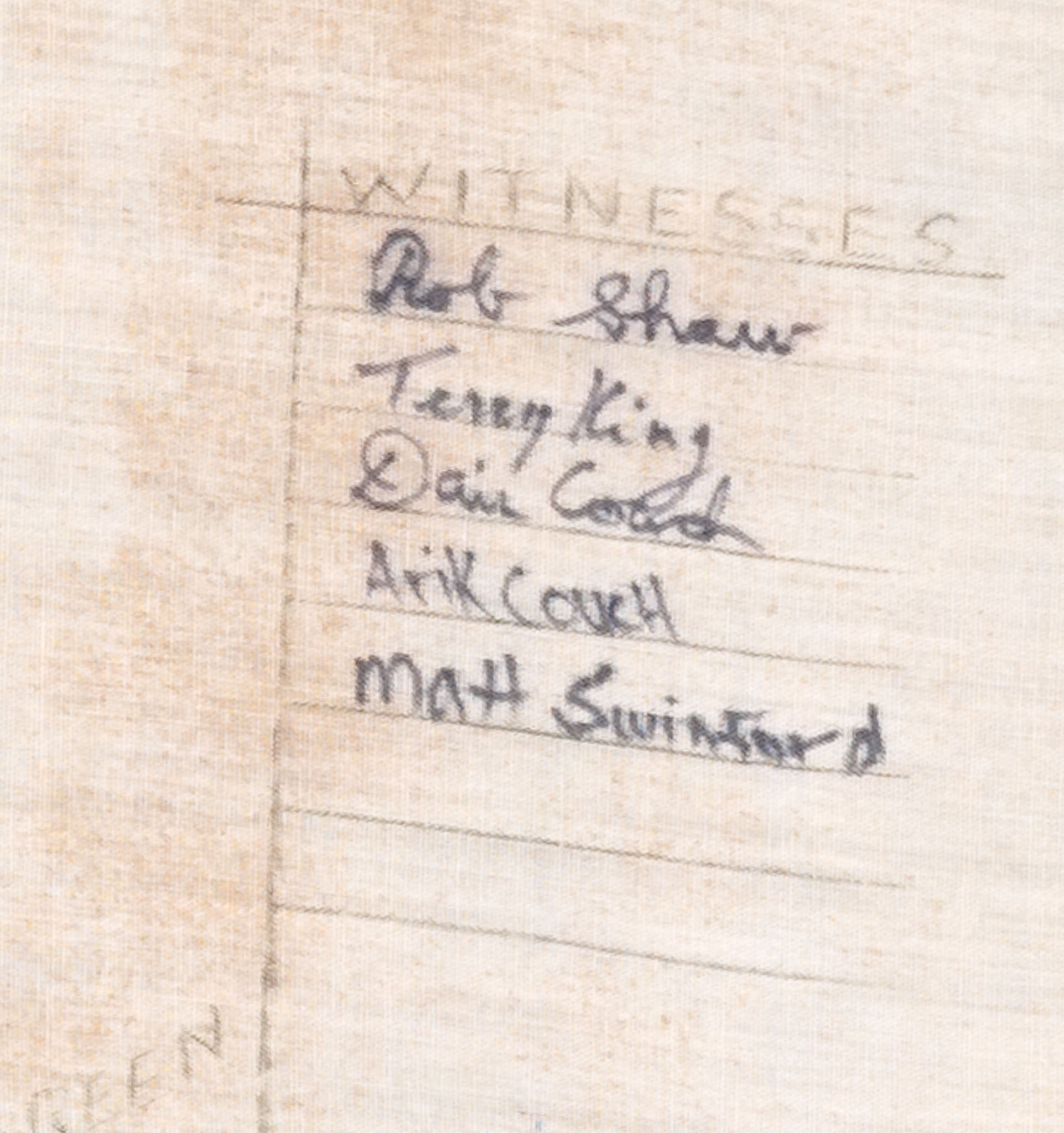
To the right is a ruled box headed “WITNESSES,” followed by the names of five individuals. These appear to read Rob Shaw, Terry King, an additional name that is presently difficult to decipher, Arik Couch, and Matt Swinford. Elsewhere, a much lighter inscription appears to identify a Scoutmaster with the surname Green, lending another layer of documentation to the event. Taken together, the inscriptions have the character of a group making an informal record immediately following the shot—essentially turning the flag into a trophy, certificate, and camp souvenir all at once.
The setting is significant. Philmont Scout Ranch, near Cimarron, New Mexico, is one of the most storied institutions in American Scouting. The ranch traces its origins to oilman Waite Phillips and his wife, Genevieve, who donated more than 127,000 acres to the Boy Scouts of America in two major gifts in 1938 and 1941. The first Scouts arrived in 1939, when the property was known as Philturn Rocky Mountain Scoutcamp; following the larger 1941 gift, it became Philmont Scout Ranch. Today the property encompasses roughly 140,000 acres of mountainous backcountry and has hosted generations of Scouts in programs centered on hiking, outdoor skills, western history, conservation, and marksmanship.
Black powder shooting has long been one of Philmont's historically themed activities. Participants learn the process of loading and firing a muzzle-loading rifle using the traditional components of powder, patch, ball, ramrod, and percussion cap. Modern Philmont program literature describes the use of .50- and .58-caliber muzzle-loading rifles, with the activity intended not only as a shooting exercise but also as an introduction to the firearms and methods associated with nineteenth-century western life. Although the precise circumstances surrounding this 1986 shot are not known, the inscriptions leave little doubt that the flag was connected directly to such a black powder rifle exercise at Philmont.
What makes the piece especially compelling is the way the participants documented the moment. A successful shot at camp might ordinarily survive only as a story or perhaps a paper target. Here, however, someone chose a Texas flag, drew the target directly onto it, recorded the location and type of shooting, dated the event, and had witnesses identify themselves alongside it. The bullet hole at dead center makes the story immediately understandable without explanation. The result is less a conventional flag than a piece of American vernacular history—an object created spontaneously to commemorate a small but evidently memorable achievement.
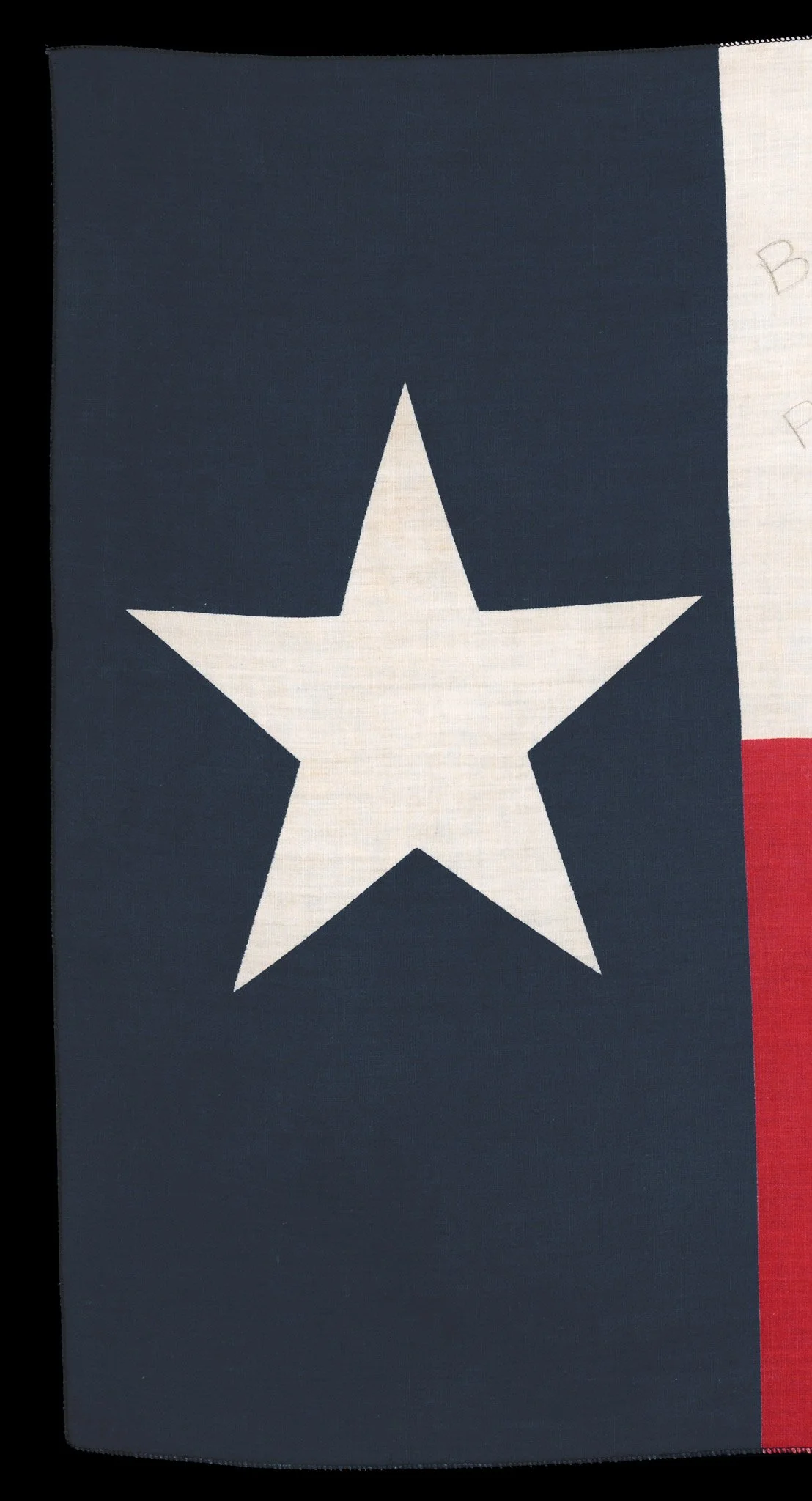
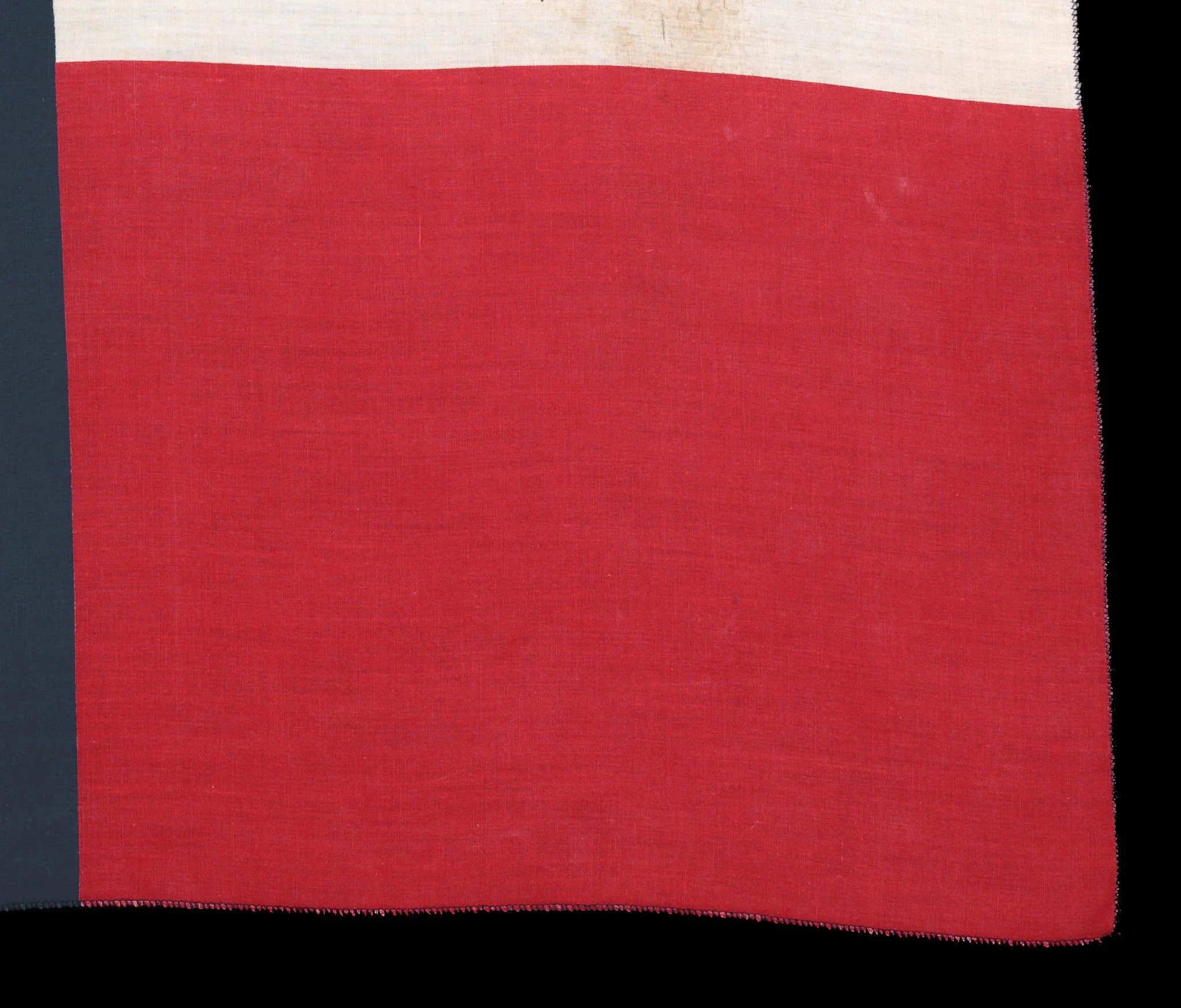
The use of a Texas flag adds another layer of character. The familiar Lone Star design originated as the national flag of the independent Republic of Texas. The Texas Congress approved the design on January 25, 1839, during the presidency of Mirabeau B. Lamar. Its composition—a vertical blue field containing a single white star, together with horizontal white and red fields—later became the state flag and remains essentially unchanged.
Under the modern Texas Flag Code, the colors are assigned the meanings of blue for loyalty, white for purity, and red for bravery. Earlier recommendations made during the Republic period proposed somewhat different symbolism—blue for friendship, white for peace, and red for war—but that language was not formally adopted by the Texas Congress. The lone five-pointed star became the enduring emblem of Texas itself, one whose history reaches back to the Republic and ultimately gave Texas its familiar identity as the Lone Star State.
Against that history, this particular flag has an especially American quality. It combines the iconography of Texas, the traditions of Scouting, the western heritage emphasized at Philmont, and the camaraderie of a group who considered a single rifle shot important enough to document for posterity. Its appeal comes precisely from its informality: the penciled lettering, the hand-drawn target, the witness list, and, above all, the bullet hole precisely where the shooter hoped it would be.
Dating to 1986, it is obviously much younger than many antique American flags, but age is not the principal attraction here. This is an object with a specific event permanently recorded upon it. Very few flags can be tied so visually and directly to a particular moment. As a Texas flag, a Philmont Scout Ranch artifact, and a remarkably graphic piece of shooting and Scouting history, it is an unusual and exceptionally engaging piece of Americana.