Signed Texas State Flag | U.S. Air Force Training Send-Off Flag with Vietnam-Era Inscriptions | Circa 1966




Signed Texas State Flag | U.S. Air Force Training Send-Off Flag with Vietnam-Era Inscriptions | Circa 1966
Price: Call 618-553-2291, or email info@bonsellamericana.com
Frame Size (H x L): 38” x 54”
Flag Size (H x L): 25 ¼” x 42 ¼”
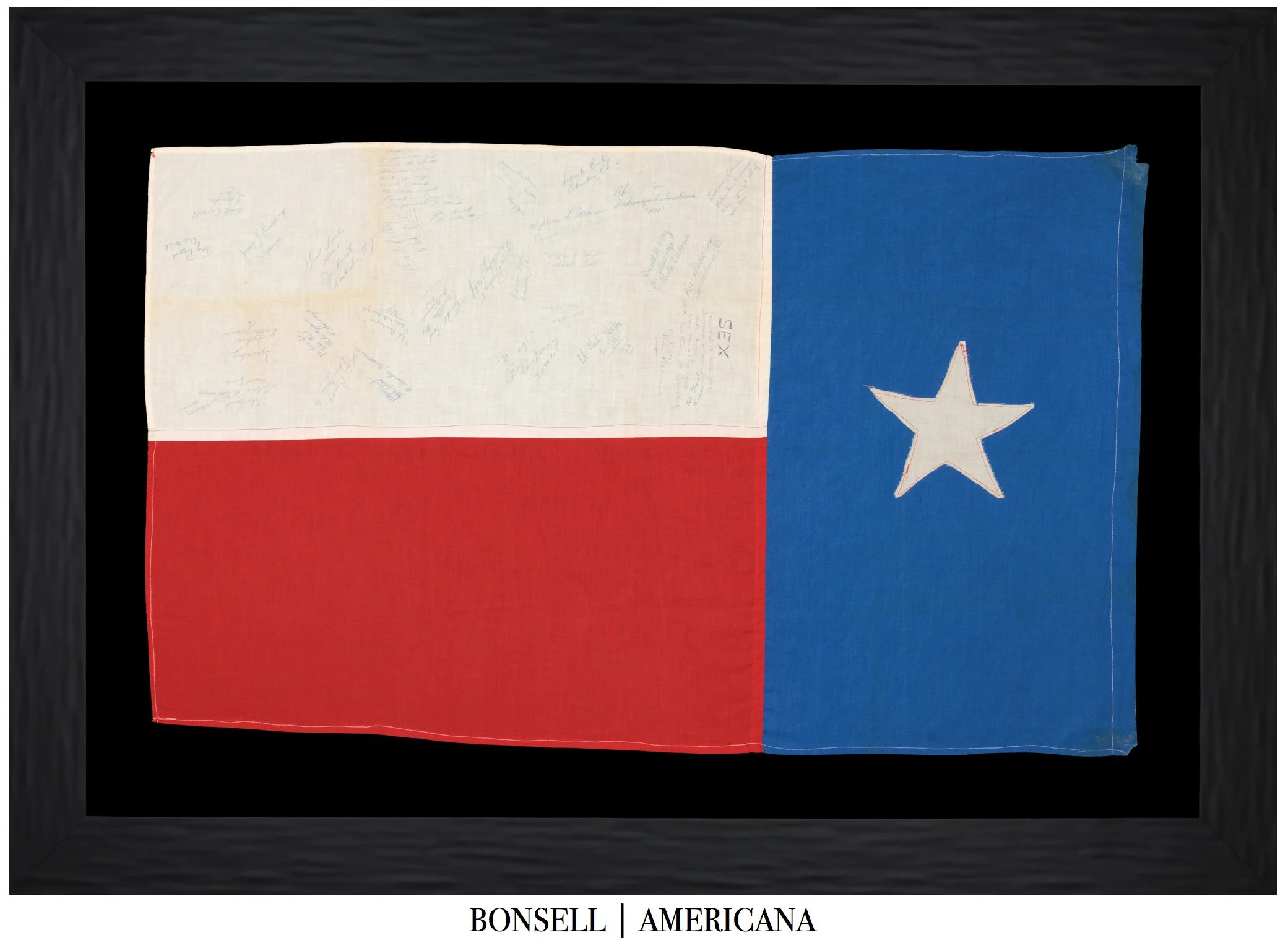
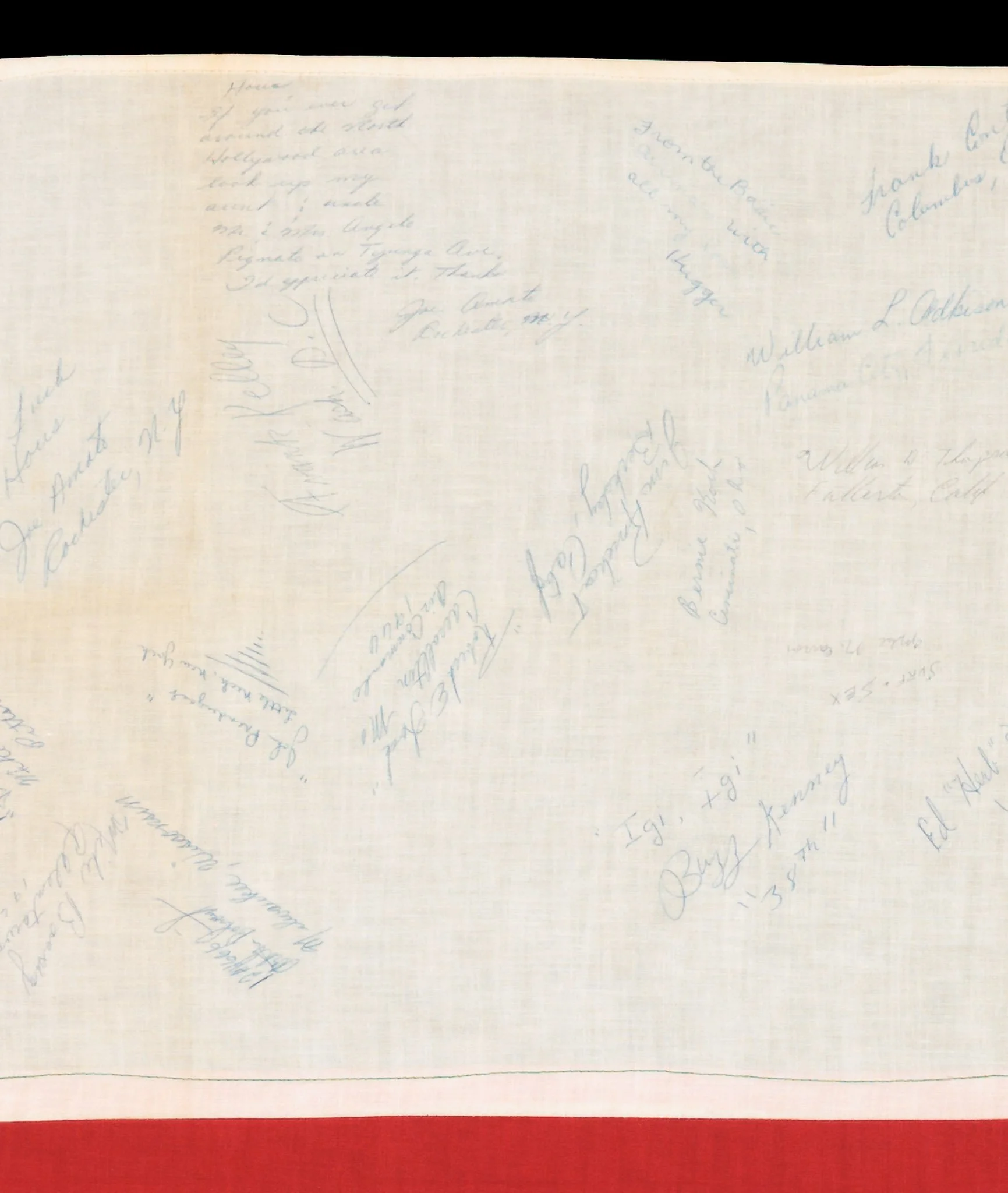
Offered is an exceptional Texas state flag, made and signed in 1966 by a group of young United States Air Force airmen at the conclusion of a shared period of military training. More than a collection of signatures, the flag is a personal Vietnam-era farewell piece, covered with names, hometowns, jokes, good wishes, and references to the places these men had come from and, in some instances, where they were headed next.
The flag is constructed entirely of cotton and is machine-sewn throughout. Its individual construction, irregular proportions, and straightforward workmanship suggest that it was made as a one-off piece rather than purchased as a commercially manufactured state flag. Given its association with Air Force personnel, it is entirely possible that it was assembled in a military setting specifically for the occasion.
Interestingly, the flag was constructed so that the signed side was clearly intended to be its primary viewing side. When displayed in this manner, the blue vertical field appears at the right rather than at the left, making the Texas flag appear reversed to the modern viewer. This is not simply the back of a conventionally made flag turned around for display; the construction indicates that this orientation was deliberate. More importantly, it is this side that the airmen chose to cover with their names and messages, and it is therefore the side on which the history of the object survives.
The most compelling aspect of the flag is the unmistakable sense of camaraderie preserved across its white field. The inscriptions appear to have been made as these men were preparing to go their separate ways following training. A date of August 12, 1966 appears among the writing, placing the flag squarely within the massive Vietnam-era expansion of the United States Air Force.
Several of the men can be independently connected with Air Force service, including Claude “Buzz” Kenney, who went on to serve for more than 21 years, and William L. Adkison, later a Staff Sergeant whose military record identifies him as a Vietnam veteran.
Another apparent signer, Michael Azzara, provides a particularly good illustration of what was happening to these young men as their time together came to an end. Azzara enlisted in the Air Force in 1966 and subsequently spent 18 months at Eielson Air Force Base in Alaska before transferring to Misawa Air Base in Japan. His path helps illustrate how quickly men who had trained together could be dispersed across the country and around the world.
One inscription identifies its writer as an “Air Commando,” a particularly evocative designation in 1966. Air Commando organizations were then deeply involved in the rapidly expanding American air war in Southeast Asia, undertaking missions that included air support, combat airlift, reconnaissance, unconventional warfare, search and rescue, and psychological operations. The presence of the term on this flag gives the piece an especially strong connection to the military environment of the Vietnam era, even though the exact subsequent assignment of the signer remains unknown.
Yet what makes the flag memorable is not the formal military history alone. It is the personality of the men.
One airman employed a joke almost guaranteed to get the attention of a barracks full of young men, writing in large letters:
SEX
and underneath
now that I have your undivided attention
Take it easy,
WALK TALL & LOOK TOUGH
AND GO EASY ON CALIFORNIA.
The reference to California is directed at the recipient of the flag and suggests that he was preparing to leave Texas for an assignment there. Elsewhere, another friend offered a practical California connection, writing that if he ever got around the North Hollywood area he should look up the writer’s aunt.
These messages make clear that this was not just an object passed around for anonymous signatures. These were friends saying goodbye.
Their hometown inscriptions also create a snapshot of America in the mid-1960s. One man proudly identifies “Indianapolis, Indiana” and adds “500,” an obvious reference to the Indianapolis 500. Another writes:
Milwaukee, Wisconsin
where you get all of
your beer
Russell M. Wong identifies himself with El Cerrito, California, along with the playful notation “ex-yellow rope,” apparently referencing a student leadership position during Air Force training. Other men came from communities scattered across the country. Taken together, the inscriptions read almost like a miniature map of the United States: young men from different regions, backgrounds, and hometowns brought together by military service, becoming friends for a short but formative period before being sent in different directions.
That quality is poignant in the context of 1966. Some would remain in the United States. Others would be sent to Alaska, Japan, Europe, the Pacific, or Southeast Asia. At least one identifiable signer later served in Vietnam. Others made the Air Force a career. At the moment this flag was signed, however, those futures were still ahead of them. What survives here is the point immediately before the group broke apart—the jokes, nicknames, hometown pride, and genuine affection between young men who knew that their time together was ending.
The choice of a Texas flag as their canvas was fitting. The familiar Lone Star design originated as the national flag of the independent Republic of Texas. It was adopted in January 1839 during the presidency of Mirabeau B. Lamar and later continued as the state flag after Texas joined the United States. The basic design has endured essentially unchanged: a vertical blue field bearing a single white star, accompanied by horizontal white and red fields.
Under Texas law today, the colors carry specific meanings: red for bravery, white for purity, and blue for loyalty. Those meanings seem particularly appropriate here. The Lone Star itself had represented Texas since the Republic era and had already been formally adopted as the Republic’s emblem before the familiar 1839 flag was created.
In this example, however, the Texas flag became something more personal. It became a yearbook, farewell card, inside joke, and record of friendship all at once.
The result is an evocative piece of Vietnam-era Americana. Rather than commemorate a battle or formal military ceremony, it preserves something more intimate: the friendships formed among a group of young Air Force airmen during training, and the moment when those friends prepared to leave one another and begin the next chapter of their military service. Their inscriptions—California, Hollywood, Milwaukee beer, the Indy 500, Air Commandos, nicknames, jokes, and good wishes—give the flag a warmth and immediacy rarely encountered in military textiles.
It is ultimately a Texas flag that tells a much larger American story.
Conservation Process: This flag was hand sewn to cotton fabric, and both were hand sewn to a mounting board. To prevent the black dye in the cotton fabric from seeping into the flag, it was first washed in a standard wash and then in a dye setting wash. The flag is positioned behind Optium Museum Acrylic.
Frame: The flag is housed in a substantial, wide-profile frame with a matte charcoal finish and subtle linear graining across the face.
Condition Report: The flag is in very good overall condition, with strong, vibrant color throughout and only light age-related wear. There is minor fraying and irregularity along portions of the outer edges, along with some loose threads around the appliquéd star and scattered light surface marks or staining. The inscriptions remain well preserved and largely legible.
Collectability Level: The Great – Perfect for Rising Collectors
Date of Origin: 1966