
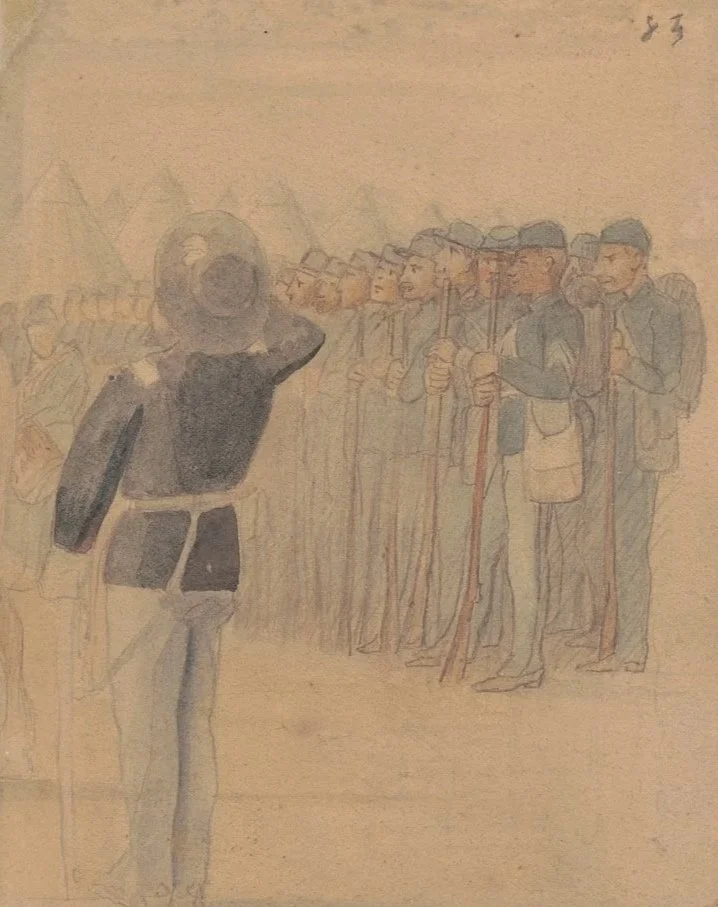
Union soldiers of the 32nd Indiana Infantry stand in formation during the Civil War, their rifles held at rest as they face an officer giving commands. Created between 1861 and 1865, the drawing reflects the discipline and structure that defined volunteer regiments drawn from communities across the North. Many of these men were recent immigrants or first-generation Americans, serving in units that often shared language and cultural ties. Their orderly ranks and simple equipment illustrate the realities of citizen-soldiers preparing for prolonged conflict, as the Union relied on such regiments to sustain its military campaigns and preserve the nation.
Sherman's March Through South Carolina - Burning of McPhersonville, February 1, 1865
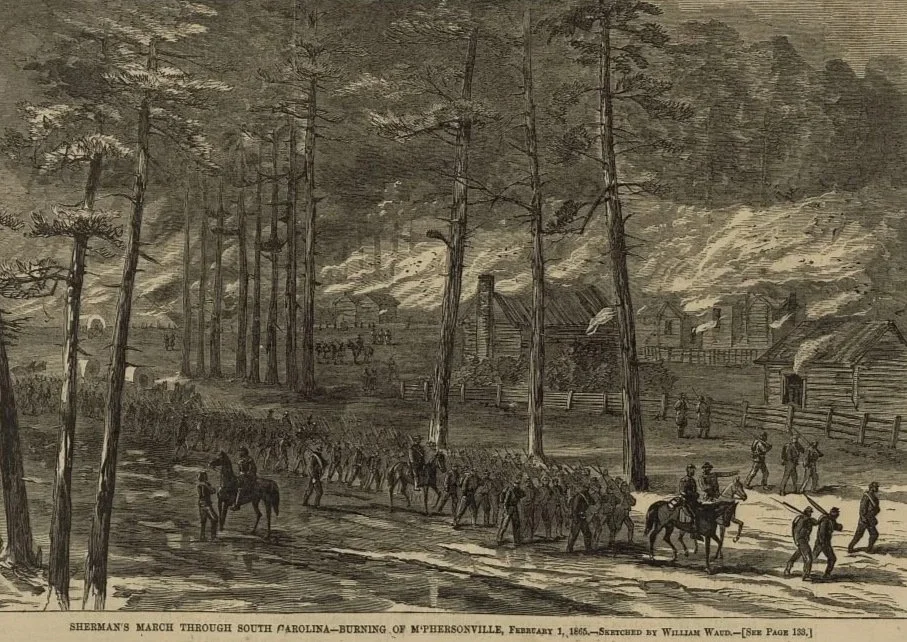
William Tecumseh Sherman’s campaign through South Carolina in February 1865 is captured in this depiction of Union troops moving through McPhersonville as buildings burn in the background. The march formed part of a broader strategy to break the Confederacy’s capacity to wage war by targeting infrastructure and supply lines. Columns of soldiers and mounted officers advance steadily while smoke rises over the town, illustrating the hard war tactics that hastened the Confederacy’s collapse in the final months of the Civil War.
Allegory of America as the Youngest Nation
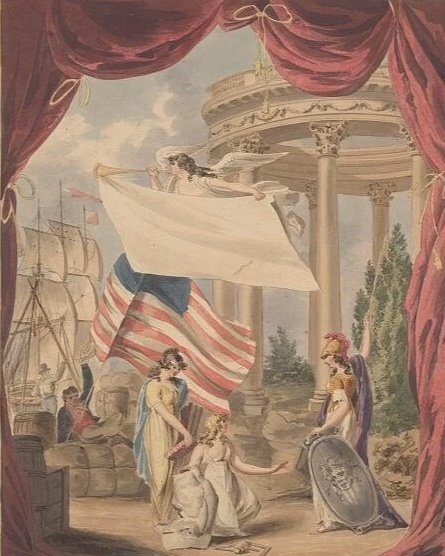
Drawing by John Rubens Smith presents the United States as a young nation finding its place in the world. America is shown as a child, guided forward while Britannia points toward a temple symbolizing liberty and constitutional government. Figures representing agriculture and commerce stand nearby, underscoring the economic base of the new republic.
The Constitution of the United States "the signing"
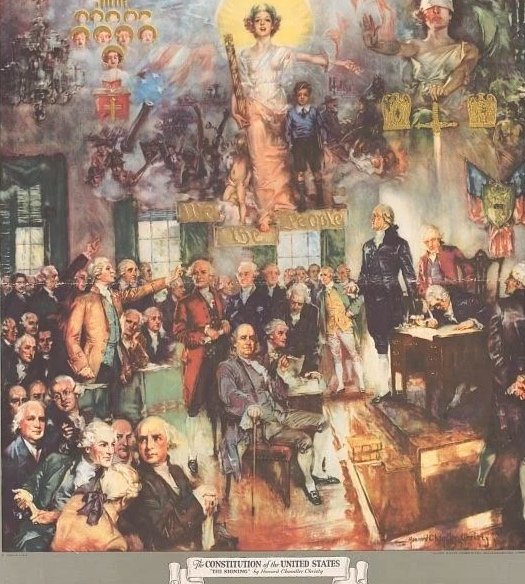
Late-19th-century interpretation of the signing of the U.S. Constitution in 1787, when delegates gathered in Philadelphia to shape the framework of the new nation. Figures associated with the Constitutional Convention, including George Washington, who presided over the meeting, and Benjamin Franklin, are shown alongside symbolic images representing liberty, law, and the American people.
Abraham Lincoln's Last Reception
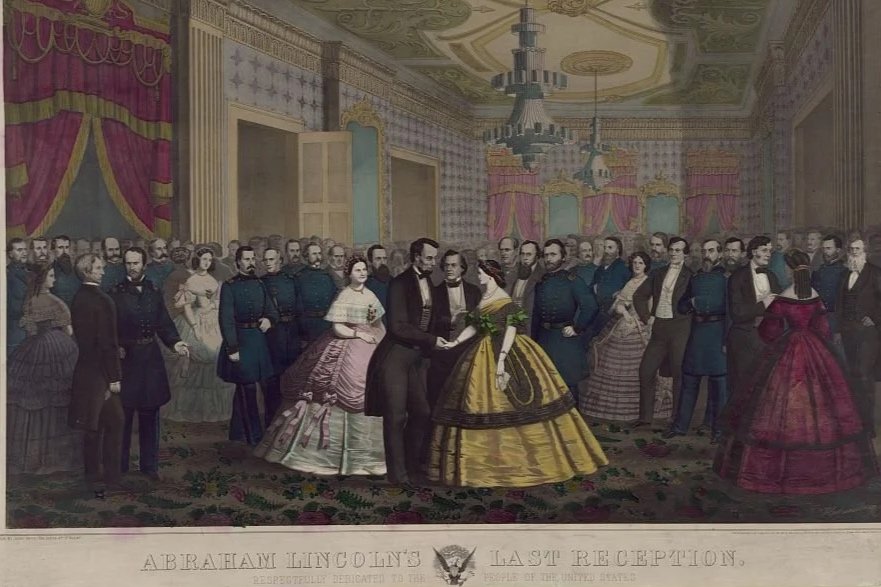
One of the last public moments of Abraham Lincoln at the White House in 1865, shortly before his assassination. Lincoln and Mary Todd Lincoln are shown greeting Union generals, cabinet members, and guests during a formal reception near the end of the Civil War. The room is crowded but orderly, reflecting the traditions and social rituals of the time, even as the nation was exhausted by four years of fighting. Seen today, the image feels like a pause before history turned, showing Lincoln in a rare moment of calm as the war ended and the country stood on the edge of loss and change.
Evacuation of New York by the British
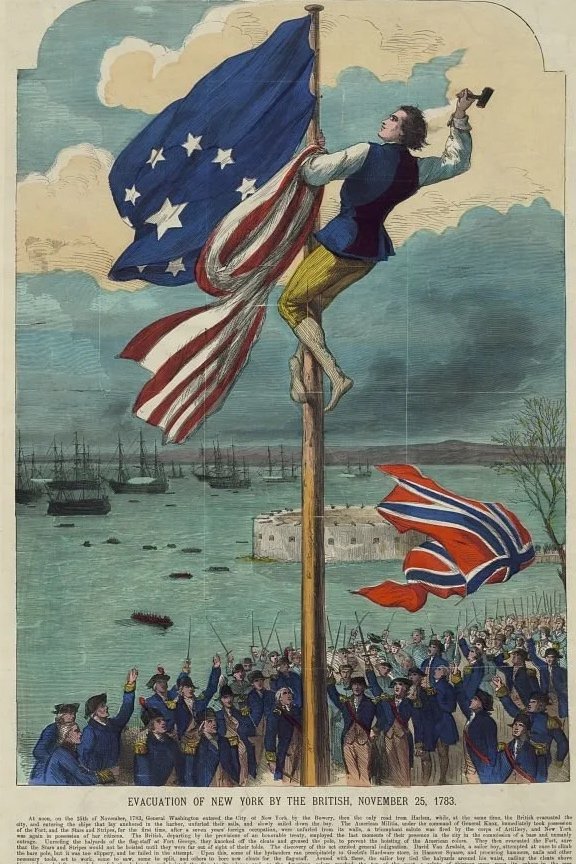
New York City passed fully into American hands at the end of the Revolutionary War. On November 25, 1783, British forces evacuated the city, their ships pulling away from the harbor as the Union Jack was taken down and the American flag raised in its place. The act was both practical and symbolic, marking the end of eight years of war and occupation. For New Yorkers, Evacuation Day became a lasting reminder that independence was finally secured, not just declared.
Proud of Her Boys
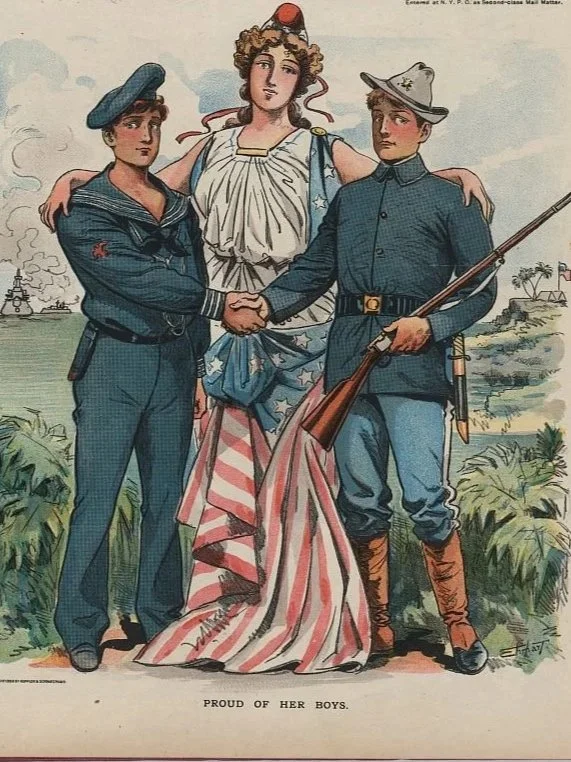
Created in 1898 during the Spanish-American War. Columbia, a common symbol of the nation, stands between a sailor and a soldier, representing the Navy and Army acting together as the country expanded its reach beyond the continent. Their firm handshake and straightforward posture emphasize unity and duty rather than heroics. Prints like this were widely circulated to reinforce public support for the war and to frame American military service as a shared national responsibility.
The Flag that has Waved One Hundred Years
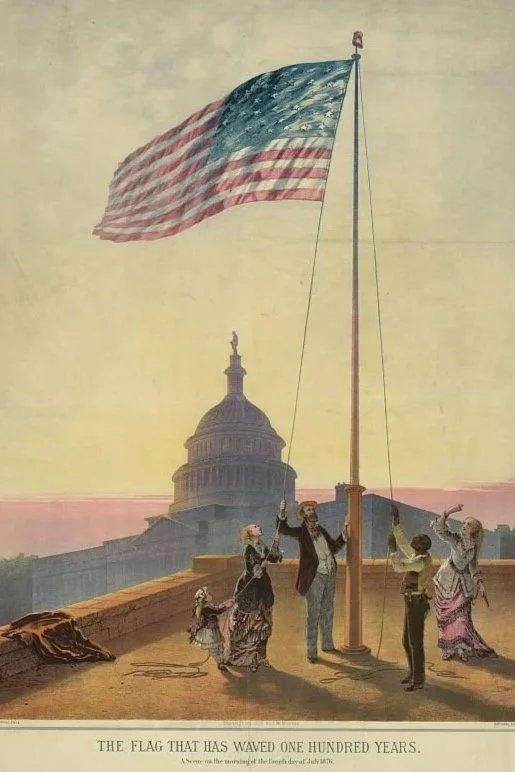
1876 image shows Americans marking the nation’s 100th birthday with a Fourth of July flag raising near the U.S. Capitol. Coming just a decade after the Civil War, reflecting a country still healing but determined to emphasize unity and shared history. The presence of families and children points to how patriotism was taught and passed down, not just celebrated. At a time when the United States was expanding and modernizing, the flag stood as a reminder of the Revolutionary era and the ideals the country claimed to carry forward.