
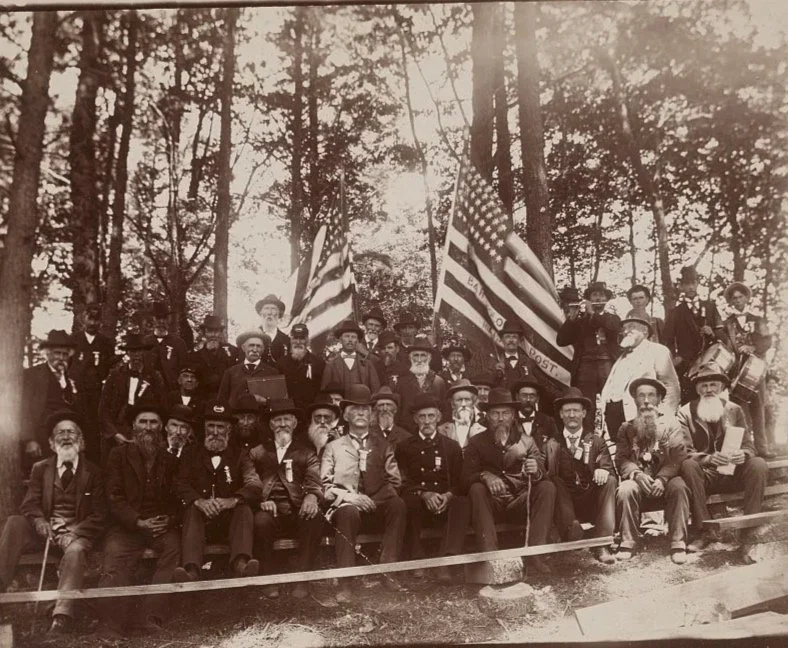
Taken sometime between 1896 and 1918, this is a group portrait of Union veterans belonging to Bartholomew GAR Post #136 out of Nunica, Michigan, a small Ottawa County farming community. The men, most with the white beards of old age, pose outdoors beneath tall trees with American flags and what appears to be a post banner behind them. Seated second from right in the front row is Henry E. Plant, who received the Medal of Honor in 1896 for his actions during the Civil War. The Grand Army of the Republic organized thousands of local posts like this one across the country, and Post #136 remained active until 1918, when its dwindling membership finally made continuation impossible.
Unidentified Civil War Veterans in Grand Army of the Republic Uniforms with Unidentified Members of Daughters of Union Veterans of Denver and Greeley, Colorado
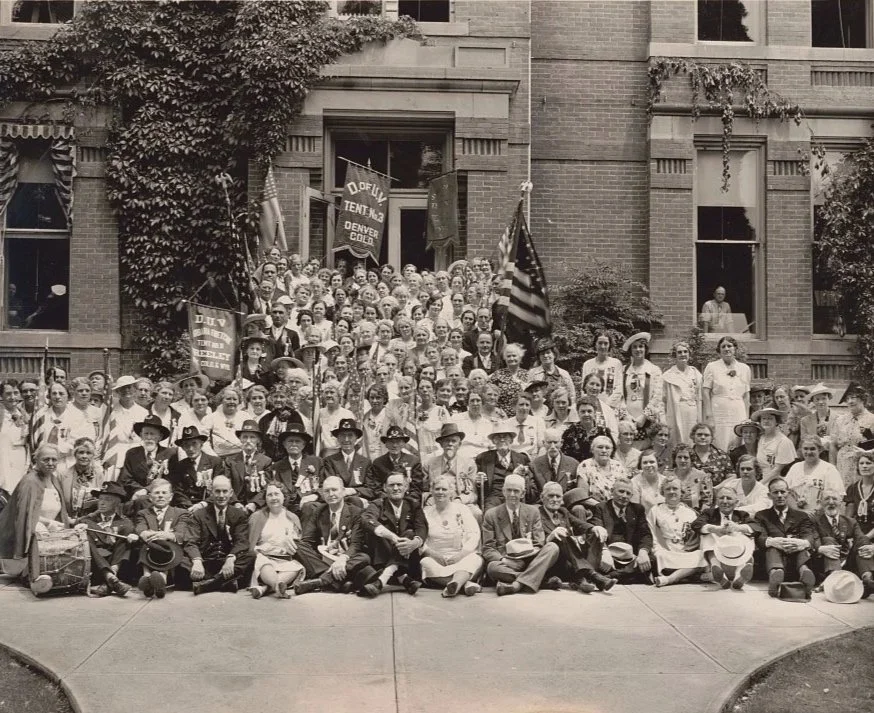
A 1938 group portrait of Civil War veterans in Grand Army of the Republic uniforms alongside members of the Daughters of Union Veterans from Denver and Greeley, Colorado, photographed by Mark D. Miller of Fort Collins. The banners visible in the crowd identify D.U.V. Tent No. 2 from Denver and a delegation from Greeley. By 1938, the surviving Union veterans were well into their nineties, and gatherings like this were becoming increasingly rare. The Grand Army of the Republic, founded in 1866, had once been one of the most powerful veterans organizations in the country, with over 400,000 members at its peak in 1890.
Civil War Camp of the 6th N.Y. Artillery at Brandy Station, Virginia,
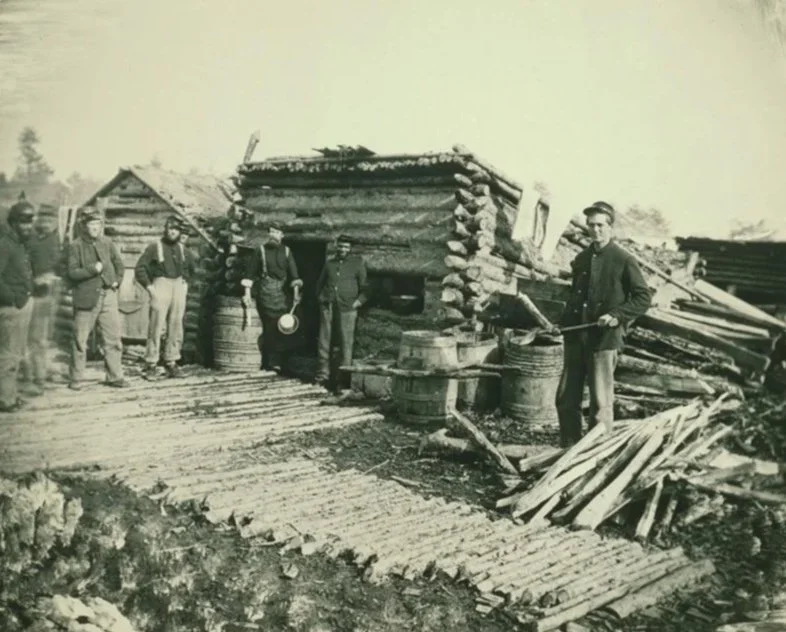
April 1864, Brandy Station, Virginia. Union soldiers of the 6th New York Artillery stand outside their log company kitchen at winter camp. The structure is typical of Civil War winter quarters, built from whatever timber was available, with wooden barrel staves and split logs corduroying the muddy ground. Brandy Station was a major Union staging area during the winter of 1863 to 1864, housing much of the Army of the Potomac as it prepared for Ulysses S. Grant's spring Overland Campaign, which would begin just weeks after this photograph was taken.
Battle Scarred Old Flag
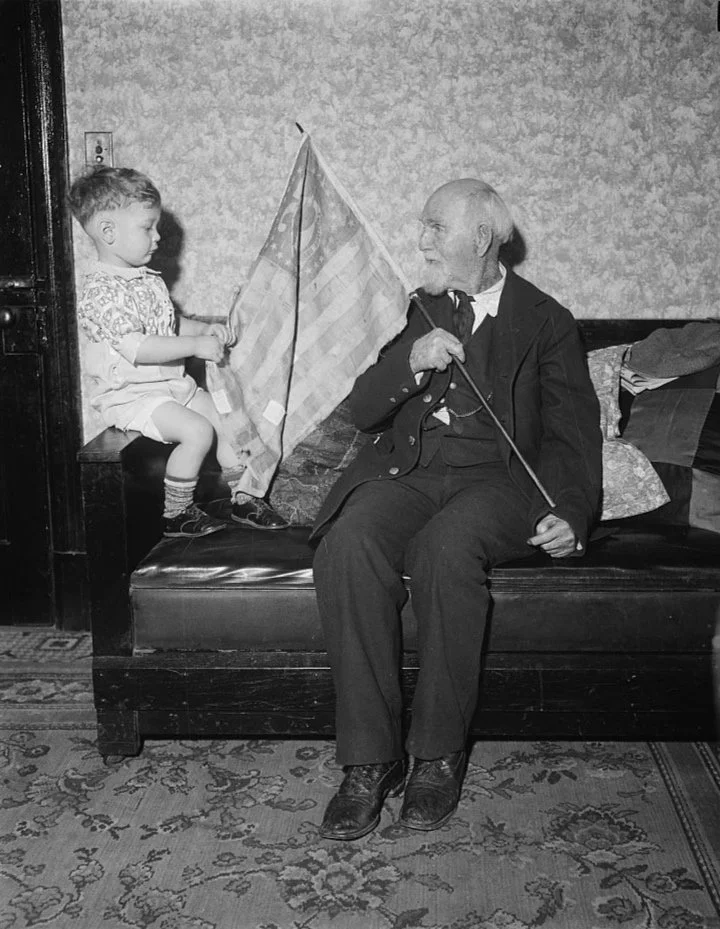
January 1931. Union Army veteran Orlando Learned sits with his great-grandson Edward Hudgins, age 2, showing the boy a 36-starred flag he carried into battle during the Civil War. Learned had obtained the flag during celebrations marking the fall of Vicksburg in 1863 and kept it for nearly seven decades. A battle wound had kept him from marching in the Union Army's triumphal entry into Washington at the war's end, and his January 1931 visit to the capital was long overdue. The 36-star flag was the official U.S. flag from 1865 to 1867, reflecting Nevada's admission to the Union in 1864.
Civil War Veteran Adjutant Edwin Francis Wyer of Cos. I, E and G, 5th Massachusetts Infantry Regiment with World War I veteran Terry McCloskey of 101st Infantry, 26th Division in Uniform
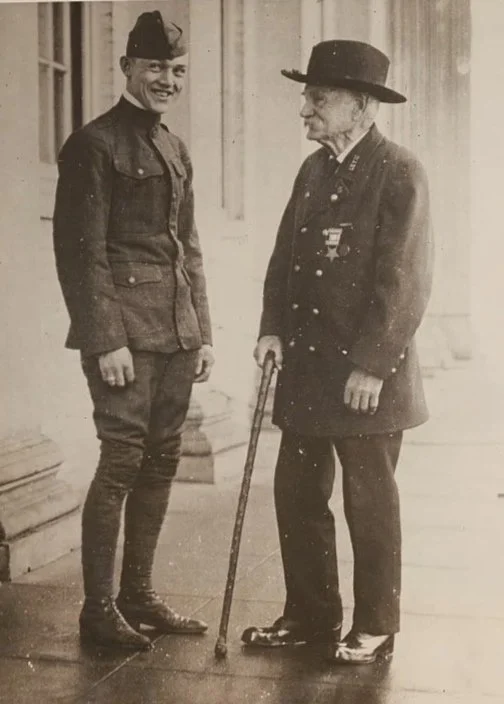
In March 1922, a Civil War veteran and a World War I soldier stand together outside the Massachusetts State House in Boston, representing two generations of American military service. Edwin Francis Wyer, who served in the Union Army, appears alongside Terry McCloskey of the 101st Infantry, 26th Division, highlighting the passage of time between the nation’s major conflicts. Public interest in such meetings reflected a continued respect for veterans and a desire to connect past and present service.
Camp of 110th Pennsylvania Inf'y Near Falmouth, Va., Dec. 1862
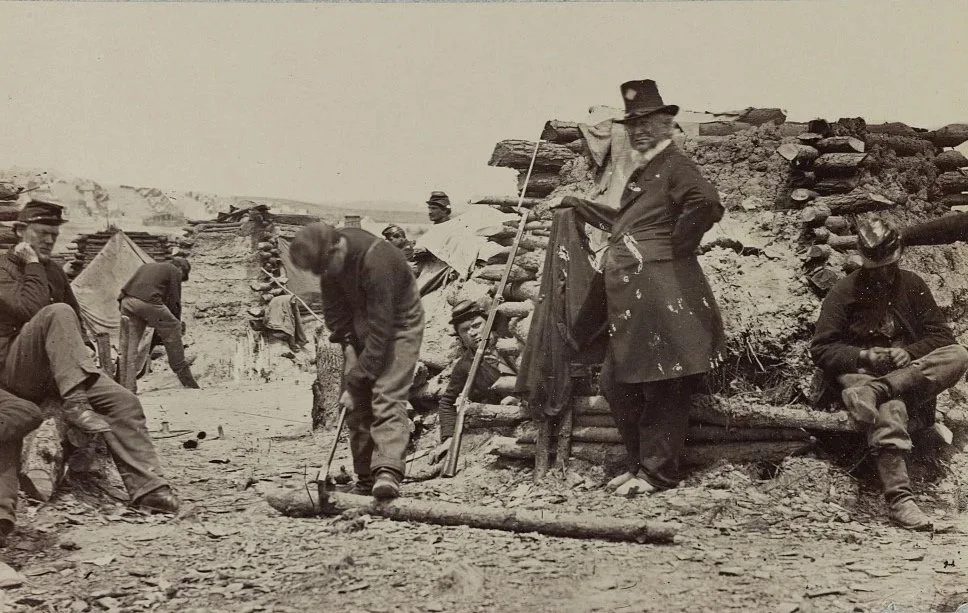
In December 1862, soldiers of the 110th Pennsylvania Infantry camped near Falmouth, Virginia, just across the Rappahannock River from Fredericksburg during a critical phase of the Civil War. Men gather around rough log shelters and tents, tending to everyday tasks and equipment while waiting for orders. Conditions in camps like this were often harsh, with cold weather, limited supplies, and constant uncertainty.
Three Unidentified Soldiers in Union Uniforms
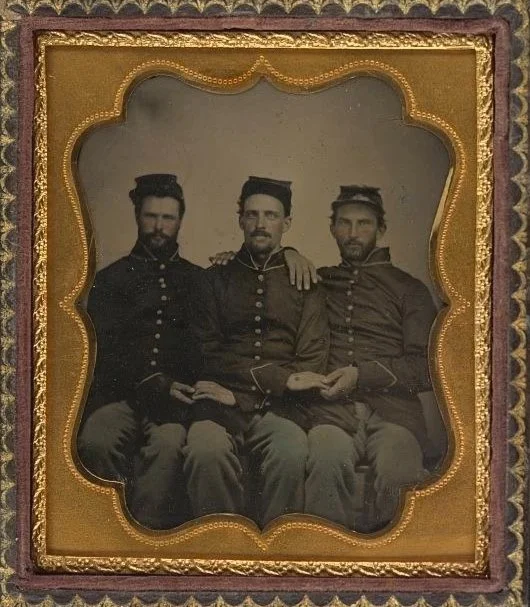
Three Union soldiers sit closely together in their uniforms during the Civil War, their caps and buttoned coats marking them as members of the Federal army between 1861 and 1865. Their steady expressions and informal pose suggest a moment taken away from the demands of camp or campaign, when soldiers often visited photographers to create keepsakes for family and friends. Images like this served as personal records in a time of uncertainty, when many who enlisted did not return home.
Drummer Jesse W. Mills of Co. G, 51st New York Infantry Regiment in Zouave Uniform with Drum
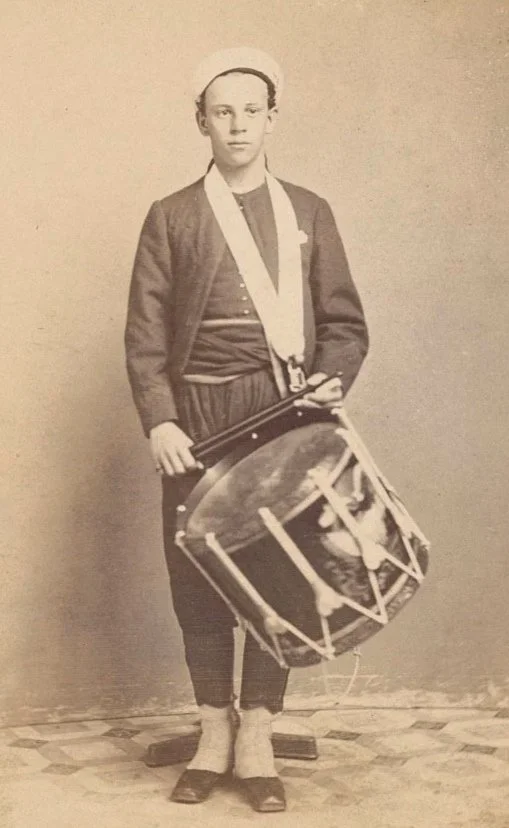
A young drummer of the 51st New York Infantry stands in full uniform during the Civil War, his drum suspended by a shoulder strap and held ready at his side. Musicians like him played a critical role in Union armies, using drumbeats to relay orders across the chaos of battle and to regulate the daily routines of camp life. The distinctive zouave-style uniform reflects a popular mid-19th century military fashion inspired by French units, adopted by several American regiments for its striking appearance.
Flag of 37th Pennsylvania Infantry
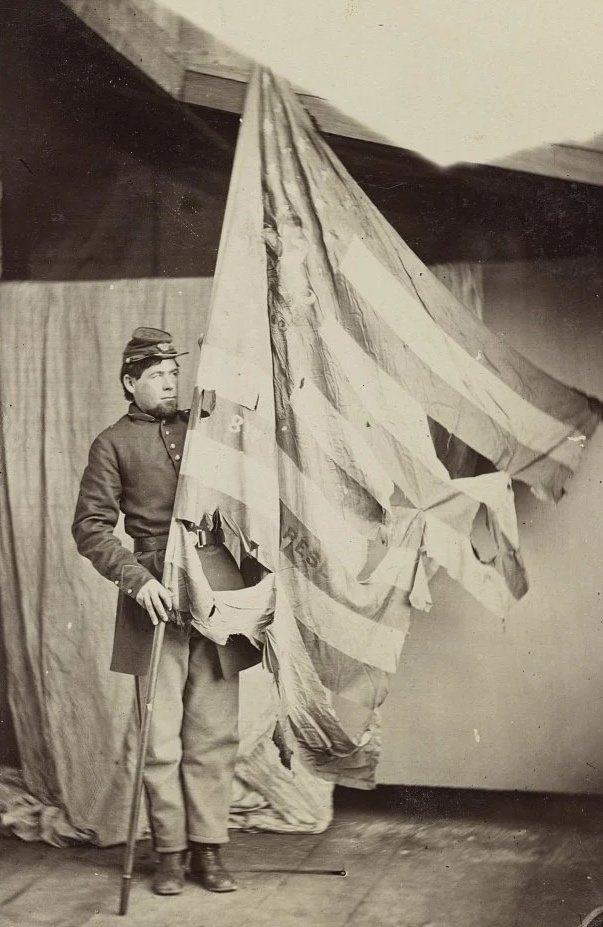
A Union soldier stands with the battle-worn flag of the 37th Pennsylvania Infantry, its torn fabric bearing the marks of heavy service during the Civil War. Regimental colors served as both a rallying point in combat and a symbol of unit identity, often carried into the most dangerous positions on the field. The damaged banner reflects the intensity of the fighting and the sacrifices made by volunteer soldiers, while preserving the legacy of a unit that endured some of the war’s hardest campaigns.
Sherman's March Through South Carolina - Burning of McPhersonville, February 1, 1865
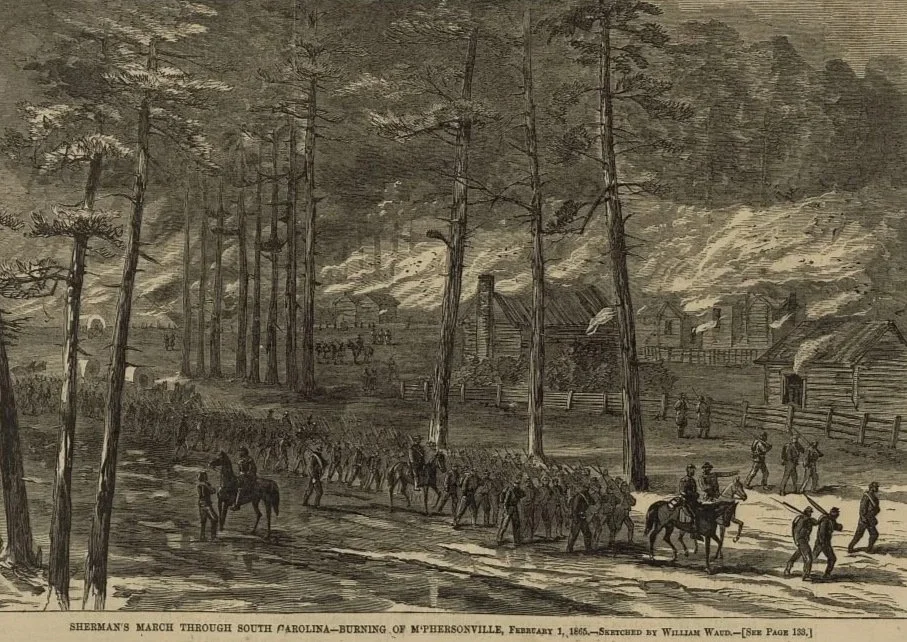
William Tecumseh Sherman’s campaign through South Carolina in February 1865 is captured in this depiction of Union troops moving through McPhersonville as buildings burn in the background. The march formed part of a broader strategy to break the Confederacy’s capacity to wage war by targeting infrastructure and supply lines. Columns of soldiers and mounted officers advance steadily while smoke rises over the town, illustrating the hard war tactics that hastened the Confederacy’s collapse in the final months of the Civil War.
General French, Taken in Camp on the Chickahominy, 29th of May, 1862
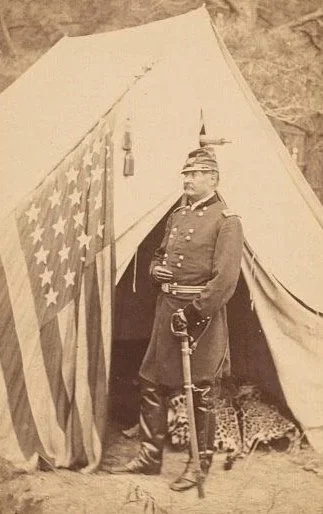
William Henry French, an officer in the U.S. Army’s 2nd Mounted Artillery, stands outside his field tent along the Chickahominy River in May 1862 during the American Civil War. A U.S. flag hangs at the entrance while the general appears in full uniform with sword at his side. Images like this were often produced by studios connected to Mathew B. Brady, whose photographers documented Union officers and soldiers during the war, creating some of the most enduring visual records of the conflict.
Soldiers of the 79th New York at Camp
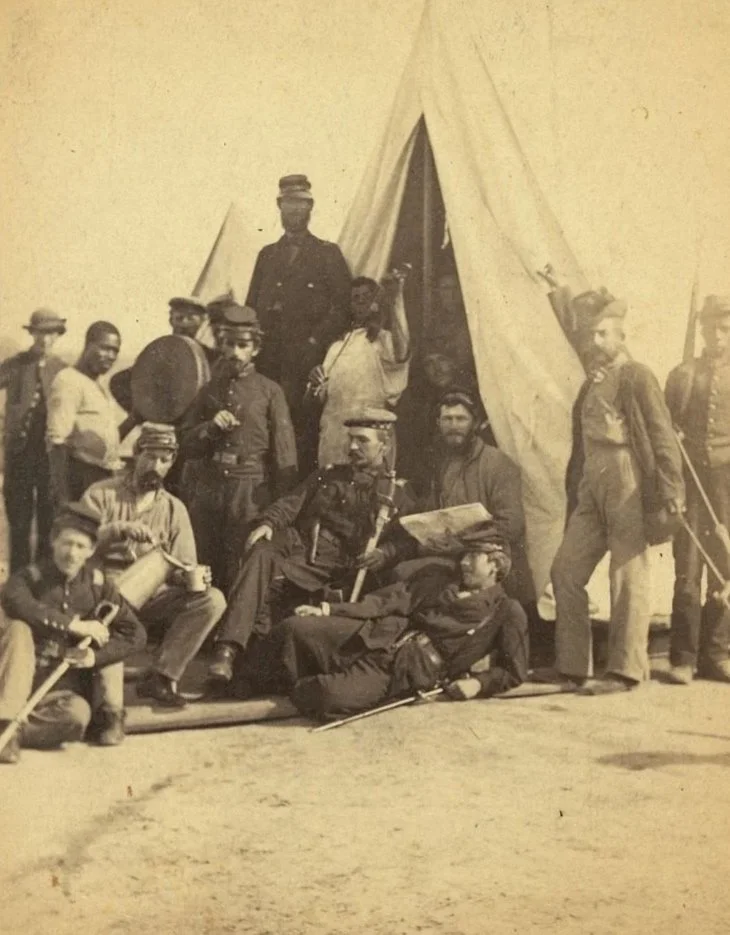
Soldiers of the 79th New York Infantry Regiment gather outside a canvas tent during the American Civil War. The regiment, often known as the “Highlanders,” was organized in New York City and took part in several major campaigns of the Union Army. Images like this offer a look at everyday life in a Union army camp, where soldiers spent long stretches of time resting, organizing supplies, and preparing for the next march or engagement.