
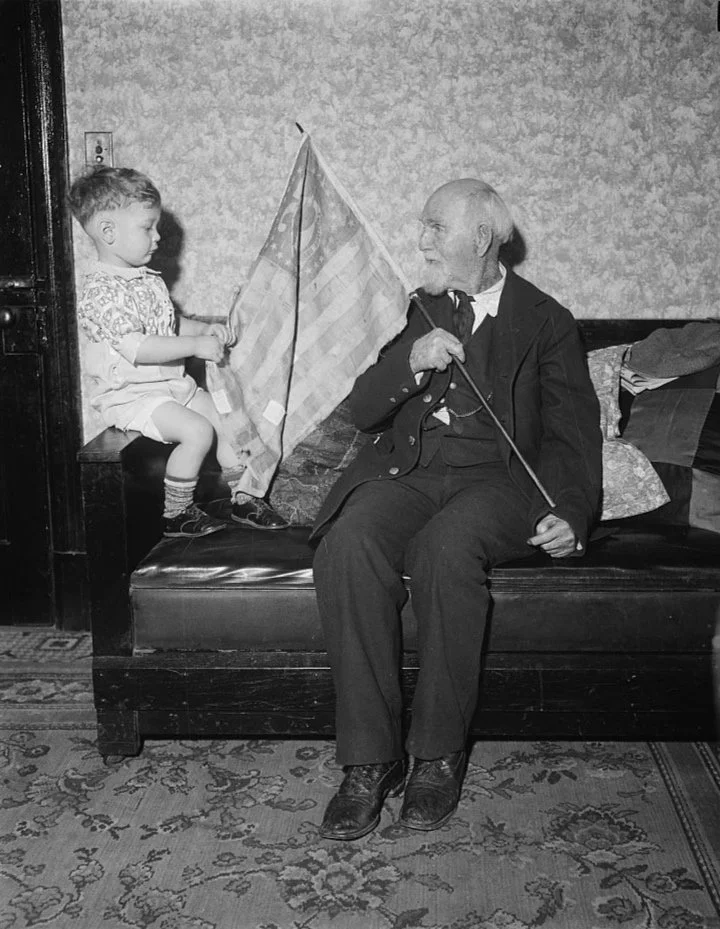
January 1931. Union Army veteran Orlando Learned sits with his great-grandson Edward Hudgins, age 2, showing the boy a 36-starred flag he carried into battle during the Civil War. Learned had obtained the flag during celebrations marking the fall of Vicksburg in 1863 and kept it for nearly seven decades. A battle wound had kept him from marching in the Union Army's triumphal entry into Washington at the war's end, and his January 1931 visit to the capital was long overdue. The 36-star flag was the official U.S. flag from 1865 to 1867, reflecting Nevada's admission to the Union in 1864.
Civil War Veteran Adjutant Edwin Francis Wyer of Cos. I, E and G, 5th Massachusetts Infantry Regiment with World War I veteran Terry McCloskey of 101st Infantry, 26th Division in Uniform
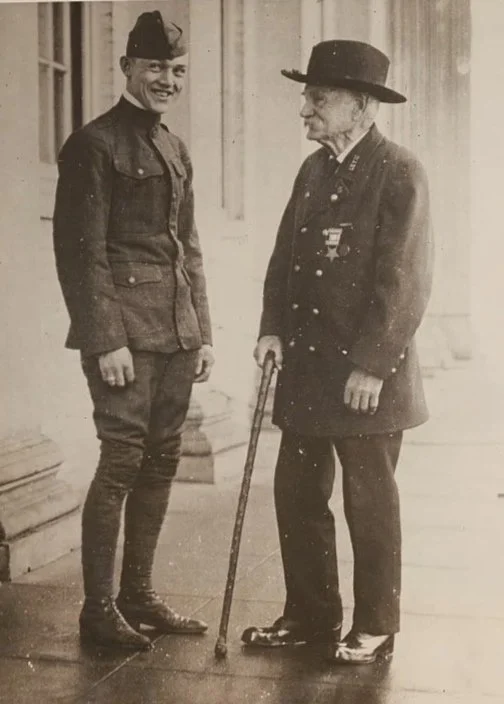
In March 1922, a Civil War veteran and a World War I soldier stand together outside the Massachusetts State House in Boston, representing two generations of American military service. Edwin Francis Wyer, who served in the Union Army, appears alongside Terry McCloskey of the 101st Infantry, 26th Division, highlighting the passage of time between the nation’s major conflicts. Public interest in such meetings reflected a continued respect for veterans and a desire to connect past and present service.
Drummer Philo H. Ravlin of Co. I, 47th Illinois Infantry Regiment in Uniform with Drum
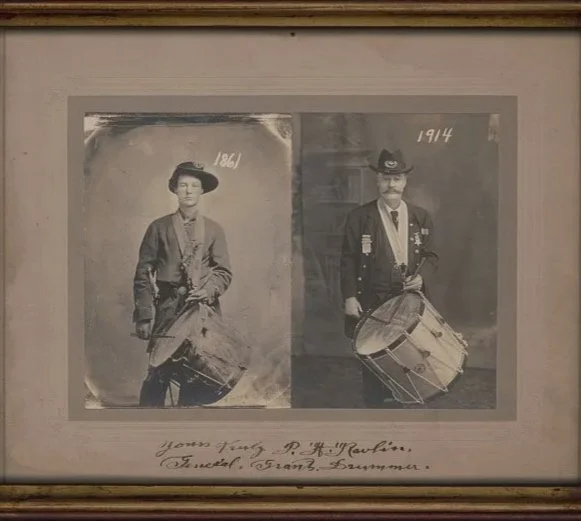
Two images of Philo H. Ravlin, a drummer with the 47th Illinois Infantry, taken more than fifty years apart. The first, from 1861, shows him as a young Civil War soldier, standing with his drum at the start of the conflict. The second, dated 1914, shows Ravlin again with the same instrument, now an older man and a veteran. Seen together, the photos trace one life across war and peace, and reflect how Civil War service remained a defining part of identity long after the guns fell silent.