
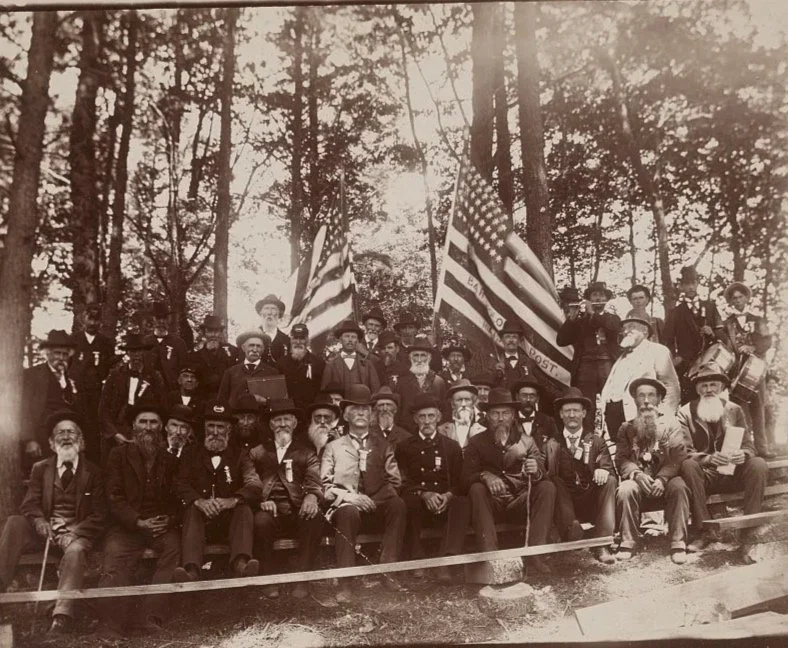
Taken sometime between 1896 and 1918, this is a group portrait of Union veterans belonging to Bartholomew GAR Post #136 out of Nunica, Michigan, a small Ottawa County farming community. The men, most with the white beards of old age, pose outdoors beneath tall trees with American flags and what appears to be a post banner behind them. Seated second from right in the front row is Henry E. Plant, who received the Medal of Honor in 1896 for his actions during the Civil War. The Grand Army of the Republic organized thousands of local posts like this one across the country, and Post #136 remained active until 1918, when its dwindling membership finally made continuation impossible.
Unidentified Civil War Veterans in Grand Army of the Republic Uniforms with Unidentified Members of Daughters of Union Veterans of Denver and Greeley, Colorado
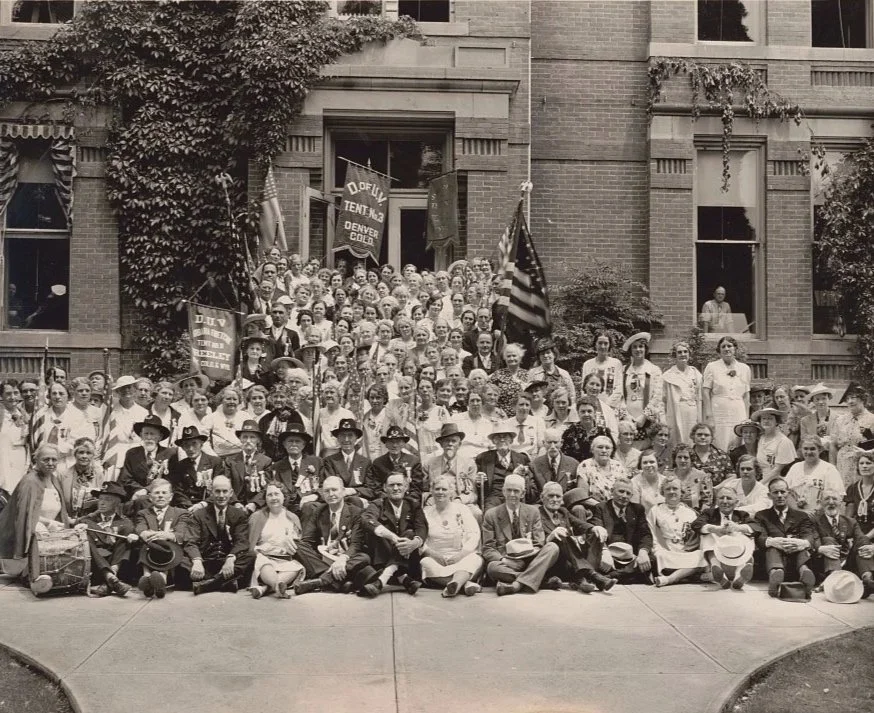
A 1938 group portrait of Civil War veterans in Grand Army of the Republic uniforms alongside members of the Daughters of Union Veterans from Denver and Greeley, Colorado, photographed by Mark D. Miller of Fort Collins. The banners visible in the crowd identify D.U.V. Tent No. 2 from Denver and a delegation from Greeley. By 1938, the surviving Union veterans were well into their nineties, and gatherings like this were becoming increasingly rare. The Grand Army of the Republic, founded in 1866, had once been one of the most powerful veterans organizations in the country, with over 400,000 members at its peak in 1890.
Civil War Camp of the 6th N.Y. Artillery at Brandy Station, Virginia,
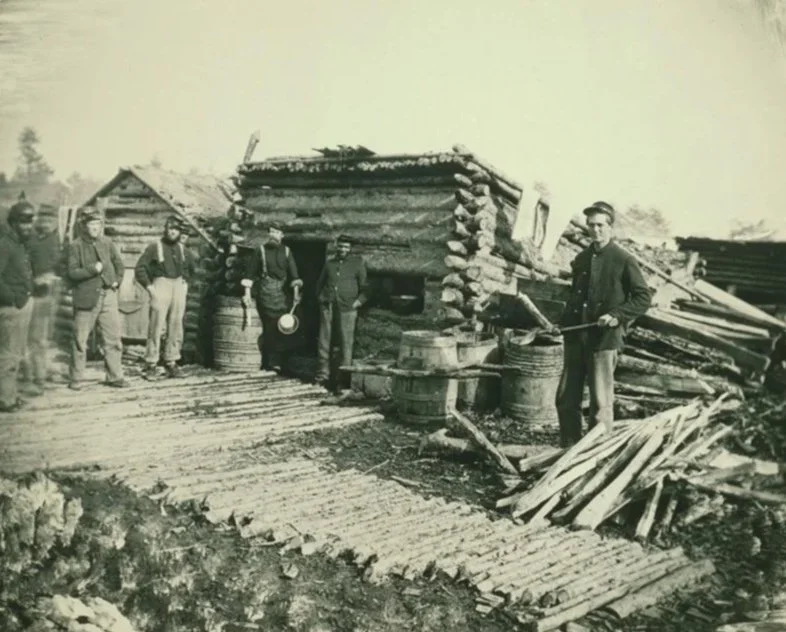
April 1864, Brandy Station, Virginia. Union soldiers of the 6th New York Artillery stand outside their log company kitchen at winter camp. The structure is typical of Civil War winter quarters, built from whatever timber was available, with wooden barrel staves and split logs corduroying the muddy ground. Brandy Station was a major Union staging area during the winter of 1863 to 1864, housing much of the Army of the Potomac as it prepared for Ulysses S. Grant's spring Overland Campaign, which would begin just weeks after this photograph was taken.
New York Gives Rousing Send Off to Her Sons Leaving for War
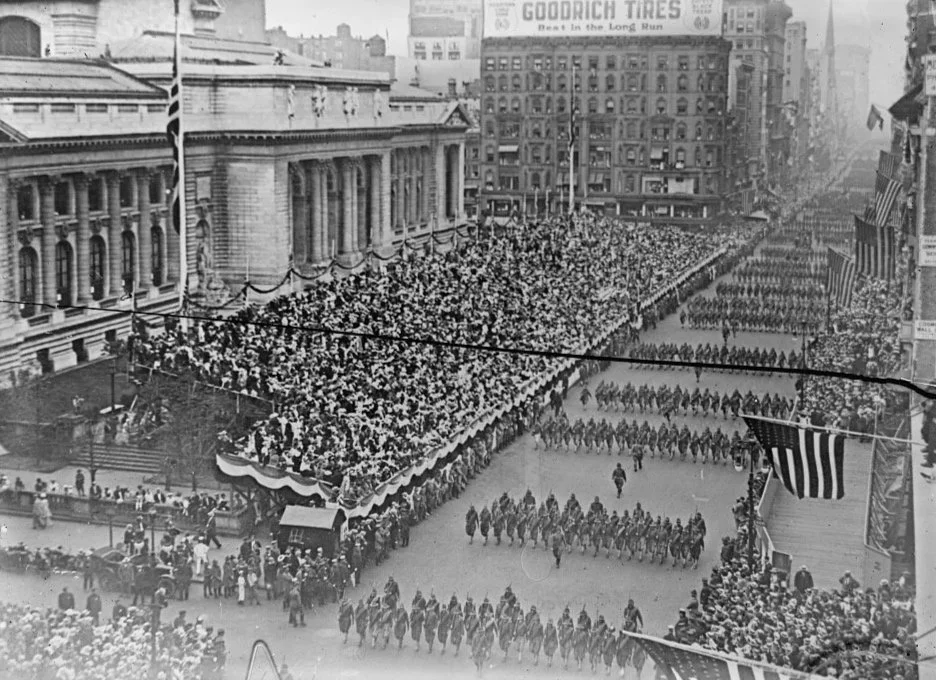
August 30, 1917. Columns of New York National Guard soldiers march down Fifth Avenue past the New York Public Library as thousands of civilians pack the sidewalks and viewing stands to see them off. The United States had entered World War I just four months earlier, in April 1917, and the country was still mobilizing. The National Guard was among the first waves of organized troops to deploy, with New York's guardsmen forming the backbone of what would become the 27th Infantry Division.
New York, New York. Flag Raising Ceremony at the Four Freedoms War Bond Show, on the Plaza of the International Building at Rockefeller Center
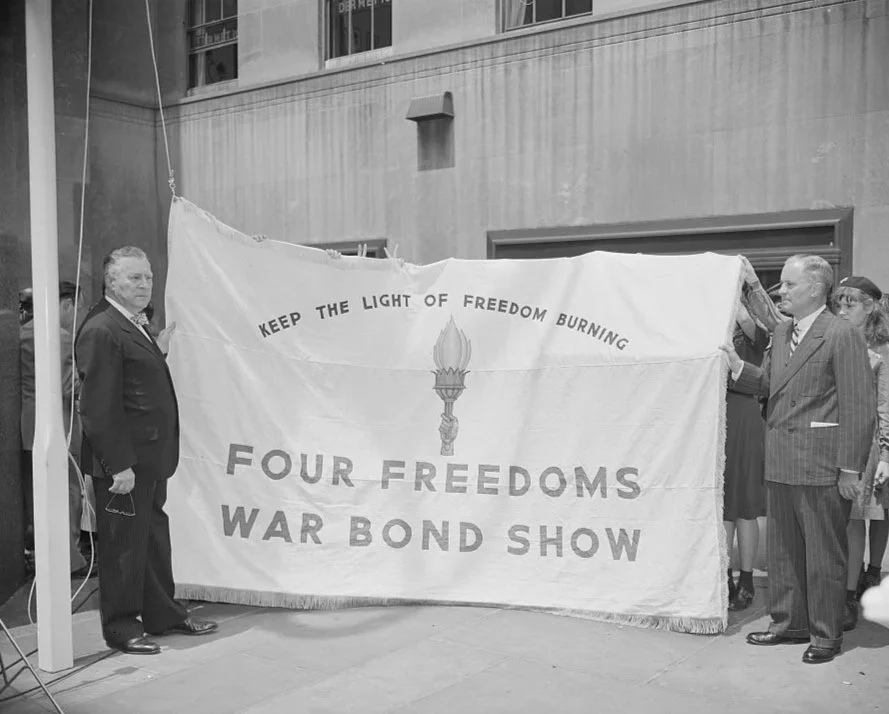
June 1943, Rockefeller Center, New York City. Two men hold a banner reading "Keep the Light of Freedom Burning: Four Freedoms War Bond Show" at a flag raising ceremony on the plaza of the International Building. The Four Freedoms referenced the goals President Franklin Roosevelt laid out in his January 1941 State of the Union address: freedom of speech, freedom of worship, freedom from want, and freedom from fear. Those four principles became central to Allied wartime messaging, most famously through Norman Rockwell's series of paintings published in the Saturday Evening Post in early 1943.
Troops of the 20th Armored Division and Units of the 9th Army Whoop it up Between Raindrops as the SS John Ericsson Nears Pier 84, North River
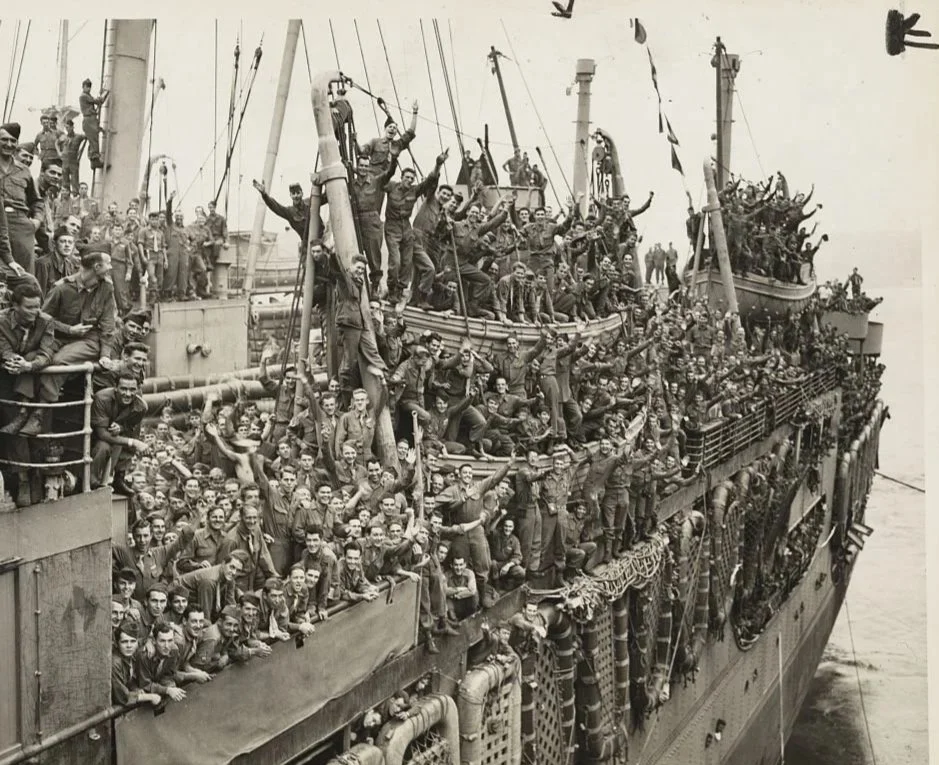
August 6, 1945. Troops of the 20th Armored Division and units of the 9th Army pack every inch of the SS John Ericsson as it pulls into Pier 84 on the North River in New York City. The men are cheering, waving, and climbing the rigging as the ship approaches the dock. The date is notable: August 6, 1945 was the same day the United States dropped the atomic bomb on Hiroshima, a moment that would bring the Pacific war to a close within days. These soldiers were part of the massive postwar repatriation effort known as Operation Magic Carpet, which ultimately returned more than eight million American servicemen and women home from Europe and the Pacific.
Ceremonies at Laying Corner Stone D.A.R. Hall
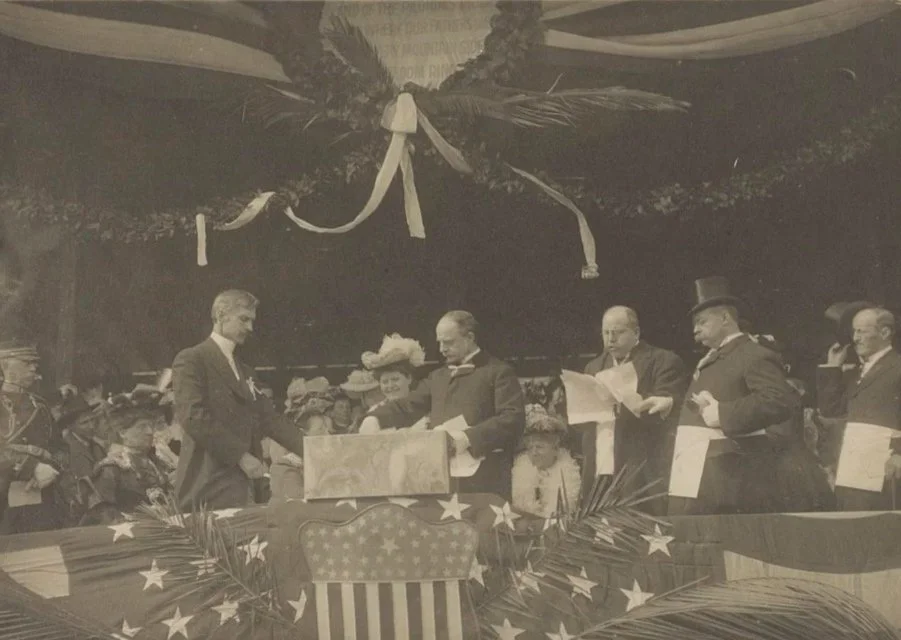
On April 21, 1904, President Theodore Roosevelt attended the cornerstone laying ceremony for Memorial Continental Hall in Washington, D.C., the headquarters building of the Daughters of the American Revolution. Roosevelt stands on a flag-draped platform reviewing documents alongside a group of dignitaries, with women in the elaborate hats typical of the Edwardian period seated nearby. The DAR, founded in 1890, was at the height of its influence during the Progressive Era, and Roosevelt's participation reflected the period's strong interest in patriotic heritage organizations.
Oswego, New York. United Nations Heroes Marching in the Flag Day Parade During United Nations Week
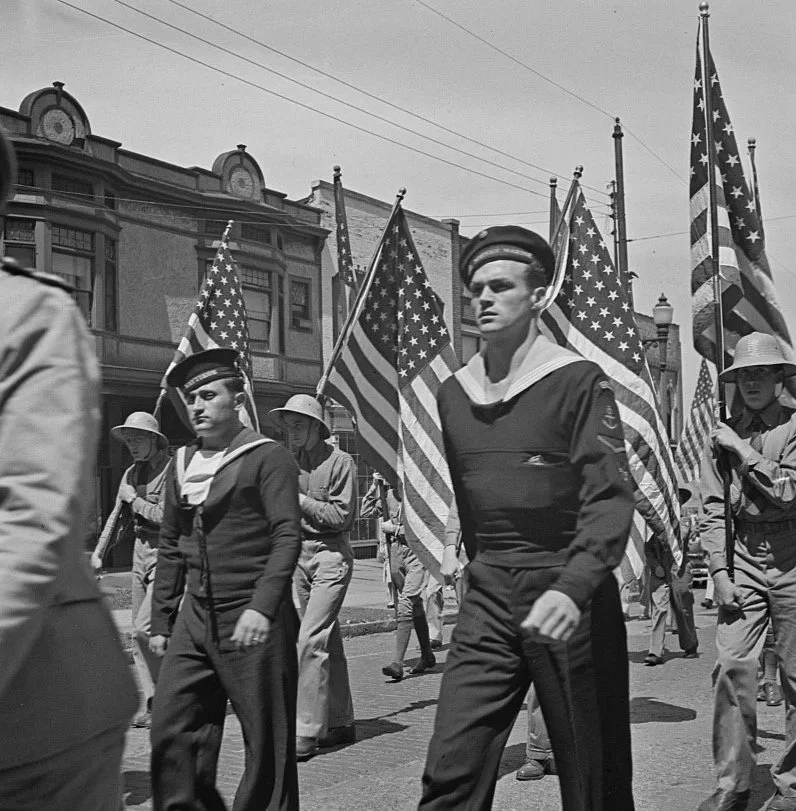
Flag Day, June 1943. U.S. Navy sailors and Army soldiers march through the streets of Oswego, New York, as American flags line the parade route during United Nations Week. With World War II in full swing, events like this served a dual purpose: honoring the flag and reinforcing public support for the Allied war effort. The "United Nations" reference was the wartime term for the Allied coalition, formalized in January 1942 when 26 nations signed the Declaration by United Nations pledging to fight the Axis powers together.
Dedication Exercises
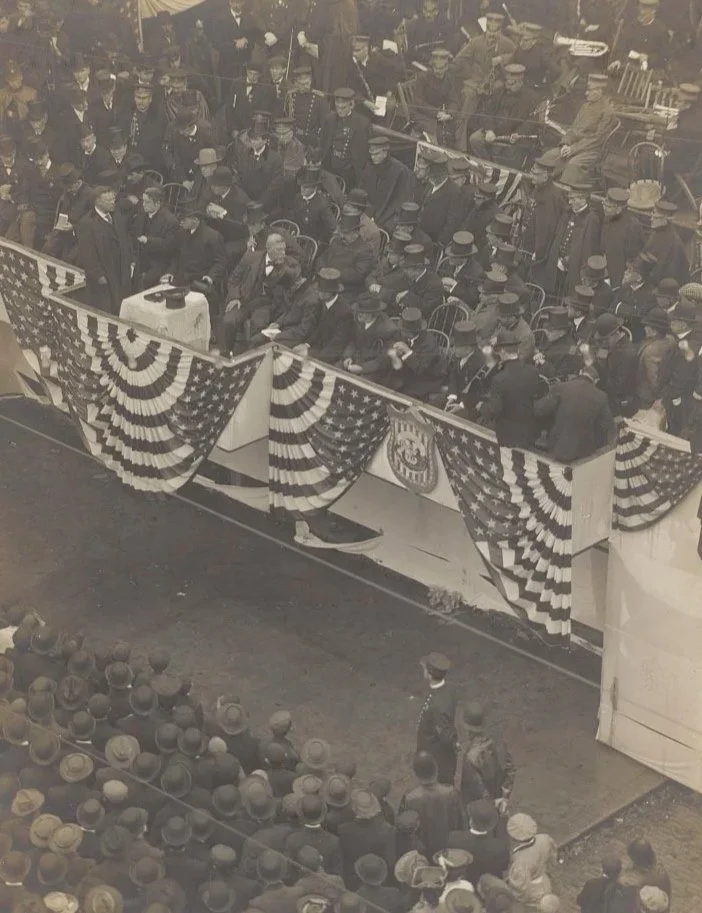
On October 23, 1906, President Theodore Roosevelt stood at a flag-draped platform to deliver remarks at a public dedication ceremony. The elevated stage was packed with dignitaries and officials while a brass band occupied the rear. Below, crowds of citizens filled the streets, nearly all wearing the dark suits and hats typical of the Edwardian era.
Southington, Connecticut. School Children Pledging Their Allegiance to the Flag
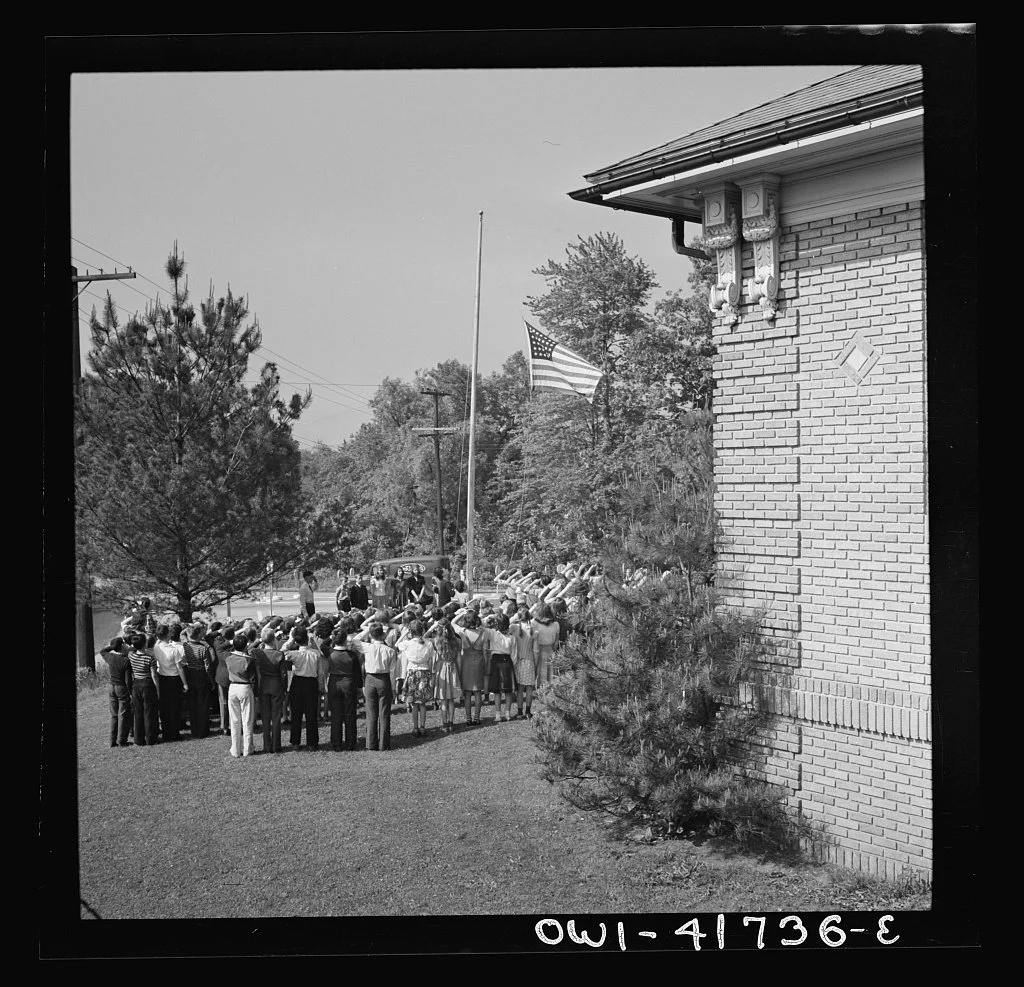
Schoolchildren gather outside a school in Southington, Connecticut, in May 1942 to recite the Pledge of Allegiance during the early months of America’s involvement in World War II. Across the country, patriotic ceremonies became a regular part of daily life as communities emphasized unity, civic duty, and support for the war effort.
Lititz, Pennsylvania. Part of the Lititz Fire Department Called out During an Air Raid Drill
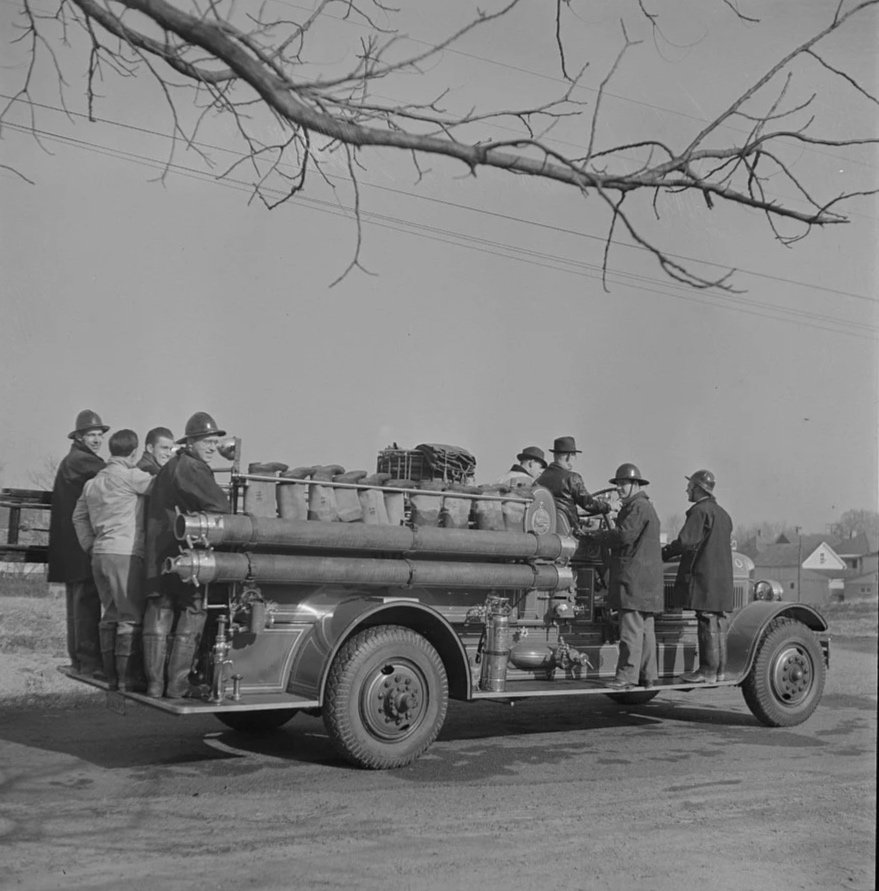
In November 1942, members of the Lititz, Pennsylvania fire department ride atop a fire engine during a World War II air raid drill, preparing for potential attacks on the home front. Civil defense exercises like this were organized across the country to train local responders and civilians in emergency procedures, including blackouts and fire response. Volunteer fire companies played a key role in these efforts, adapting their equipment and routines to meet wartime needs.
Civil War Veteran Adjutant Edwin Francis Wyer of Cos. I, E and G, 5th Massachusetts Infantry Regiment with World War I veteran Terry McCloskey of 101st Infantry, 26th Division in Uniform
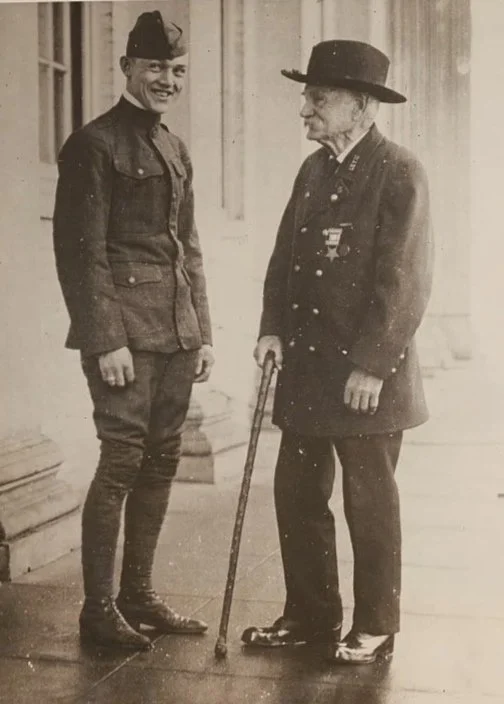
In March 1922, a Civil War veteran and a World War I soldier stand together outside the Massachusetts State House in Boston, representing two generations of American military service. Edwin Francis Wyer, who served in the Union Army, appears alongside Terry McCloskey of the 101st Infantry, 26th Division, highlighting the passage of time between the nation’s major conflicts. Public interest in such meetings reflected a continued respect for veterans and a desire to connect past and present service.
First Quarter of 1943 Kentucky Derby from Infield
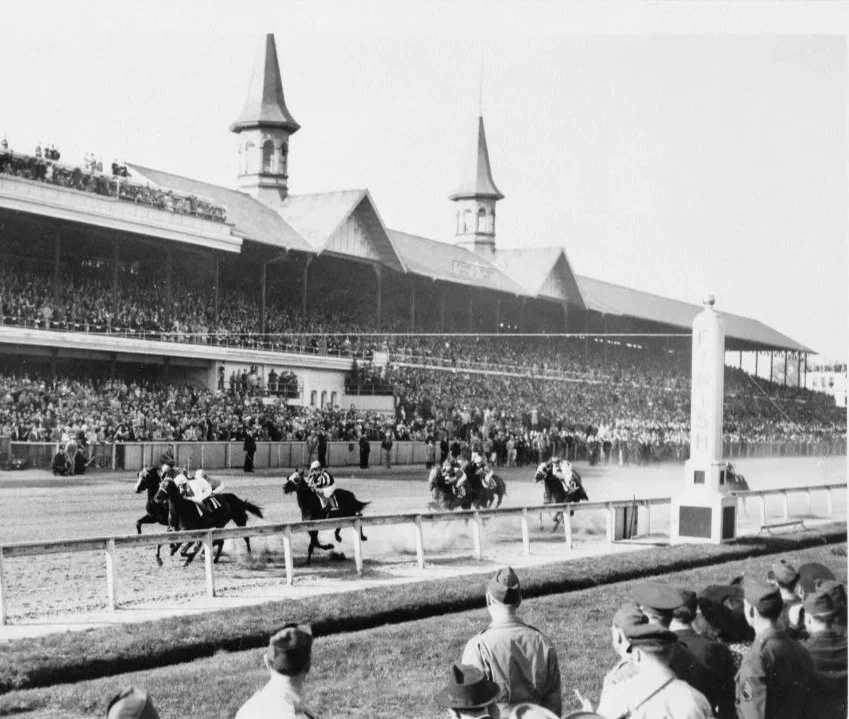
During the 1943 Kentucky Derby in Louisville, horses race past the grandstand as a packed crowd watches from multiple tiers. The event took place during World War II, when major sporting traditions continued despite wartime restrictions on travel and resources. Known as one of the country’s leading horse races since the late nineteenth century, the Derby remained a major public gathering, drawing attention from across the nation.
Apple Picking in Berkely County, West Virginia
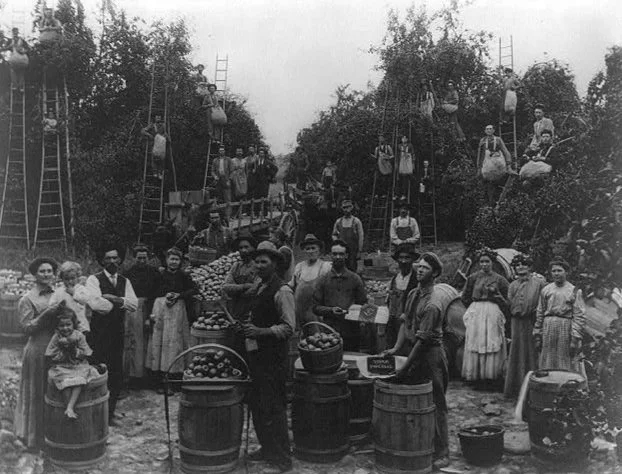
Around 1910 in Berkeley County, West Virginia, apple harvesting brought together entire families and crews to gather and sort fruit in busy orchard rows. Workers stand on ladders reaching into the trees while others fill barrels and baskets on the ground, showing the labor-intensive process behind a major regional crop. Orchards like these were central to the local economy, supplying fresh fruit and cider to nearby markets and beyond.
"Lemonade Stand" Mr. Hersey, Prop. and Mr. O'Reilly
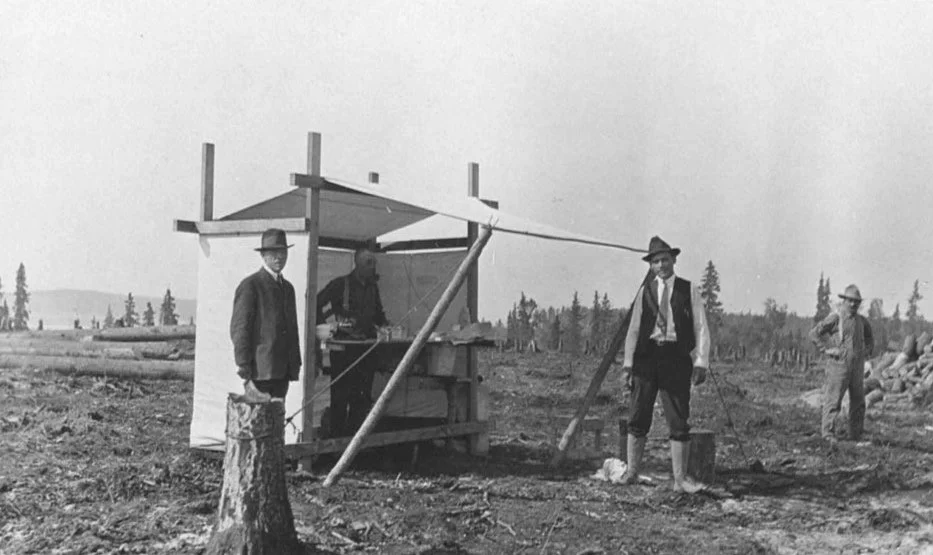
In 1916, two men operate a makeshift “lemonade stand” in a cleared field, likely serving workers in a logging or land-clearing area. A simple wooden structure with a canvas cover provides shade for basic supplies, while cut stumps and felled timber stretch across the background, marking an active work site. Such small, informal setups were common in remote areas, offering food and drink to laborers far from towns and established businesses.
Camp of 110th Pennsylvania Inf'y Near Falmouth, Va., Dec. 1862
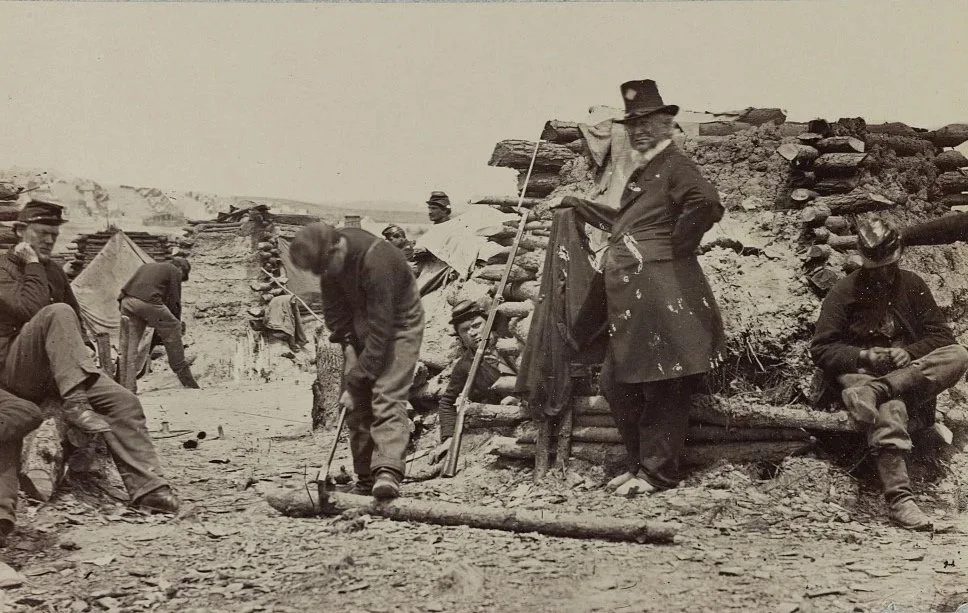
In December 1862, soldiers of the 110th Pennsylvania Infantry camped near Falmouth, Virginia, just across the Rappahannock River from Fredericksburg during a critical phase of the Civil War. Men gather around rough log shelters and tents, tending to everyday tasks and equipment while waiting for orders. Conditions in camps like this were often harsh, with cold weather, limited supplies, and constant uncertainty.
Horse Shows. Horse And Wagon
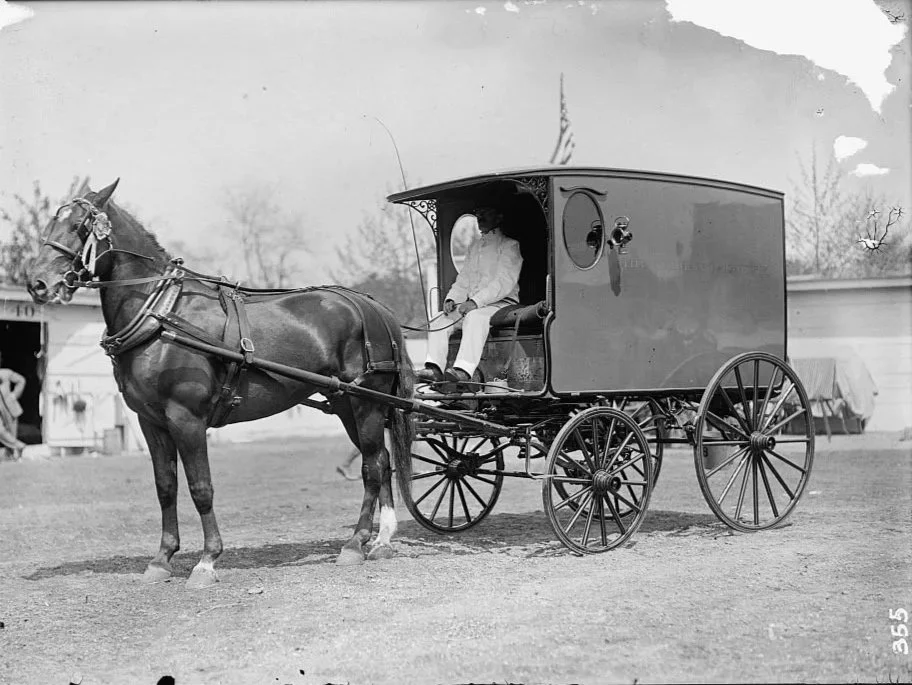
At the 1911 National Capital Horse Show in Washington, D.C., a driver sits in an enclosed wagon pulled by a harnessed horse on display for judges and spectators. Horse shows at the time focused on breeding, training, and the quality of equipment, reflecting how important horses still were for transportation and work.
The New President Takes The Oath of Office. The Wilcox Home in Which President Roosevelt was Sworn In
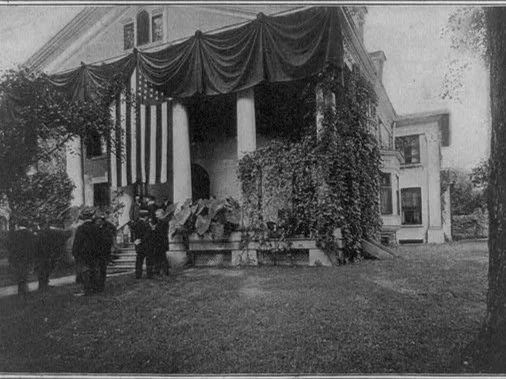
In September 1901, a small gathering assembled on the porch of the Wilcox home in Buffalo, New York, where Theodore Roosevelt took the oath of office following the assassination of William McKinley. The house, draped in American flags, became an unexpected setting for a pivotal moment in national history as Roosevelt assumed the presidency amid uncertainty and mourning.
Farmers on Main Street, Saturday Night. Iowa Falls, Iowa
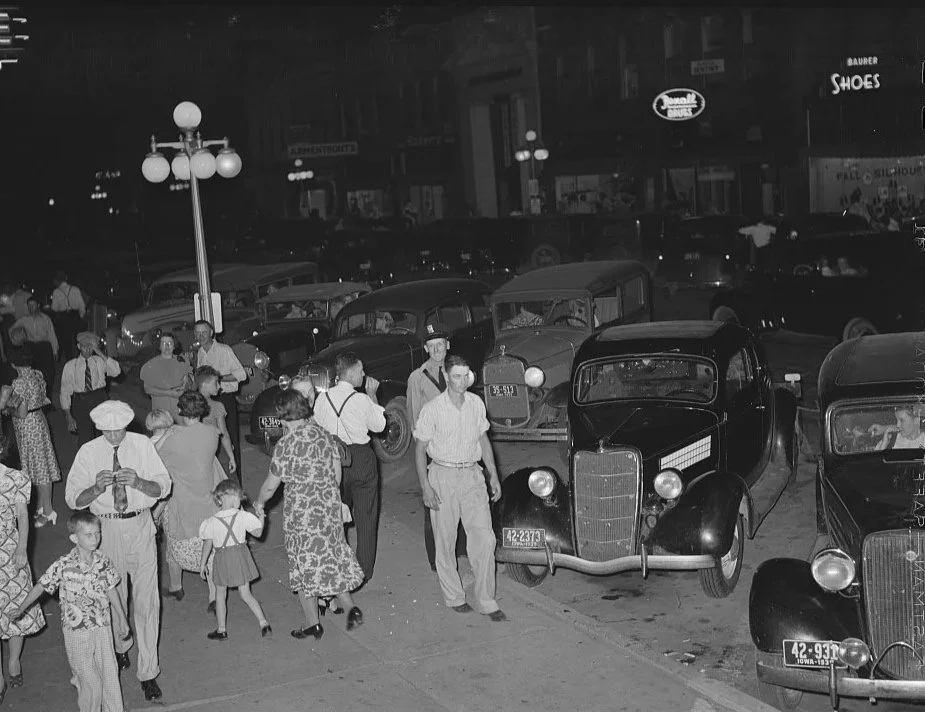
Farm families and townspeople fill the sidewalks and streets of Iowa Falls, Iowa, on a Saturday night in 1939, as automobiles line the curb under the glow of streetlights. The gathering reflects a weekly ritual in rural communities, when residents came to town to shop, socialize, and take part in public life after a week of work. Men, women, and children move easily between parked cars and storefronts, illustrating the central role of Main Street as both marketplace and meeting place.
Times Boy on Bicycle
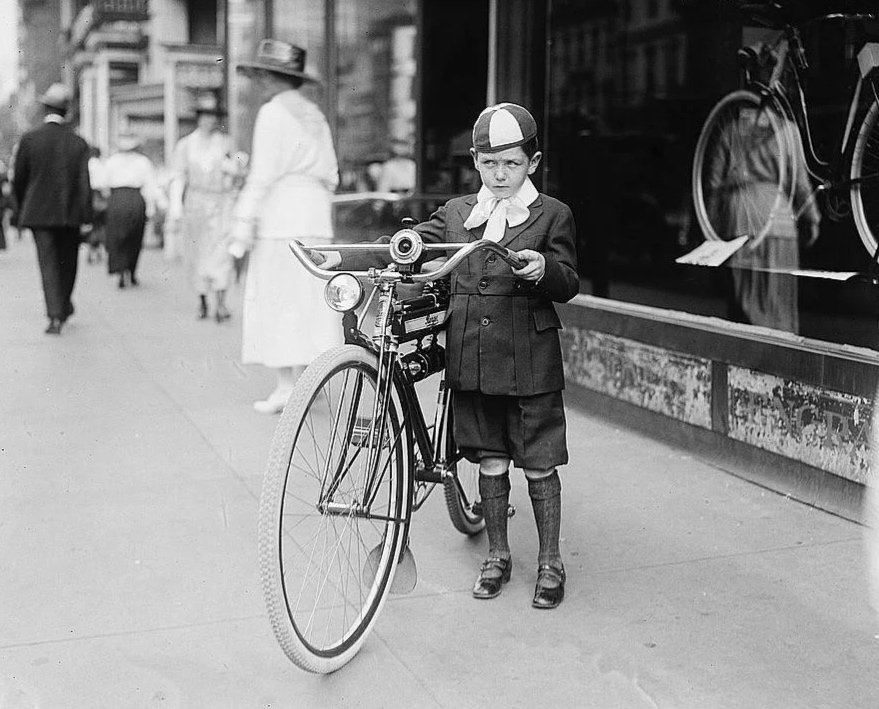
A young newspaper carrier stands with his bicycle in 1921, representing the vital role of youth labor in the distribution of daily news during the early twentieth century. Identified as an employee of the Washington Times, he was part of a nationwide network of “newsboys” who ensured that papers reached city streets and doorsteps each day. Dressed in period attire and equipped with a sturdy bicycle. At a time when newspapers were a primary source of information, boys like him formed the backbone of a fast-moving industry that connected communities to national and world events.