
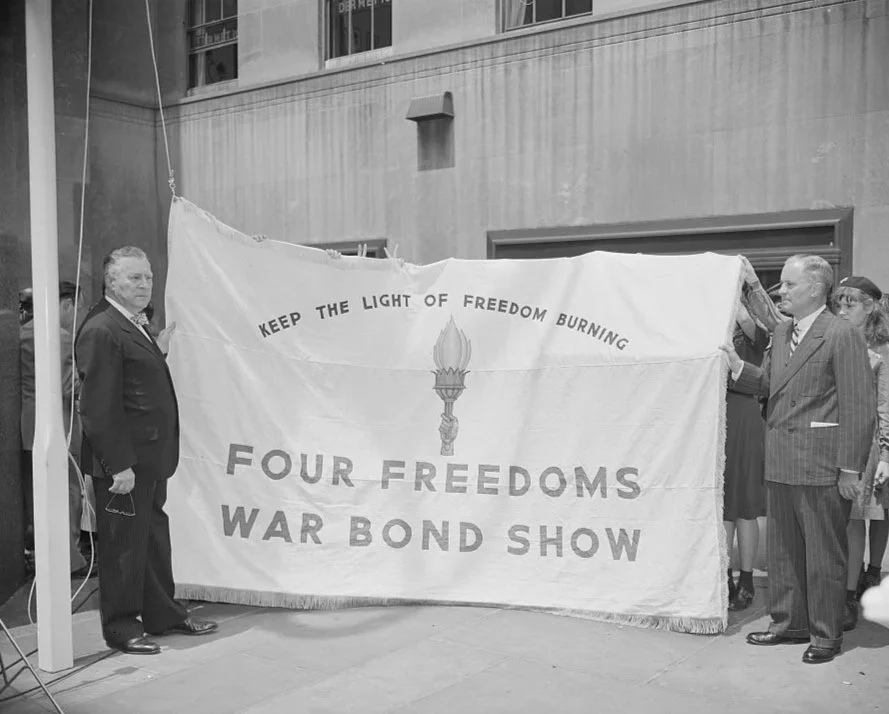
June 1943, Rockefeller Center, New York City. Two men hold a banner reading "Keep the Light of Freedom Burning: Four Freedoms War Bond Show" at a flag raising ceremony on the plaza of the International Building. The Four Freedoms referenced the goals President Franklin Roosevelt laid out in his January 1941 State of the Union address: freedom of speech, freedom of worship, freedom from want, and freedom from fear. Those four principles became central to Allied wartime messaging, most famously through Norman Rockwell's series of paintings published in the Saturday Evening Post in early 1943.
5th Ave. Decorated for Preparedness Parade
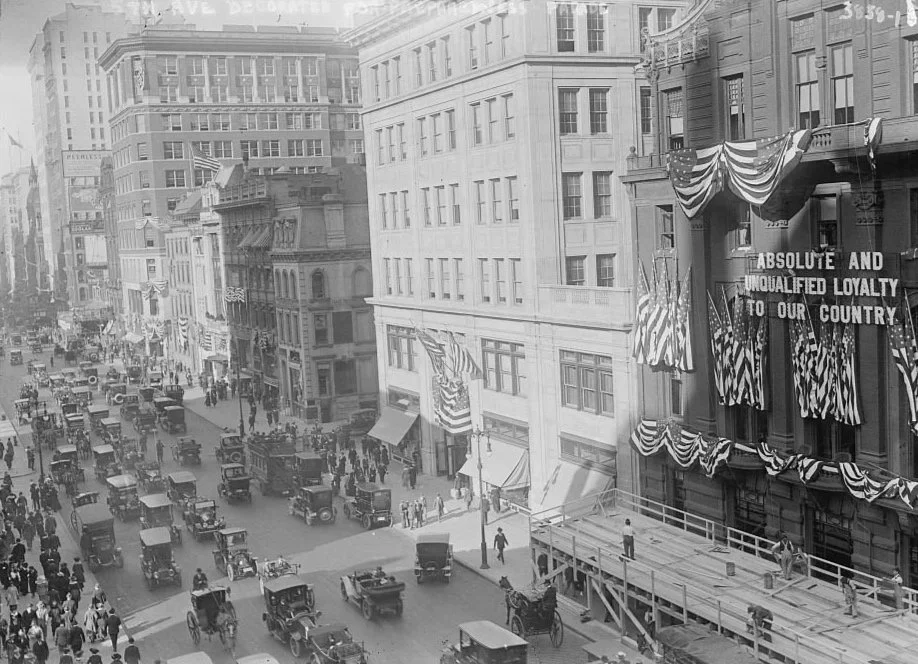
New York City’s Fifth Avenue is shown during the 1916 Preparedness Parade, as the nation weighed its role in the growing conflict overseas. Buildings are draped in flags and patriotic bunting, with a prominent sign declaring “Absolute and unqualified loyalty to our country,” reflecting rising public support for military readiness. Streets filled with early automobiles, carriages, and dense crowds capture a city in motion, where civic display and national sentiment converged in the years just before American entry into World War I.
American Flag Amid Rubble Following September 11th
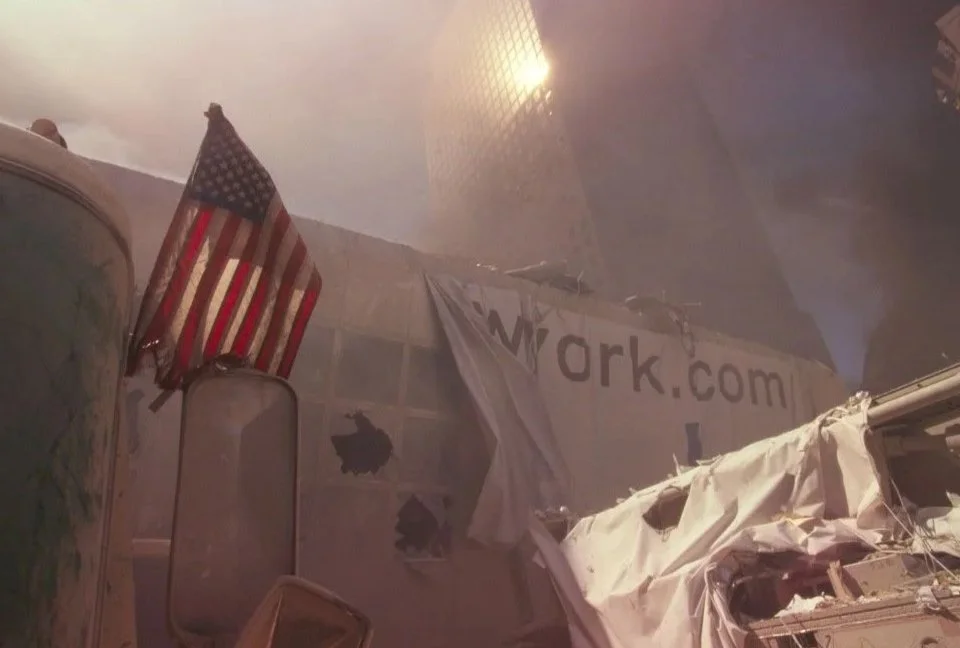
Taken on September 11, 2001, an American flag set among the wreckage at the World Trade Center in New York City in the hours after the attacks. Twisted metal, torn surfaces, and smoke frame a scene of sudden loss and confusion as the city and the country tried to understand what had just happened. The flag was not a planned display, but something placed by hand in the middle of destruction, reflecting how people reached for familiar symbols in an unfamiliar moment.